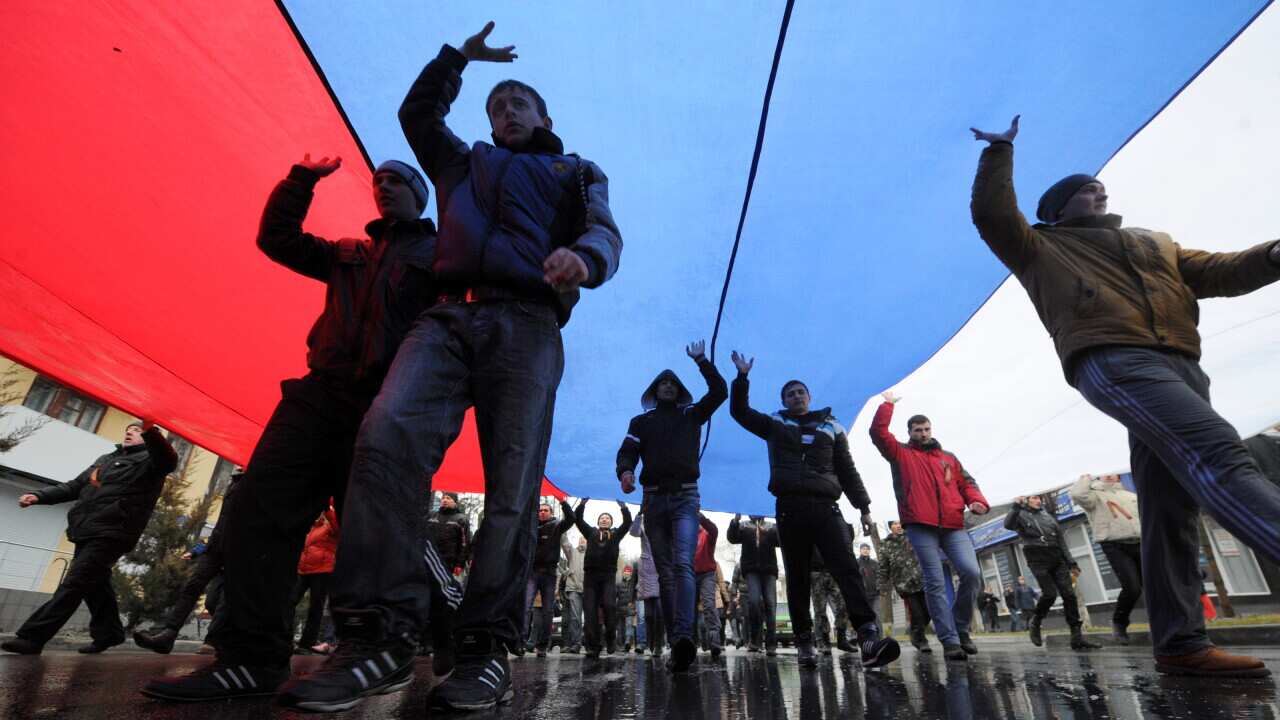
The United Nations Security Council has held an emergency meeting to discuss the escalating crisis in Ukraine, with the United States demanding urgent mediation and Russian troops to pull back.
Friday's urgent meeting in New York came as Russia flew more troops into Crimea, where it already has a major military base, and Ukraine's ousted president resurfaced in Russia, insisting he had not been overthrown.
But the talks broke up without a formal statement, leaving the US, British, Russian and Lithuanian ambassadors to make separate statements to the press.
Council president Raimonda Murmokaite of Lithuania said only that members expressed support for Ukraine's territorial integrity and sovereignty and for "inclusive political dialogue".
US envoy Samantha Power went further, calling for an urgent, international mission to "de-escalate the situation" in Crimea and mediate dialogue among all Ukrainian parties.
News that makes sense
Your trusted source for staying up-to-date with the world around you. Get free daily news updates and analysis, straight to your inbox.
President Barack Obama and key European leaders could skip June's G8 summit in Sochi if Moscow's forces are involved in Ukraine, a US official said.
And a "deeply concerned" Obama warned there would be "costs" for any military intervention.
Power called on Russia to pull back its troops so that the Ukrainian people could "pursue their own government, create their own destiny and to do so freely without intimidation or fear".
"We urge Russia to join us in helping Ukraine get back on a path to the right future," she added.
Pressed for details on the prospective mission, Power said it should be seen as "independent, credible".
UN Secretary-General Ban Ki-moon already has a special envoy in Kiev, Robert Serry, who has spent several days emphasising the importance of Ukraine's sovereignty and territorial integrity. Power backed his calls.
Close US ally Britain also said that any newly deployed Russian troops not answering to the Ukrainian government should withdraw.
Britain said the mediation visit would not need Security Council approval if Serry were to travel in Crimea with colleagues from the Organisation for Security and Co-operation in Europe.
"Perhaps there might be some OSCE people that would go with him to discuss with the authorities there and try and de-escalate the tension in Crimea," Britain's UN Ambassador Mark Lyall Grant said.
"That would not in itself require a Security Council mandate."
But Russian Ambassador Vitaly Churkin said Moscow opposed enforced mediation.
"We need to ask the authorities in the Crimea ... As a matter of principle, we are against imposed mediation but if they are comfortable with it, we have no objection," he added.
Churkin said Russia was acting within the framework of its agreement with Kiev on the presence of Russia's Black Sea Fleet and its base at Sebastopol.
Asked if Russia was willing to use military intervention in Ukraine, he laughed. "Even the question is aggravating," Churkin said.
He said Ukrainians needed to have dialogue to form a new constitution and refrain from "hasty" presidential election that is "most likely going to create more friction".
After briefing the council, Ukrainian Ambassador Yuriy Sergeyev said Kiev considered the Russian troops aggressive and a move toward encouraging "separatism" and "clashes".
In Kiev, a Ukrainian official said 13 Russian cargo planes carrying nearly 2000 suspected troops had landed at a military air base near Crimea's regional capital Simferopol.
Sergeyev said he had been informed about 10 aircraft and described them as Mi-24 military attack helicopters.
Ukraine's ousted president Viktor Yanukovych insisted he had not been overthrown, surfacing in Russia after a week in hiding and hitting out at the new pro-Western powers in Kiev.







