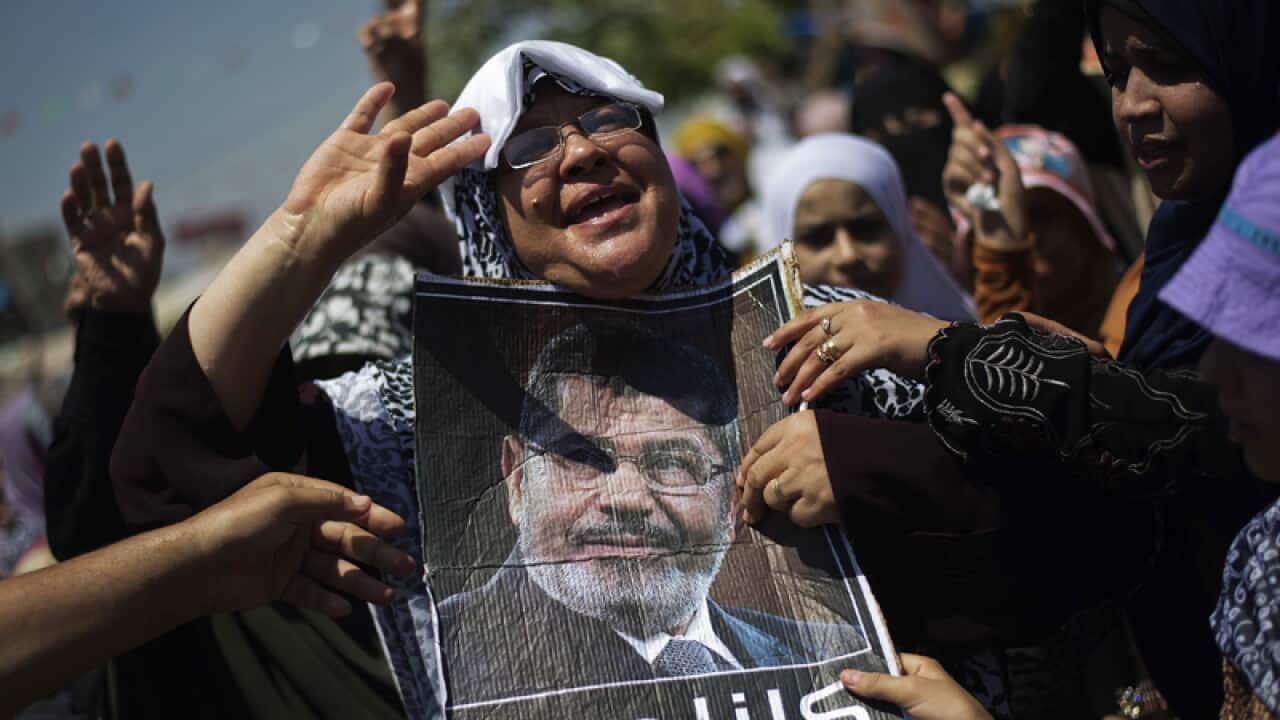
The United States and the European Union have urged Egypt's battling political factions and dominant military to agree a path for a return to democratic rule.
Last month's overthrow of Egypt's elected Islamist president Mohamed Morsi by the military embarrassed Western leaders already struggling to adapt their policies in the wake of the Arab Spring revolts.
Diplomatic attempts to broker a negotiated settlement in Egypt, the Arab world's most populous nation, have made no headway and now the military risks provoking further violence by ordering its opponents off the streets.
Washington and Brussels sent envoys - US Deputy Secretary of State William Burns and EU Special Representative Bernadino Leon - to Cairo to talk to the army-imposed interim government and to its Muslim Brotherhood opponents.
But their outreach was rebuffed, and on Wednesday US Secretary of State John Kerry and EU foreign policy chief Catherine Ashton released a joint statement.
News that makes sense
Your trusted source for staying up-to-date with the world around you. Get free daily news updates and analysis, straight to your inbox.
"While further violent confrontations have thus far been avoided, we remain concerned and troubled that government and opposition leaders have not yet found a way to break a dangerous stalemate and agree to implement tangible confidence building measures," they said.
"The Egyptian government bears a special responsibility to begin this process to ensure the safety and welfare of its citizens," the statement continued.
"This remains a very fragile situation, which holds not only the risk of more bloodshed and polarisation in Egypt, but also impedes the economic recovery which is so essential for Egypt's successful transition," they said.
Kerry and Ashton underlined that both the US and Europe would support any Egyptian-led attempt to find a negotiated solution to the political crisis, but insisted this must include a return to elected rule.
"We are convinced that a successful democratic transition can help Egypt lead the rest of the region toward a better future, as it has so often done during its rich and proud history," they said.
Egypt's interim government has demanded that Morsi's Islamist supporters bring an end to their large-scale street protests and sit-ins.
Meanwhile, US diplomatic efforts have been overshadowed by a parallel visit to Cairo by Senator John McCain.
McCain enraged supporters of the military and the Egyptian interim regime by dubbing their power grab a "coup," a term that the Obama administration has studiously avoided.
"We have said that we share the democratic aspirations and criticisms of the Morsi government that led millions of Egyptians into the streets on June 30. We have also said that the circumstances of the former government's president's removal were a coup," McCain said on Tuesday.
If the US government was to formally recognise that Morsi's overthrow amounted to a military putsch, it would be bound by US law to halt its $US1.6 billion ($A1.79 billion) in annual aid to Egypt, and lose what limited leverage it has over the military.







