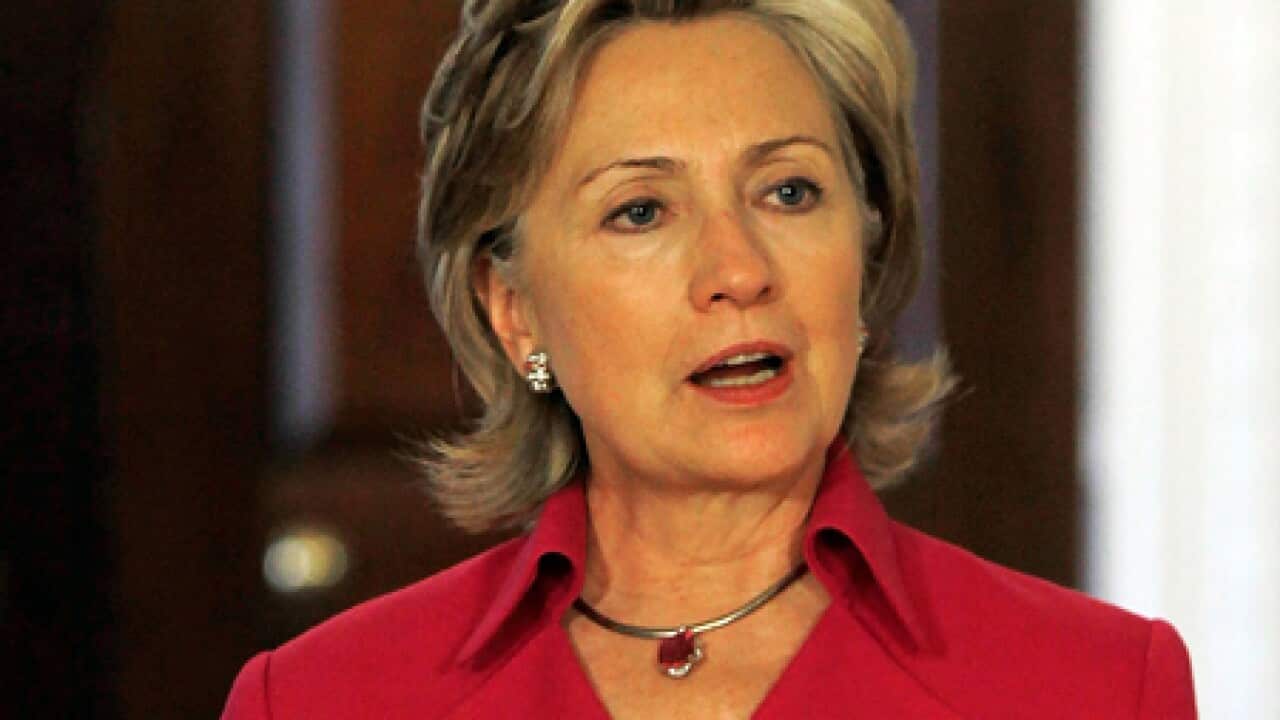
US Secretary of State Hillary Clinton has warned that Iran is headed towards "military dictatorship" posing a threat to all, but said she was hopeful of "serious" new Middle East peace talks.
On a Gulf tour aimed at drumming up international support for tough new UN sanctions against Iran, Clinton said that the whole region had reason to fear Iran's nuclear programme and the growing influence of the elite Revolutionary Guard.
The US chief diplomat told students in Qatar that the United States was not seeking to use military action against Iran to curb its nuclear ambitions but rather seeking to use international pressure through the UN Security Council.
News that makes sense
Your trusted source for staying up-to-date with the world around you. Get free daily news updates and analysis, straight to your inbox.
Such pressure "will be particularly aimed at those enterprises controlled by the Iranian Revolutionary Guard, which we believe is in effect supplanting the government of Iran," Clinton said.
"We see the government of Iran, the supreme leader, the president, the parliament is being supplanted and Iran is moving toward a military dictatorship," Clinton told students at the Qatari branch of Carnegie-Mellon University.
In a speech in Doha on Sunday night to the US-Islamic World Forum, Clinton said: "I fear the rise of the influence and power of the Revolutionary Guard... poses a very direct threat to everyone."
The Guard continue to be the military guardian of revolutionary leader Ayatollah Ruhollah Khomeini's Islamic ideology, but also own large tranches of Iran's economy.
The United States last week imposed a fresh round of sanctions against the Revolutionary Guard and hopes for UN sanctions to target the group blamed for Iran's nuclear programme and alleged support to militants in the region.
"We're still hoping that Iran will decide to forego any nuclear ambitions or nuclear weapon... and... respect its own people," she told a conference in Qatar, which lies across the Gulf from Iran.
"We cannot keep hoping for that."
She told students that her talks with leaders in the region revealed great concern about Iran and its intentions.
"I think people have reason to worry. The question is what can Iran do to allay the fears of its neighbours. And yet I don't see much progress there."
After her meeting with Qatari students, Clinton headed for talks in neighbouring Saudi Arabia, where aides said she would press Saudi leaders to use their influence with China to secure a change of heart on Iran sanctions.
China appears to be the strongest holdout to sanctions among the five veto-wielding permanent members of the UN Security Council.
Clinton's top assistant for the Middle East, Jeffrey Feltman, told reporters travelling with her that China had an "important trading relationship" with the Saudi oil kingpin and there were frequent official visits between the two countries.
"We would expect them (the Saudis) to use these visits, to use their relationship in ways that can help increase the pressure that Iran feels," said Feltman, the assistant secretary of state for Near East Affairs.
The Middle East peace process was also expected to loom large in Clinton's talks in Saudi Arabia.
"The peace process is the main issue, of course," said Saudi foreign ministry spokesman Osama Nugali. "Our position is still the same... that we need to revive the peace process."
Clinton said she was optimistic that talks would resume this year after a long hiatus since Israel launched its devastating assault on the Gaza Strip in December 2008.
"I'm hopeful that this year will see the commencement of serious negotiations" between the two sides, she said.
She added that she hoped for the "kind of breakthrough" people were expecting after President Barack Obama said he would not stay on the sidelines and would actively promote peace between the two parties.
Clinton met Palestinian negotiator Saeb Erakat in Doha on Sunday and told him Washington would send an envoy to the West Bank soon, a US official said.
The official gave no further details of Sunday's meeting nor a date for the visit to Ramallah by deputy Middle East peace envoy David Hale.
US Middle East peace envoy George Mitchell has proposed that the two sides hold indirect talks over a three-month period to get round Israel's refusal to accept Palestinian demands for a complete freeze on settlement construction before any direct negotiations.
But the idea has met with little enthusiasm from the Palestinians or their regional backers, including Saudi Arabia.
The kingdom's Arab News daily on Monday called the proposal a "charade" that only served Israel's attempts to avoid any meaningful progress towards a deal.
"They could be labelled the proximity talks but the more apt description is the nonsense of non-talks," the government-linked newspaper said.







