In brief
- The ceasefire between the US and Iran has been extended, but little progress has been made.
- The parties involved have demonstrated diverging views on what the agreement entailed.
When the ceasefire between the United States and Iran was announced two weeks ago, it was hailed as an opportunity to facilitate peace talks and prevent further attacks throughout the Middle East.
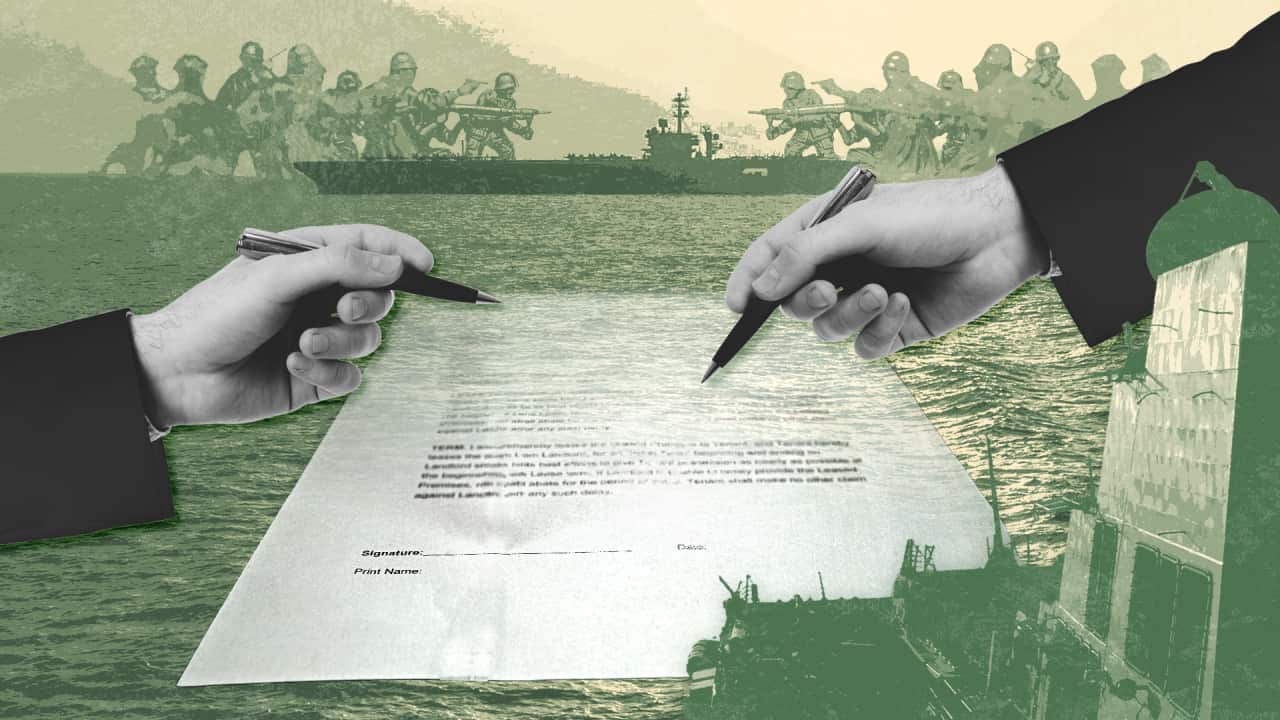
But the agreement — which appears to be entirely a verbal contract — has proven to be vague and impossible to enforce.
While both sides agreed to stop immediate military strikes against each other, indirect confrontation continued — namely, Israel's targeting of Iranian ally Hezbollah in Lebanon.
Experts have told SBS News that the original two-week-long ceasefire was shaky at best.
While it created space for the US and Iran to negotiate a deal, key flashpoints such as freedom of naval navigation and Iran's nuclear program are keeping peace talks at arm's reach.
News that makes sense
Your trusted source for staying up-to-date with the world around you. Get free daily news updates and analysis, straight to your inbox.
A second round of peace talks was set to be hosted on Wednesday in Islamabad at the conclusion of the original ceasefire.
But that scheduled end date was extended by US President Donald Trump, who said on Tuesday that he is allowing more time for an Iranian proposal to be submitted and for discussions to be concluded.
Iran's parliament speaker and top negotiator, Mohammad Baqer Qalibaf, has called Trump's ceasefire extension a "ploy to buy time" for a surprise strike.
Pakistan has welcomed the ceasefire and remains on board to host additional peace talks, but its unclear when they could take place.
What was agreed to?
There are differing perspectives among the parties involved on what the ceasefire deal entailed, and both the US and Iran have accused the other of violating its terms.
Iran argues that the latest violation is the US naval blockade and the seizure of an Iranian-flagged ship near the Strait over the weekend.
Both the US and Iran made peace plan proposals in the lead-up to the original negotiations in Pakistan, but what was agreed to was quite narrow.
Eyal Mayroz, a senior lecturer in peace and conflict studies at the University of Sydney, told SBS News the only "clear outcomes" from the agreement were to temporarily stop fighting, reopen the Strait of Hormuz, and start negotiations.
Mayroz said that Donald Trump's "unpredictable" nature further obscures what was in the deal.
"We have Trump and other Americans saying they agree to certain terms, then changing their minds," he said.
"There's also ongoing attacks in Lebanon, which could be a result of a talk between Netanyahu and Trump about Israel not agreeing to stop the ceasefire."
Israeli strikes on Lebanon shortly after the Iran-US ceasefire came into effect killed more than 300 people.
Recent strikes in southern Lebanon killed four medics and wounded six others, Lebanese officials said, as they accused Israel of deliberately targeting medics.
The Israeli military did not respond to a request for comment on the strikes beyond saying it was "looking into" what happened.
Iran and Pakistani mediators have argued that the ceasefire applies across the wider region, including conflicts involving groups like Hezbollah in Lebanon.
The US insists the deal is limited to direct US-Iran hostilities and does not restrict Israel's separate military actions.
Mayroz said that the disagreement over Lebanon shows the ceasefire deal was largely meaningless.
"Any meeting they (the US and Iran) had carries little significance without a signed document. There's nothing that resembles a signed agreement and terms for a deal," he said.
The lack of written terms means the US and Iran are not beholden to follow through with any verbal agreements, Mayroz added.
Murky world of mediation
Ian Parmeter, a Middle East expert at the ANU Centre of Arab and Islamic Studies, told SBS News that wartime negotiations are "notoriously difficult".
"You'll have delegations from both sides who will make their demands, which will start off with the most they hope to gain," he said.
"Then opposing delegations will make concessions and trade-offs in order to secure a deal."
He described this as a balancing act between the maximum one side wants and the minimum they're willing to accept.
Parmeter, who has held diplomatic postings across the Middle East and Europe, said filling this gap with mutually agreeable terms is the key to successful mediation.
He said the gap between what the US and Iran want out of negotiations is akin to a "chasm".
"The difference between the maximalist positions of both sides is huge, and it would really take quite a lot of negotiation," he said.
"And it would take professional career negotiators, not the likes of JD Vance, Steve Witkoff and Jared Kushner."
The three men, close allies of Trump, were part of the previous negotiating team between the US and Iran.
Parmeter said the lack of a written and signed agreement from those negotiations suggests the trio is out of its depth.
He described past attempts at mediation between the US and Iran as fraught with challenges.
"One has to bear in mind that the Joint Comprehensive Plan of Action, or the Iran nuclear deal, which was signed in September 2015, took two years to negotiate," he said.
"So, 21 hours, as they had for negotiations sometime last week, at the start of last week, is not nearly enough to come up with the deal which would satisfy the demands of both sides."
Another obstacle to negotiations is the death of Iran's late supreme leader Ayatollah Ali Khamenei. In Parmeter's view, his death will make it harder for an Iranian delegation to agree to a deal.
"It is ironic, but the US killing Ali Khamenei could make peace much harder, as the delegation has no clear leader to defer to. His son Motjaba (Khamenei) hasn't been seen since he was supposed to succeed his father," he said.
How much longer can Iran keep the Strait of Hormuz closed?
Two major sticking points in the peace talks — Iran's stockpile of near-weapons-grade enriched uranium and the future of the Strait of Hormuz — appear to be up in the air.
US-Israeli strikes have targeted Iranian military and nuclear research sites, with Trump saying the state's navy has been obliterated, reducing Iran's ability to control the strait.
Professor Kevin Rowlands, a former Royal Navy officer at the Royal United Services Institute, told ABC radio on Tuesday morning that Iran has a firm group on the key shipping route.
He explained that it's a maritime wing of the Iranian Revolutionary Guard Corps (IRGC), and not the state's navy, that has been targeting the strait.
"It's that [IRGC] core that is using different kinds of guerrilla or insurgent tactics in small boats using drones, dropping mines, to put pressure on seafarers, users in the Strait, the Americans, the Gulf states, and keep it closed that way," he said.
"I think they've got a range of pretty unsophisticated capabilities, but they're using them in a very sophisticated way. "
Iran has claimed to have laid mines throughout the Strait of Hormuz; however, no ships have reported being damaged by any. Rowlands said they remain enough of a threat to bring traffic to a halt even if they never existed in the first place.
The US, United Kingdom and France have confirmed they are planning operations to remove any potential mines in the sea channel.
But Rowlands said the situation will remain "tense" while the US maintains its naval blockade near the Strait's entrance.
While it appears designed to put pressure on Iran to agree to a deal, Rowlands said that's unlikely, as blockades are "not a quick win".
"If you are imposing a maritime blockade, what you're trying to do is damage and weaken the economy and the will of the people. And that doesn't happen overnight," he said.
He cited the example of blockades imposed on Nazi Germany during World War Two, which were imposed by Allied forces for years.
"Traffic is still much reduced, and I think it's going to stay that way for the foreseeable future until there's a political diplomatic settlement."
For the latest from SBS News, download our app and subscribe to our newsletter.







