(Transcript from SBS World News Radio)
President Barack Obama is not ruling out US military action to help the Iraqi government fight the progress of Sunni militants known as ISIS, who are continuing to take over more of Iraq.
And Prime Minister Tony Abbott has said Australia would consider any request to join in.
Christine Heard reports.
(Click on the audio tab above to hear the full report)
News that makes sense
Your trusted source for staying up-to-date with the world around you. Get free daily news updates and analysis, straight to your inbox.
At a recruitment centre in Baghdad, hundreds of young men dance and chant after joining the Iraqi army.
Chief recruiter Brigadier General Fadhi, says the volunteers have vowed to defeat the ISIS militants.
(Translated)"Since yesterday they've been flocking to the recruitment centre. Young men, and even old men, have been volunteering to defend Iraq and all its sacred places and areas."
The men were prompted by the latest audio message released by ISIS.
It warns that Iraq's capital will be destroyed in its plans to create a Sunni Islamic state, known as a Caliphate.
(Translated)"March to Baghdad, the Baghdad of the Caliphate. We have a score to settle for there is a history between us which we must make even. Do not let them catch their breath, be sure that victory comes from God."
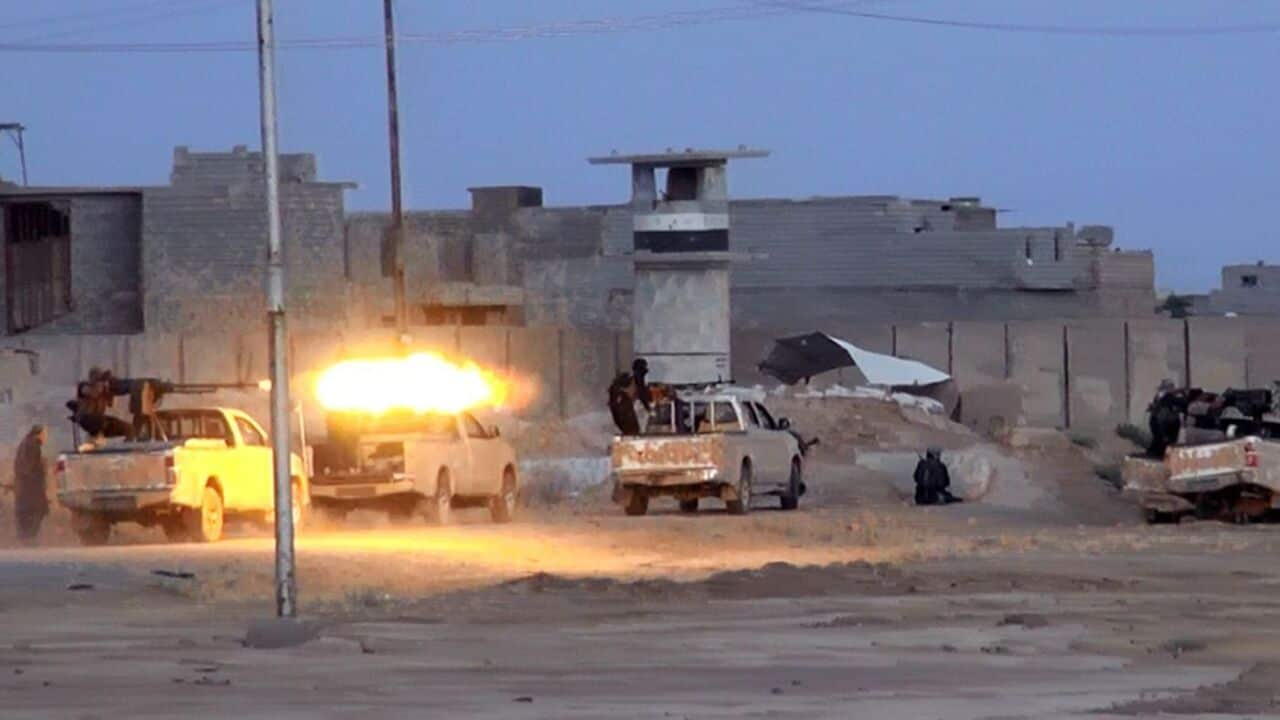
ISIS militants have captured significant population centres in recent days.
Their reach now extends to Diyala province and the town of Dhuluiyah, just 90 kilometres from Baghdad.
Despite this, the United Nations Security Council has decided against taking any action.
Russia's ambassador to the UN, Vitaly Churkin, says the decision was made after a briefing from the organisation's Special Representative to Iraq.
"He was quite assured that Baghdad is well-protected, and the government is in control so there is no immediate, at least this is the way I understood him, there is no immediate danger of the violence spreading towards Baghdad, to Baghdad."
Iraq's Foreign Minister has even suggested the tide is turning against ISIS.
Hoshyar Zebari says the Iraqi government's counter-offensive is forcing a retreat.
"The information I have today from my capital, really the situation started to be reversed and the Iraqi security forces have managed to reorganise and to push them back, to prevent them from taking some other important, strategic installations further south of Tikrit. And now, I think they are on the run. There are indications they are withdrawing from Mosul because of the counter offensive or attack."
Iraqi tate television broadcast the aerial bombardment of Mosul, showing targets - said to be militant positions - exploding into black clouds.
A video posted on the Defence Department's YouTube channel showed more bombing on a militant stronghold in Salahuddin province, home to Tikrit, which ISIS captured earlier this week.
And Kurdish soldiers have taken control of Kirkuk after Iraqi soldiers abandoned their posts.
The Kurds have long laid claim to Kirkuk which they want to incorporate into their autonomous region in the north.
What happens now that it's in their control is unclear.
But Iraq's Foreign Minister, Hoshyar Zebari, hopes it leads to better relations between Baghdad and the autonomous Kurdish regional government.
"So this could force the Iraqi leaders - in fact, I hope, to come together - to look at this serious mortal threat to the country. Because this has been one of the most serious threats we have faced over the last several years."
But the threat from ISIS is far from over.
Iraq's Prime Minister, Nuri Al Maliki tried to get the country's deeply divided politicians to come together to declare a state of emergency, but less than half of the 325 MPs turned up.
ISIS has been posting videos showing militants parading through Mosul streets in Iraqi army vehicles, walking through deserted army bases, and marching hundreds of captured Iraqi soldiers out of the city.
US President Barack Obama says it's in America's interests to help Iraq combat the militants.
And he hasn't ruled out American air strikes in support of Iraqi government forces.
"My team is working around the clock to identify how we can provide the most effective assistance to them. I don't rule out anything because we do have a stake in making sure that these jihadists are not getting a permanent foothold in either Iraq or Syria for that matter."
In not ruling out military action, President Obama has found an unusual ally.
Iran's President, Hassan Rouhani, says his Supreme National Security Council is reviewing developments in Iraq.
(Translated)"We won't tolerate this violence, this terror, and - as we announced at the United Nations - we will fight violent extremism and terrorism in the region and around the world."
As for Australia, Prime Minister Tony Abbott has spent time with President Obama in Washington as he debates action in Iraq.
Mr Abbott says it's in Australia's interests, too, to prevent militant jihadists.
"The US is considering what the appropriate response might be. They haven't finalised their views on what the appropriate response might be and they haven't requested assistance from us. Let's see what, if any, help they might request but obviously any request for help would be taken very seriously by us."







