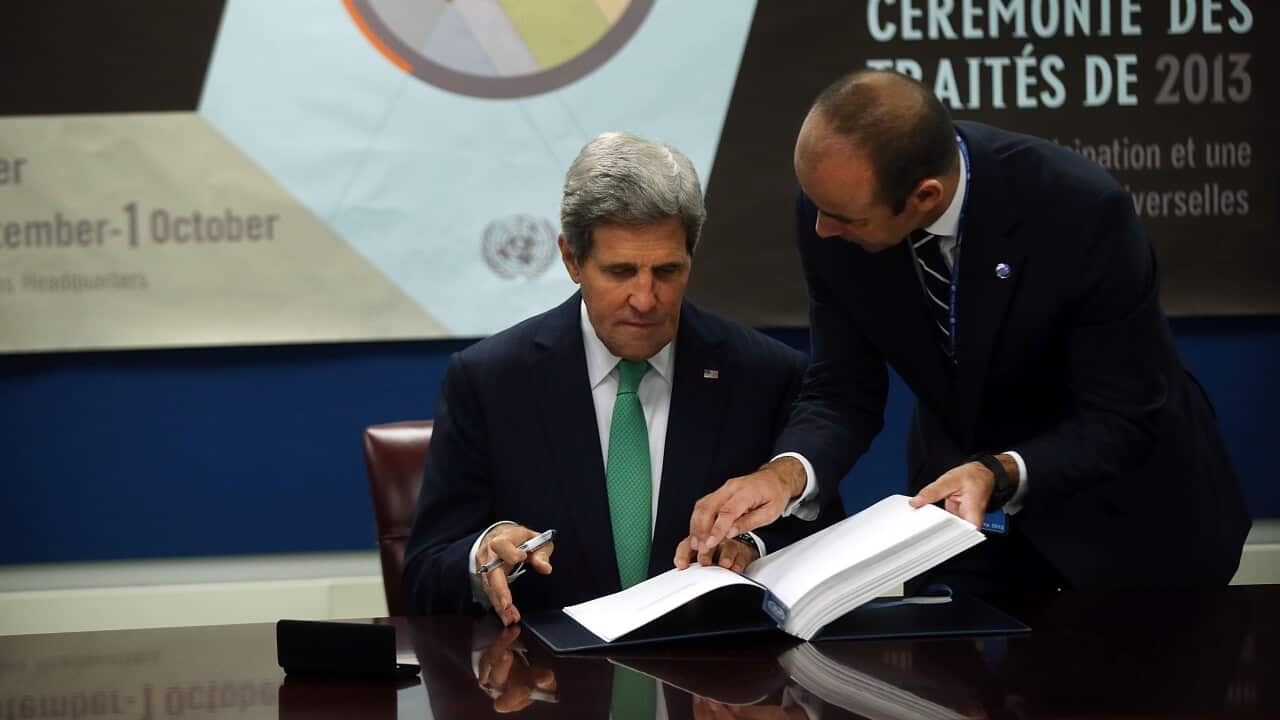
US Secretary of State John Kerry signed the treaty on behalf of President Barack Obama on the sidelines of the annual UN General Assembly in New York.
But it remains to be seen if the US Senate will ratify it.
The United States is the world's largest exporter of conventional arms.
News that makes sense
Your trusted source for staying up-to-date with the world around you. Get free daily news updates and analysis, straight to your inbox.
So when U-S Secretary of State John Kerry announced that he would sign a treaty to set up greater international regulations on arms exports, the move was not taken lightly.
"I signed it because President Obama knows that from decades of efforts that at any time that we work cooperatively to address the elicit trade in conventional weapons, we make the world a safer place. And this treaty is a significant step in that effort."
The arms treaty was negotiated for seven years before it was finally adopted by the UN last April.
Only three member states voted against it - Iran, North Korea and Syria.
Its advocates say the treaty would - for the first time - impose a set of moral standards on the multi billion dollar arms trade.
The treaty is designed to prevent munitions reaching groups that are likely to break humanitarian law, engage in terrorism or genocide, and kill women and children.
It covers trade in tanks, armored combat vehicles, large-caliber weapons, combat aircraft, attack helicopters, warships, missiles, small arms, and light weapons.
There are no powers to enforce it, but it's hoped that the threat of disclosure for breaches would be enough to bind the member states.
Australian foreign minister Julie Bishop says the international community needs to take advantage of the new momentum of the treaty.
"In want to underline the importance of the strong international momentum which is now behind the treaty to ensure it's earliest international force so that the treaty's great humanitarian and security potential can be realised as soon as possible. After all this is about saving lives."
Despite more than half of UN member states having signed, only six have ratified.
The United States needs the support of the Senate to ratify the treaty, but that is unlikely.
The US National Rifle Association and various other gun-rights groups have voiced their objection - claiming it infringes on Second Amendment rights to bear arms.
But John Kerry says the government would never support a treaty that is inconsistent with the rights of Americans.
"This is about keeping weapons out of the hands of terrorists and rouge actors. This is about reducing the risk of international transfers of conventional arms that will be used to carry out the world's worst crimes. I also want to be clear about what this treaty is not about. This treaty will not diminish anyone's freedom."
If the US Senate blocks ratification, the country could face another situation similar to that of the Kyoto Protocol on climate change - in which the US participated in talks but did not participate in measures.
By Abby Dinham







