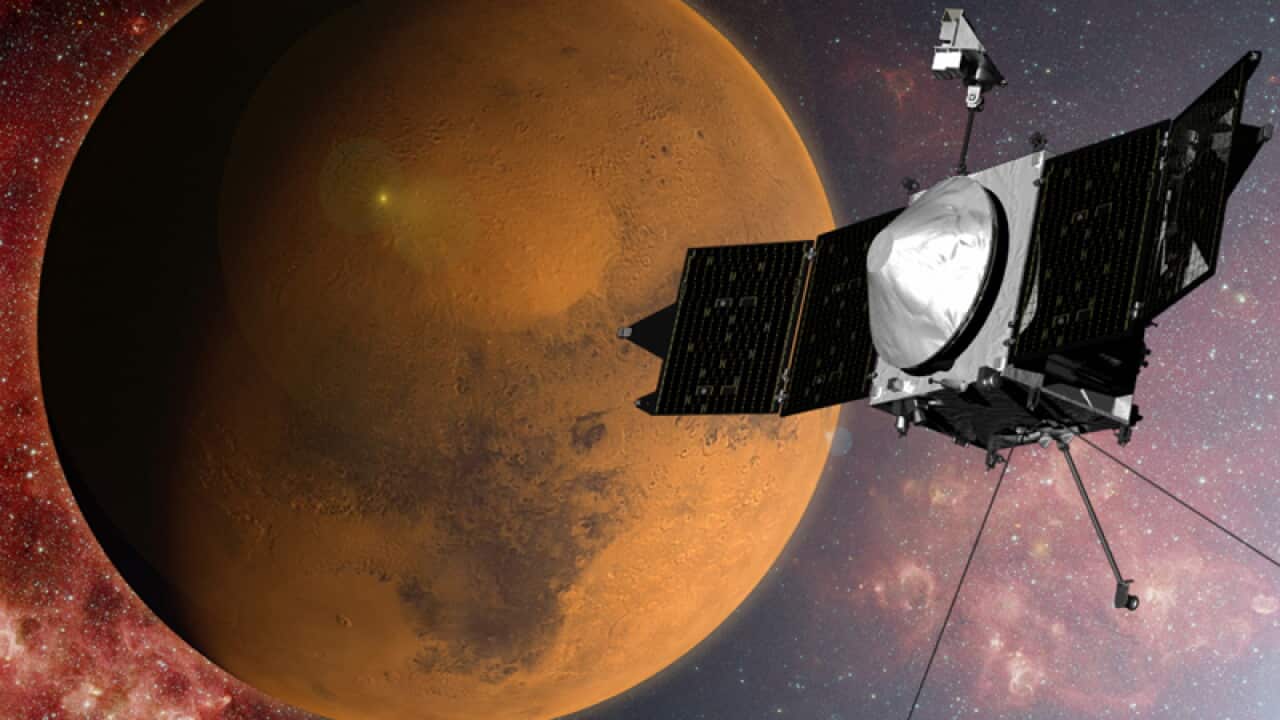
With NASA's Maven spacecraft safely in orbit around Mars, the spotlight shifts to India's first mission to the red planet.
The Indian spacecraft is due to slip into Martian orbit on Wednesday morning (Indian local time).
It's India's first interplanetary mission, and no nation has been fully successful getting to the red planet on its first try. There have been more than three dozen attempts, and more than half of them have failed.
So US scientists were relieved when Maven reached its destination after a 711-million-kilometre journey that began nearly a year ago. It joined three spacecraft, two American and one European, orbiting Mars.
"I think my heart's about ready to start again," Maven's chief investigator, Bruce Jakosky of the University of Colorado, said early on Monday.
News that makes sense
Your trusted source for staying up-to-date with the world around you. Get free daily news updates and analysis, straight to your inbox.
"All I can say at this point is, 'We're in orbit at Mars, guys!'"
Now the real work begins for the $US671-million ($A726-million) mission, the first dedicated to studying the Martian upper atmosphere and the latest step in NASA's bid to send astronauts to Mars in the 2030s.
Flight controllers in Colorado will spend the next six weeks adjusting Maven's altitude and checking its science instruments, and observing a comet streaking by at relatively close range.
Then in early November, Maven will start probing the upper atmosphere of Mars. The spacecraft will conduct its observations from orbit; it's not meant to land.
Scientists believe the Martian atmosphere holds clues as to how Earth's neighbour went from being warm and wet billions of years ago to cold and dry.
That early wet world may have harboured microbial life, a tantalising question yet to be answered.
Jakosky, of University of Colorado's Laboratory for Atmospheric and Space Physics, hopes to learn where all the water on Mars went, along with the carbon dioxide that once comprised an atmosphere thick enough to hold moist clouds.
The gases may have been stripped away by the sun early in Mars' existence, escaping into the upper atmosphere and out into space. Maven's observations should be able to extrapolate back in time, he said.
NASA launched Maven last November from Cape Canaveral, the 10th US mission sent to orbit the red planet. Three earlier ones failed. Maven - short for Mars Atmosphere and Volatile Evolution Mission - will spend at least a year collecting data.
India's Mangalyaan probe was also launched that month, and Jakosky said on Monday its arrival at Mars was eagerly awaited.
India would become the fourth space program to reach Mars after the Soviet Union, the US and Europe.
"We're hoping for their success," he said. "We're sending them the best wishes from the entire Maven team."







