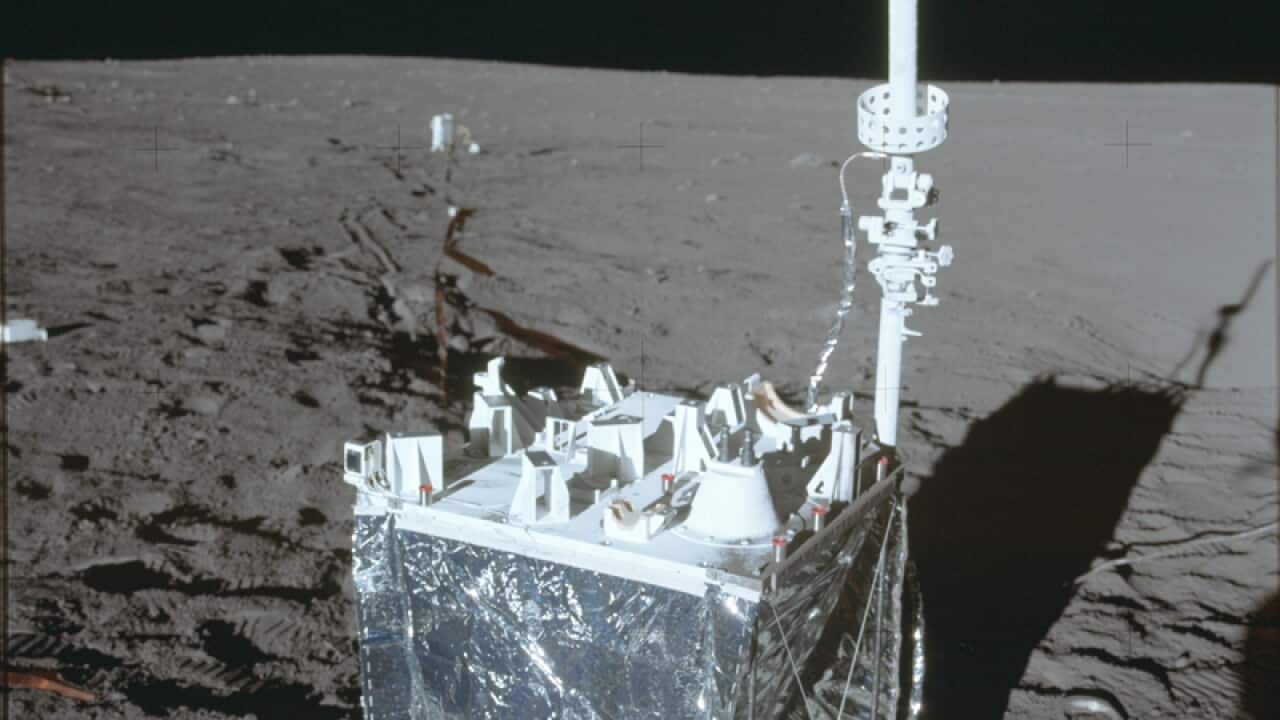
A matchbox sized machine, dropped on the moon's surface almost half a century ago, has uncovered the answers to a phenomenon that has puzzled scientists for years.
The bizarre glowing occurrence on the moon's western horizon, known as "horizon glow", has been linked to dust particle movements just after sunset.
The dust movements were detected by a small machine, invented by University of Western Australia adjunct professor Brian O'Brien in 1966, and mounted one metre above the moon's surface a few years later.
Prof O'Brien said the rocket exhausts of 1969 Apollo 12 mission, which delivered his invention to the moon's surface, stirred up dust during landing and take-off, freeing particles, which lay dormant until sunrise weeks later.
The high-energy sunlight positively charged the dust particles, pushing them away from each other, lifting the dust a metre above the moon's surface, Prof O'Brien told AAP.
News that makes sense
Your trusted source for staying up-to-date with the world around you. Get free daily news updates and analysis, straight to your inbox.
"The dust continued to seamlessly scatter extra light into the solar cell of the Dust Detector, which we discovered and reported as horizon brightening by about one to four per cent more than direct sunlight," he said.
"Our `horizon brightening' is the sunrise equivalent of the post-sunset horizon glow."
Prof O'Brien said it was important to understand characteristics of dust, as it caused overheating and failure of many instruments and machines on the moon's surface.
The Dust Detector was switched off in 1976 but the data it recorded was only recently collated, showing the dust did in fact hover about 100cm off the ground, rather than kilometres above the surface as previously predicted and later disproved.







