
Wall Street has tumbled after the US-China trade war escalated in dramatic fashion, with President Donald Trump demanding American companies seek alternatives to doing business with China after Beijing announced its own slate of retaliatory measures.
All three major US stock indexes ended the session sharply lower, posting their fourth consecutive weekly declines.
The latest exchanges in the long-running tariff row triggered a broad-based sell-off that hit shares of companies with high exposure to China the hardest, such as chipmakers and other top technology names.
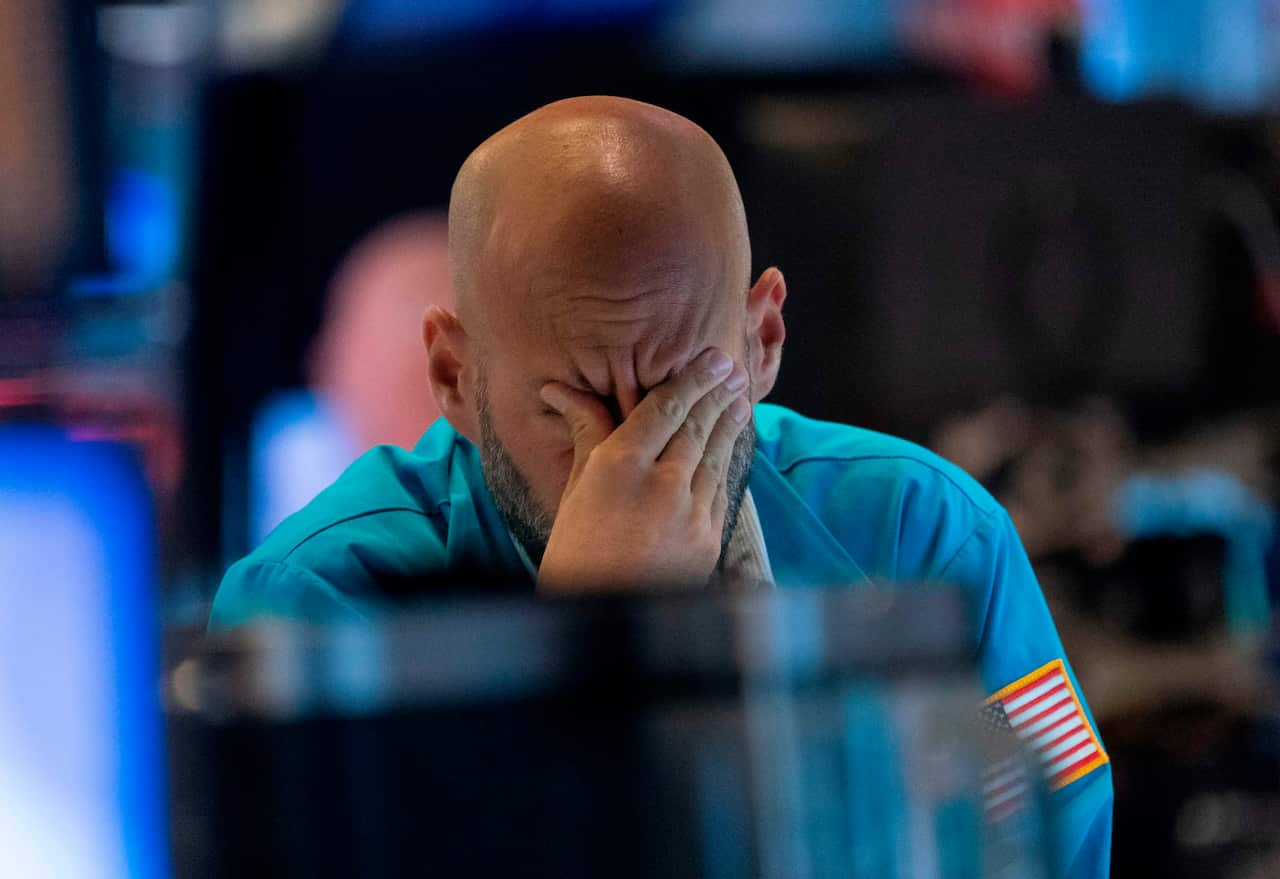
Dow Jones Industrials components Intel and Apple dropped 3.9 per cent and 4.6 per cent respectively on Friday.
News that makes sense
Your trusted source for staying up-to-date with the world around you. Get free daily news updates and analysis, straight to your inbox.
The developments overshadowed a highly anticipated speech from US Federal Reserve Chair Jerome Powell, in which he reiterated a pledge the central bank would "act as appropriate" to support the economy.
Powell stopped short of committing to the series of rapid-fire rate cuts Trump has been demanding.
Trump's tweeted response to the speech labelled Powell an "enemy".
David Katz, chief investment officer at Matrix Asset Advisers in New York, said the president was clearly upset.
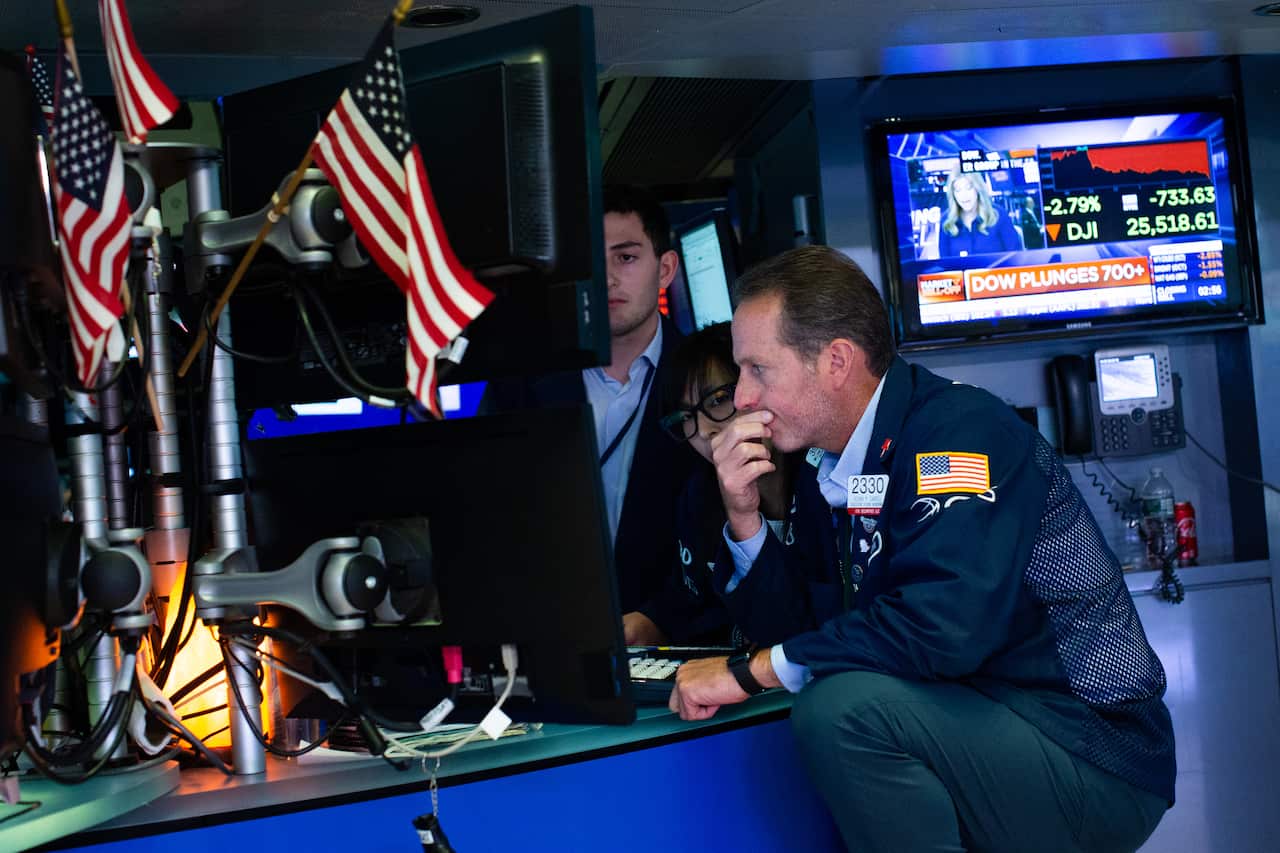
"(Trump) seems to be irate that China reacted to what the US has done and is basically having a mini-tantrum and is angry at everybody," he said.
"He's angry at China, he's trying to put the blame on the market and the economy on Powell.
"But at this point, it's very clear ... that the issues that have been coming to fruition of late with the economy and the slowdown are all trade-related and have very little to do with the Fed," Katz added.
Bernard Baumohl, managing director and chief global economist at the Economic Outlook Group in Princeton, agreed.
"The biggest folly is the belief that lowering interest rates by 25 or 50 bp will do anything to revive the economy," Baumohl said.
"Don't ask the Federal Reserve to bail out the economy, because they're not going to be able to do it this time."
The escalating US-China trade dispute has emerged as a major tripping point for the market in recent weeks.
Friday marked the third decline of more than two per cent for the S&P 500 so far in August, and the benchmark index has now shed 5.8 per cent in the last four weeks.
Yields for two-year and 10-year US Treasuries entered inversion territory, a classic recessionary red flag. The curve has traded in and out of inversion for the past three days.
The Dow Jones Industrial Average fell 623.34 points, or 2.37 per cent, to 25,628.9, the S&P 500 lost 75.84 points, or 2.59 per cent, to 2847.11 and the Nasdaq Composite dropped 239.62 points, or three per cent, to 7751.77.
All 11 major sectors in the S&P 500 ended the session in negative territory. Energy and technology were the biggest percentage losers, both sliding more than three per cent.
Trade-sensitive chipmakers dropped on the bellicose trade rhetoric, with the Philadelphia SE Semiconductor index dipping 4.4 per cent.
Specialty retailer Foot Locker plummeted 18.9 per cent on the heels of disappointing second-quarter results.
Computer hardware company HP announced the departure of chief executive Dion Weisler and forecast lower-than-expected fourth quarter profit, sending its shares down 5.9 per cent.
Declining issues outnumbered advancing ones on the NYSE by a 4.52-to-1 ratio; on Nasdaq, a 5.27-to-1 ratio favoured decliners.
The S&P 500 posted 33 new 52-week highs and 38 new lows; the Nasdaq Composite recorded 38 new highs and 195 new lows.
Volume on US exchanges was 8.07 billion shares, compared with the 7.58 billion average over the last 20 trading days.







