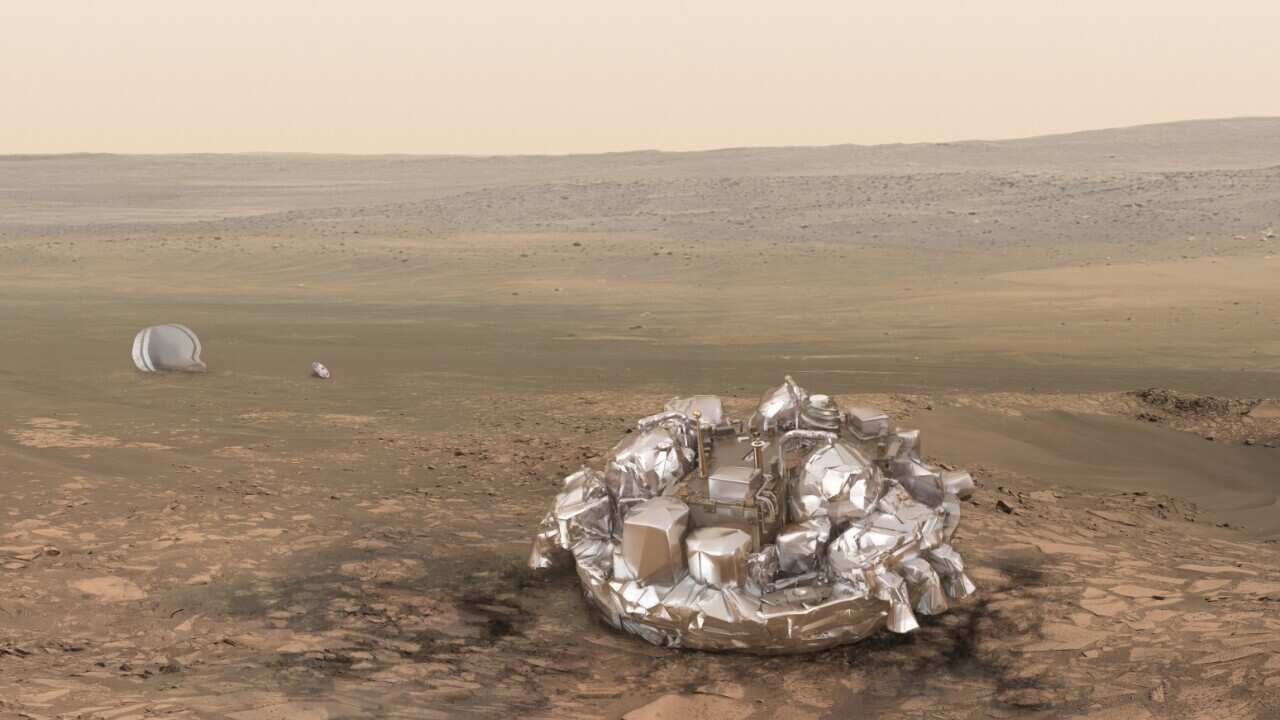
The paddling pool-sized "Schiaparelli" lander was scheduled to touch down at 1448 GMT Wednesday after a scorching, supersonic dash through Mars' thin atmosphere to conclude a 496 million-kilometre (308 million-mile) journey from Earth.
But signal was lost before touchdown - evoking the ghost of Europe's first, failed, bid to land on Mars 13 years ago.
"We are not in a position yet to determine the dynamic condition at which the lander touched the ground," European Space Agency (ESA) head of solar and planetary missions, Andrea Accomazzo, told a webcast press briefing at mission control in Darmstadt, Germany.
Further analysis was needed of some 600 megabytes of data Schiaparelli sent home before falling quiet, to "know whether it survived structurally or not," he said.
This would be Europe's second failed Mars landing in a row, joining a string of other unsuccessful attempts by global powers to explore our planetary neighbour's hostile surface.
News that makes sense
Your trusted source for staying up-to-date with the world around you. Get free daily news updates and analysis, straight to your inbox.
The British-built Beagle 2 robot lab disappeared without trace after separating from its mothership, MarsExpress, in 2003. Its remains were finally spotted in a NASA photograph last year.
Schiaparelli had travelled for seven years onboard the joint European-Russian Trace Gas Orbiter (TGO) to come within a million kilometres from Mars on Sunday, when it set off on its own mission to reach the surface.
The pair comprised phase one of the ExoMars mission through which Europe and Russia seek to join the United States in probing the alien Martian surface.
The TGO was successfully placed in Mars orbit on Wednesday, to cheers and applause from ground controllers some 170 million kilometres away.
Its task, starting in 2018, will be to sniff atmospheric gases potentially excreted by living organisms -- however small or primitive.
Schiaparelli's landing, in turn, was designed to inform technology for the bigger and more expensive rover scheduled for launch in 2020 - the second phase and high point of ExoMars.
The six-wheel rover will be equipped with a drill to look for clues of life, past or present, up to a depth of two metres.







