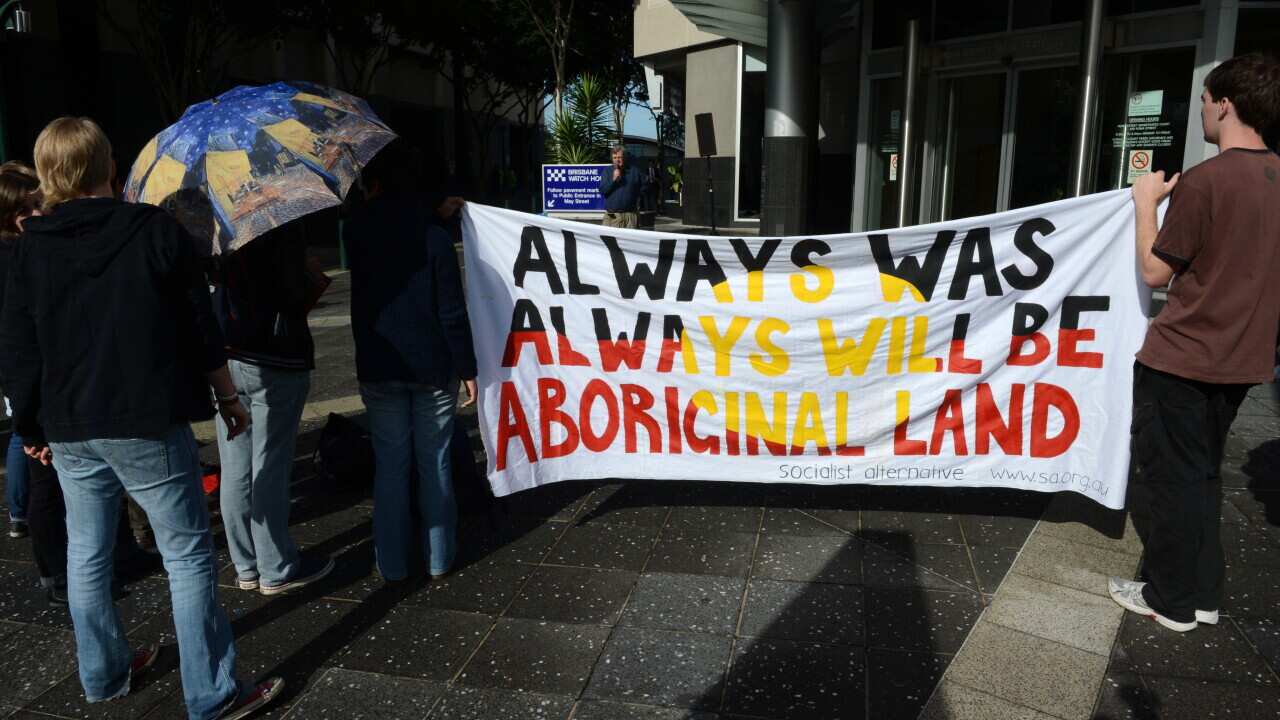
Over 40 years ago four Indigenous activists set up a protest under a beach umbrella on the lawns of Parliament House in Canberra.
It was to be the first Aboriginal Tent Embassy to demand Aboriginal land rights and would later serve as a hub for the broader Indigenous movement.
Key Aboriginal leaders, activists and advocates of change have just attended a two-day forum in the national capital.
As Calliste Weitenberg reports, it was an opportunity for them to reflect on the history of the Tent Embassy, Aboriginal activism, and the way forward for a new, younger generation of Indigenous leaders.
"What do we want? Land rights. What do we want? Land rights. What do we want? Land rights. What do we want? Land rights."
News that makes sense
Your trusted source for staying up-to-date with the world around you. Get free daily news updates and analysis, straight to your inbox.
It was the 1970s and the decade Aboriginal activists knocked on Canberra's door.
Amid the marches and rallies was Cheryl Buchanon, a member of the Aboriginal Tent Embassy in 1972.
Even then, she knew the Land Rights movement would be important for generations yet to come.
"What's land rights going to mean to them? This is something that I believe we now must think about. What have we left? What are we building? What have we done? .... We need to be much much more organised than what we are."
Cheryl Buchanon has just joined other prominent Aboriginal campaigners, artists, authors and new young leaders to reflect on those same questions today.
She recalls that she knew the groundwork they had laid.
"What you had at the time is what I would call a groundswell. There was a sense of unity right throughout Australia so there was this whole grassroots movement that existed. It wasn't in someone's mind it wasn't something that's made up on social media like you do today, it was actually real and we were communicating with people right throughout Australia and that we knew there was a lot of support for what we were going to do. And it made it feel different it just made you feel when you were there that you were actually being part of something huge that you were there for all of the thousands of Aboriginal people who couldn't be there.
Cheryl Buchanon says the setting up of the Tent Embassy ensure that Indigenous voices could no longer be ignored.
"We wanted to have an eyesore so that when people came to Canberra and when ambassadors from other countries and when people were visiting embassies that they would come and they would see us and we would be able to talk about the plight of, what was happening with our people. That's what it was about."
Cheryl Buchanon says the Tent Embassy was the first real sign of Indigenous engagement with a political system that had previously seen them ignored.
"We were meeting with ministers, ministerial advisors, different politicians of the day and trying to influence them and so yeah it was very much political activism. I think there were some wonderful historical things in terms of you know the 1946 strike over the Pilbara and some other wonderful things that happened with the Gurindji strike and so on but I think this was more engaging in that we knew what we were about was to influence government because if we could do that then we could influence change."
And they did, with the Aboriginal Land Rights Act passed in 1976.
But Cheryl Buchanon, a Queenslander, says it was activism met by very real forms of resistance.
"I was from the police state so you know it was a very, very murky history of you know, Aboriginal people disappearing from country towns, being murdered, no investigation taking place, you know a long line of Aboriginal deaths in custody, um it just goes on and on, big infant mortality rate, not many people engaged in the education system."
She remembers clearly the clashes between police and protestors - none like July 20, 1972, when police moved in to pull down the Tent Embassy.
"That will always stick in my mind. I was actually standing at the Tent Embassy today and was thinking you know how amazingly naïve you are as a young person and that we used to almost get dressed up you know I used to call it wall to wall badges because we used to have the badges 'Land Rights Now' and so on that we used to wear on our jackets and jeans and that, and it was like, we knew that we were probably gonna get bashed by the police but we still did it."
This beginning for Aboriginal activism isn't forgtten by Adam Hill.
A Koori man and political artist, he grew up in Sydney's west.
"That pathway that has been paved for us is something that is an absolute luxury and you know I Just felt it my duty to continue the reminder or perhaps keep the echo going around the valley. It's paved the way for us to be really quite free with our commentary and I feel it is a very proud time to be in at the moment because there are way fewer deaf ears nowadays. "
Taking his cue from the broader Indigenous movement, at 27 Adam Hill picked up his brush, he says, to make art a new weapon of change.
"Gordon Hockey was just beginning to reach his stratospheric status as an artist and I looked at his works on the wall in Camperdown and you know I saw these works and I thought how is this fella gonna sell these - they were pretty hard core and of course it was a sell out show and the next thing he's having these major shows in major institutions and he was the big inspiration for me in the early days because I realised that it was ok to be abrasive and cut throat with your commentary."
Of his early paintings, Adam Hill says the aim was straight up commentary on social justice - in particular, the way Aborignal kids were being effected by what he calls "the big change" - urbanisation.
His most successful painting, he says, was described in a newspaper as the first visual depiction of child sex abuse by the church upon Aboriginal children.
It sold almost immediately.
Adam Hill says he wanted to reach those who still weren't listening to Aboriginal Australia - what he calls a white, middle and upper-class Australia.
"I realised well you know you could reach those people, you paint the painting, you have a uptown lavish exhibition and the main fundamental thing is you get the people there, you get them in the mood and you drum them home with the message, and that's what I've been trying to do with art."
Fellow creative and Indigenous man Kim Scott is a descendant of Western Australia's Noongar people and an award-winning author.
In 2011 he received Australia's most prestigious literary award, the Miles Franklin, for his novel That Deadman Dance.
Kim Scott speaks of a different kind of Indigenous voice for change today - one that is less loud, perhaps less consciously engaging with political structures.
More personal and intimate, his writing represents a new form of activism in a contemporary, literary discussion space for Aboriginal identity.
"Writing is a large part of who I am and I think it starts as an exploratory sort of thing. There's a South American writer I greatly admire Eduardo Galeano who talks about in writing as against the declamatory sort of speech in the public arena, writing is somewhat different. Particularly writing fiction. You're saying sometimes this is who I am and encourage people to think about who they are. And I think in writing novels also there's a certain sort of intimacy that's one-on-one so it is almost you create a consciousness that reader and author inhabit and I think change can come from that."
Like Adam Hill, Kim Scott sees the power of Indigenous creative voices in the history of Aboriginal activism.
"It's how you get self-representation, it's also how you expand the means available to people for representing themselves. You enlarge the languages available to us. Writing and a lot of different art forms in this area work with expanding the possibilities and sometimes you have to do a critique of what's most readily available to you and then through the arts more than any other form I think supply another means of articulating who you are."
It's the collective push for change, driven in waves by activists, painters and writers alike that Cheryl Buchanon, Adam Hill and Kim Scott are seeing the results of today.
No longer simply on the outside, yelling from the street, or through their paintings and art, they see Aborignal people today as being at the discussion tables alongside the nation's leaders and decision-makers.
"Certainly I know at home in South Western Australia in Noongar country there's a great number of people working in what you might call the third space I suppose and trying to enlarge that. And I suppose that third space is where people have got through doors and through barriers and have to transform those areas that they're operating in and they bring their own values in."
It's the new generation of Indigenous people who are now occupying this space - working to see change across areas of welfare, education, health, media, and politics through policy work, leadership and volunteer roles.
One is 25 year-old Benson Saulo, a descendant of the Wemba Wemba and Gunditjmara nations of Western Victoria and the New Ireland Province of Papua New Guinea.
He's already the director of the National Indigenous Youth Leadership Academy and in 2011 was Australia's youth representative to the United Nations.
He's clear about who he owes.
""I look at my parents and my mum growing up in Bordertown South Australia growing up in a tin shed with dirt floors, not being allowed into town after 6pm and I also look at my father and his experience growing up...That actually really inspires me because it kind of shows the sacrifices that our parents had to make the sacrifices that people of the past in past movements had to make in their own lives to ensure the next generation had that step up and I really feel that young people are really benefiting from the hard work and I guess the blood sweat and tears that have gone into past movements to ensure that there's opportunities available for us."
Benson Saulo is the new generation of Indigenous activist, seeking change from inside, a part of institutions and political structures that once left his ancestors out.
"It really has transformed in a, the political landscape over the last forty years, where we are seeing federal representation with Ken White from WA. We are seeing Nova Peris up in Darwin and, it has taken a lot of time and a lot of pressure but what's something that is really inspiring is that there is change that is happening...."I think we've spent so many years on the outside, really protesting and knocking on the door and being excluded and what's actually, we've seen change, people are really stepping up, we are really moving in this political structure, so no longer are we standing on the outside banging on the door because we do have people on the inside that are willing to listen, willing to support."
But like Cheryl Buchanon, decades on, even Benson Saulo's rise isn't without its own challenges.
"When I was actually working in the bank I made the mistake of printing off financials double sided and the district manager came up to me with this print out and he said to me, Benson, you know your family's standing out there in the bush. Don't you think they want more trees to stand under? Remember to print off double sided. And uh, he said that in the open planned office and everyone just laughed and as a 19 year old getting hit with that... it really does shake your confidence."
This lingering evidence of a so-called casual racism is just one of many big social challenges Benson Saulo says his generation is now tasked with changing.
Expanding the new political space for Indigenous voices, dealing with the anger and hurt left by the past as well as intervention in the Northen Territory, are just a handful of others identified by his forebears.
Because for older pioneers, like Cheryl Buchanon, getting a seat at the table is just the beginning.
"My understanding of partnership is it has to be based on equality so when you sit across the table you have a level playing field. Now, we are still in a situation where we don't have funding we don't have financial we don't' have the economies to back us on anything and so we're still in that same situation you know almost that we were right at at the very beginning. Where we haven't moved on with any kind of sustainable economy that you know, we have. So we're still very heavily reliant on government for basic things in our community."
But Cheryl Buchanon says her success and activist years were spirit-led.
And, bucking criticisms his generation is disengaged and lazy, Benson says he's confident that same spirit is still around today.
"I've been very lucky over the past couple of years to actually travel around Australia and I always speak about the spark that you get to see and you witness in different communities and these might be the most vulnerable hard communities but there's always a spark which kind of ignites this sense of passion and hopefulness and so I'm constantly inspired by that."
As she and other activists move on to new challenges, Cheryl Buchanon is clear the past, her past, must always play a role.
"I think it's really good to reflect on things that have happened in the past um and I don't think that we don't do enough of it. I think, you know, people are always trying to look forward without trying to bring the past with them."
All archival audio used in that report is courtesy of LeftPress.







