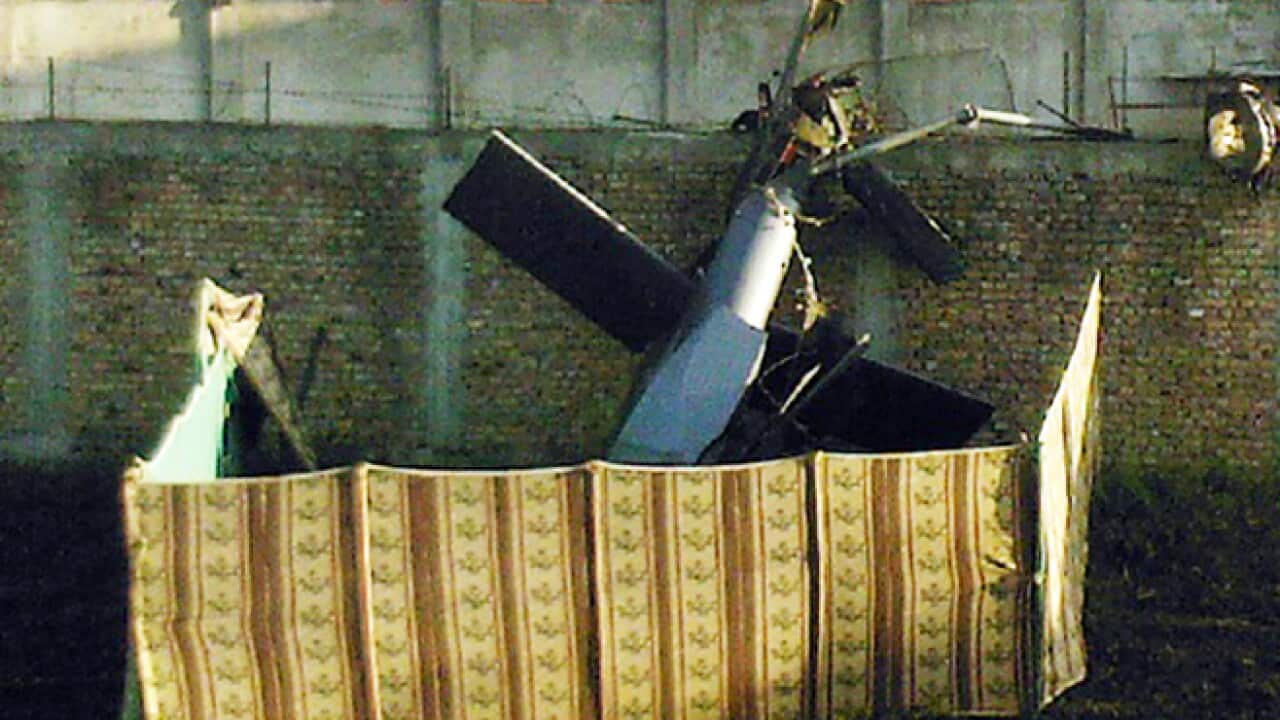
The US Navy's special forces certainly got their man when they raided Osama bin Laden's hideout at the weekend, but the alleged loss of one of their stealth helicopters in the process could prove a problem in the long term - especially if some of its stealthy secrets reach China, which has an aggressive stealth aircraft manufacturing programme.
When one of the helicopters failed on the ground, it was set ablaze by the US troops, per protocol, presumably after high security systems like encrypted radios were removed. The problem? Large chunks of the chopper's superstructure survived the inferno - including a large part of the tail, the horizontal stabilisers and the tail rotor.
These pieces have an unusual construction which suggests they may be both acoustically and electromagnetically stealthy. The engine shroud has angled edges reminiscent of Gulf War I's Lockheed Martin F-117 Stealth Fighter, whose edges famously deflect, rather than reflect, radar signals. And a dish-shaped cover over the tail rotor's axle - where the propellor blades join and create drag - looks designed to quell noise.
News that makes sense
Your trusted source for staying up-to-date with the world around you. Get free daily news updates and analysis, straight to your inbox.
It all figures: many news sources quote Abbottabad locals saying that they didn't hear the choppers until they were directly overhead. And the Pakistani air force did not intercept the incoming US aircraft, suggesting a stealthy approach.
In this report, CNN pictures local children cheerfully collecting other parts of what was thought to be a stealthy version of the Blackhawk chopper and taking them...somewhere. The cable newscaster is right to say that "these parts could end up in the hands of governments trying to build stealth technology".
The clear candidate destination here is China, which surprised western observers earlier this year when its first stealth fighter was pictured in flight tests.
What's crucial with stealth technology is the precise chemical composition of the secret radar absorbing surface coating. When initially developed, the coatings for the F-117 were so secret that staff allegedly exposed to noxious chemicals initialy had trouble proceeding with a lawsuit - on national security grounds.
If parts of the stealthy Blackhawk do get into Chinese hands the latter's military R&D teams could save years of effort by analysing their surface chemistry.







