
As temperatures rise, so do many Australians' energy bills.
The high cost of keeping their homes at a comfortable temperature is, according to new research from Energy Consumers Australia (ECA), driving millions of renters to avoid it altogether.
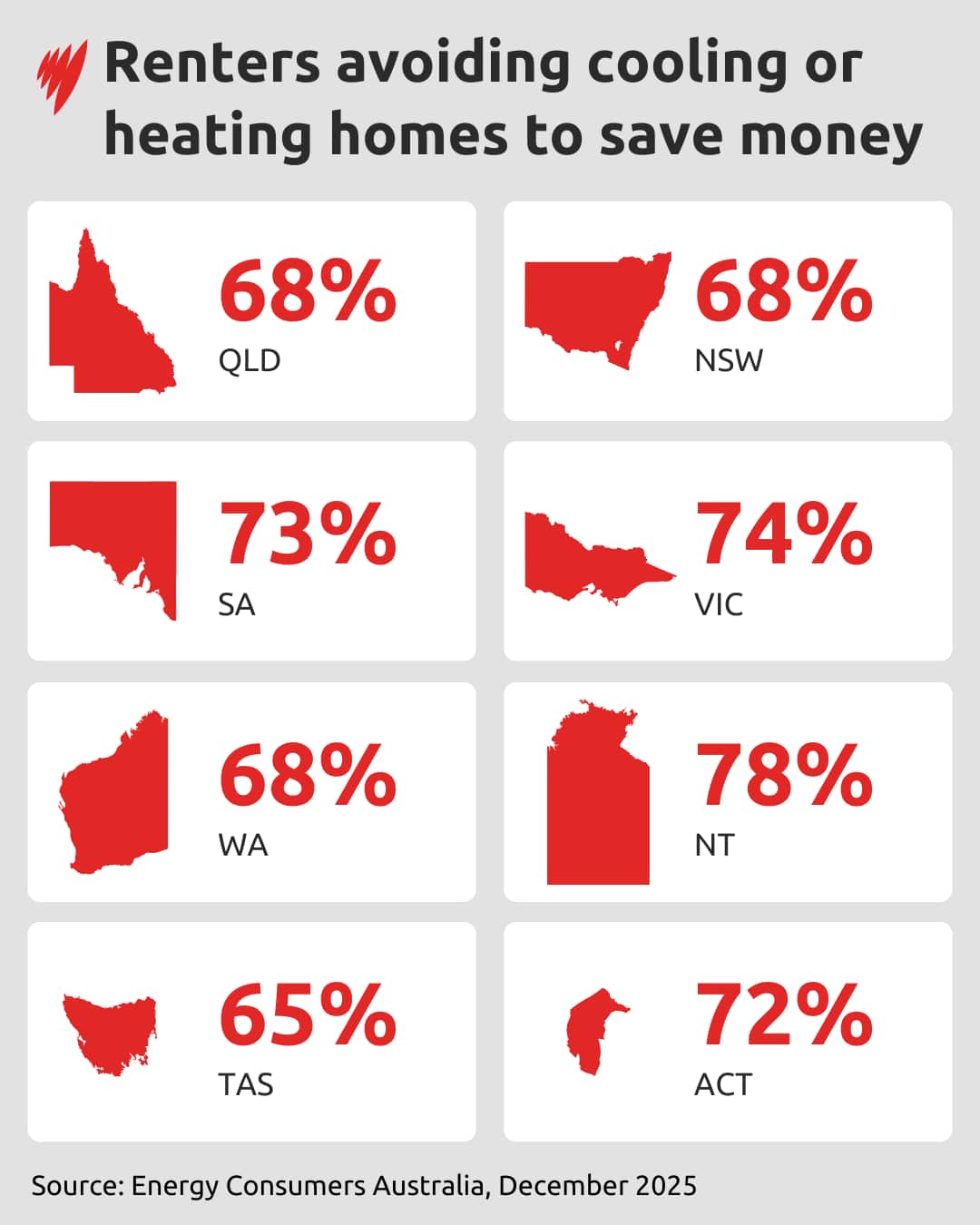
ECA's latest Consumer Energy Report Card, released on Thursday, found that 70 per cent of a poll of 1,428 renters nationwide were avoiding heating or cooling their homes to save money.
At the same time, two in five (40 per cent) of those polled said they couldn't afford to keep their home at a comfortable temperature on hot days without using a lot of energy.
For cold days, the national figure was 32 per cent.
News that makes sense
Your trusted source for staying up-to-date with the world around you. Get free daily news updates and analysis, straight to your inbox.
ECA's executive manager of analysis and advocacy executive manager, Ashley Bradshaw, said the findings supported the need to introduce minimum energy efficiency standards for rental properties across Australia.
"On the one hand, renters are telling us they're avoiding using energy, but on the other hand, they're also telling us that their bills are generally a lot higher than any household of the same size," he told SBS News.
"Without some sort of mandatory enforceable standards, renters are going to keep living in homes that are too hot in summer, too cold in winter, and very expensive to run."
Separate data by research firm SECNewgate polled 1,208 Australians and found 65 per cent of respondents supported a minimum efficiency standard for rental homes.
And of 1,056 respondents, almost half said landlords should cover the cost of home upgrades to meet minimum energy-efficiency standards, with government support. Another 27 per cent said landlords should pay the full amount, 14 per cent believed the government should fund the upgrades, and 7 per cent said the cost should be shared between landlords and tenants.
What are minimum energy efficiency standards?
Minimum energy efficiency standards can include requirements such as draught-proofing and proper insulation, and the installation of energy-efficient appliances.
The ECA data suggest just over a third of rentals in Australia have at least one form of insulation, compared to 78 per cent of owner-occupied homes.
Climateworks Centre's buildings lead, Gill Armstrong, said: "We know that rentals are in really worse shape than other housing segments like owner-occupiers, and we know that tenants just can't upgrade — they've got no rights to do that — so we need that requirement for landlords to have minimum rental standards throughout all the states."
"I don't think it should be guesswork as to whether this home is going to be acceptable to live in or you're going to have really high bills," she said.
Both Victoria and the ACT are progressively introducing minimum energy efficiency standards for rentals.
That means more than two million rental homes are in jurisdictions without any minimum, enforceable energy-efficiency requirements, according to ECA.
"At the moment, some state restrictions are simply very high level, just that the house needs to be 'in working order' — essentially words around that respect — so nothing at all related to energy efficiency," Bradshaw said.
What changes are being proposed?
Bradshaw said ECA first wants to see the disclosure of a home's energy efficiency rating made mandatory at the point of lease in every state and territory.
"A [rating of] 10 is this theoretically perfectly-efficient house, where almost the internal temperature of the house is irrespective of the outdoor temperature," he said.
"On the other hand, a zero star would essentially be you are literally outside, a one star would be a tent.
"I think the average rating of a house in Australia is 1.8, so we're kind of closer to a tent in terms of certain quality of homes, particularly rentals."
Bradshaw said that would then be followed by the progressive introduction of minimum energy-efficiency standards, making homes unable to be rented out unless they meet a certain benchmark.
"If we look forward, we're going to seemingly have more extreme weather and see the health and societal impacts of that, so it becomes more and more important."
How much could energy efficiency standards save you?
Having a better-insulated home with more energy-efficient appliances means you don't need to use as much power or have appliances running for as long to make your living environment comfortable.
Armstrong said that can result in a significant cut to your annual energy bills.
"Depending on the size of your home and how much heat or cool you like, we're looking at saving a considerable amount per year — up to $2,000, our modelling showed, particularly in the homes that are the lowest performers," she said. "So that's no insulation and things like you've got gaps around windows, you've got old vents that are not blocked up, so your house is very leaky."
But the benefits extend far beyond cheaper energy bills, Bradshaw and Armstrong said.
They can also make your home quieter, reduce pressure on the energy grid, lower greenhouse gas emissions, and improve your physical and mental health and well-being.
How to get a more energy-efficient rental
Regardless of whether minimum energy efficiency standards have been introduced where you live, Armstrong said it was worth talking to your landlord about upgrading your home.
Research shows most landlords have no idea what their rental properties feel like in summer or winter, so you should let them know exactly how your home "is not fit for purpose", she said.
"I'd communicate that as best as possible and document why the home is too hot, too cold, any air vents that are from past gas appliances that may have been removed that you can see daylight coming through, show them copies of bills, and suggest ways forward," Armstrong said.
"The Your Home website by the federal government has heaps of advice that landlords can follow."
For the latest from SBS News, download our app and subscribe to our newsletter.







