
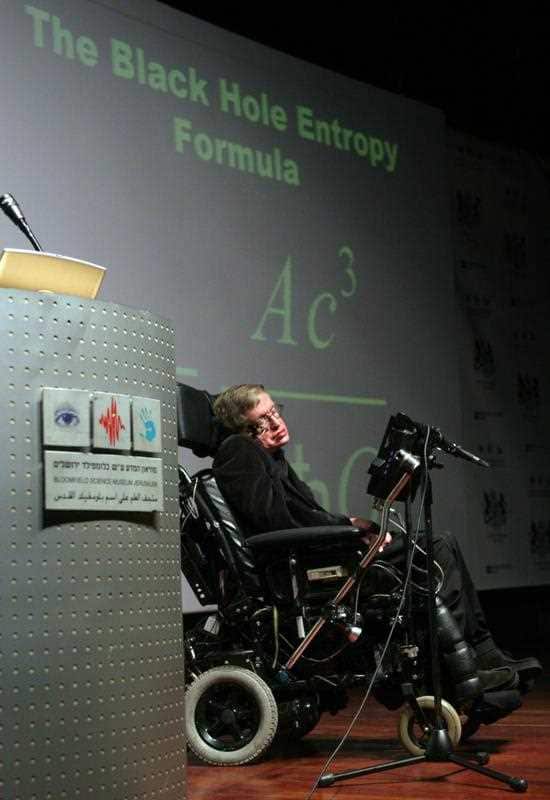
Hawking wanted his revered Hawking radiation formula engraved on his tombstone, according to a 2002 story published in The New York Times.
Hawking, who died on Wednesday at the age of 76, developed the formula explaining how energy and matter could escape from a black hole in 1974.
The discovery was groundbreaking at the time and helped set Hawking on the path to being regarded as one of the world’s greatest intellectuals.
In the 2002 story, which outlines how Hawking came to his conclusion and subsequent studies, Times reporter Dennis Overbye cited that the acclaimed physicist wanted the formula engraved on his tombstone.
News that makes sense
Your trusted source for staying up-to-date with the world around you. Get free daily news updates and analysis, straight to your inbox.
When Hawking postulated that black holes leak radiation, slowly dissolving like aspirin in a glass of water, he overturned a core tenet of the Universe.
Ever since Albert Einstein published his theory of general relativity in 1915, predicting the existence of black holes, it was thought they devour everything in their vicinity, including light.
Black holes, it was thought, were bottomless pits from which matter and energy could never escape.
But Hawking, sometimes described as the most influential theoretical physicist since Einstein, questioned this, saying that black holes were not really black at all and must emit particles.
In so doing, he touched on a persistent headache for physicists: Einstein's theory, which has withstood every experimental test so far, does not explain the behaviour of particles in the subatomic, "quantum" sphere.
Considered controversial at first, Hawking's black hole theory pointed to a possible bridge between the two mainstay physics theories -- general relativity and quantum mechanics.
"Hawking realised that black holes, these objects that are made of gravity, because of quantum mechanics... can actually emit particles," astrophysicist Patrick Sutton of Cardiff University told AFP.
"This was the first case where we had a physical process that links gravity, this classical theory of gravity, with quantum mechanics."
The mechanism was named "Hawking radiation" after the famous scientist who died Wednesday-- Einstein's birthday.
And it painted a completely new portrait of black holes.
"Stephen Hawking discovered that when the quantum laws governing the physics of atoms and elementary particles were applied to black holes, the surprising outcome was that black holes actually must emit radiation," physicist Raymond Volkas of the University of Melbourne said via the Australian Science Media Centre.
-With AFP







