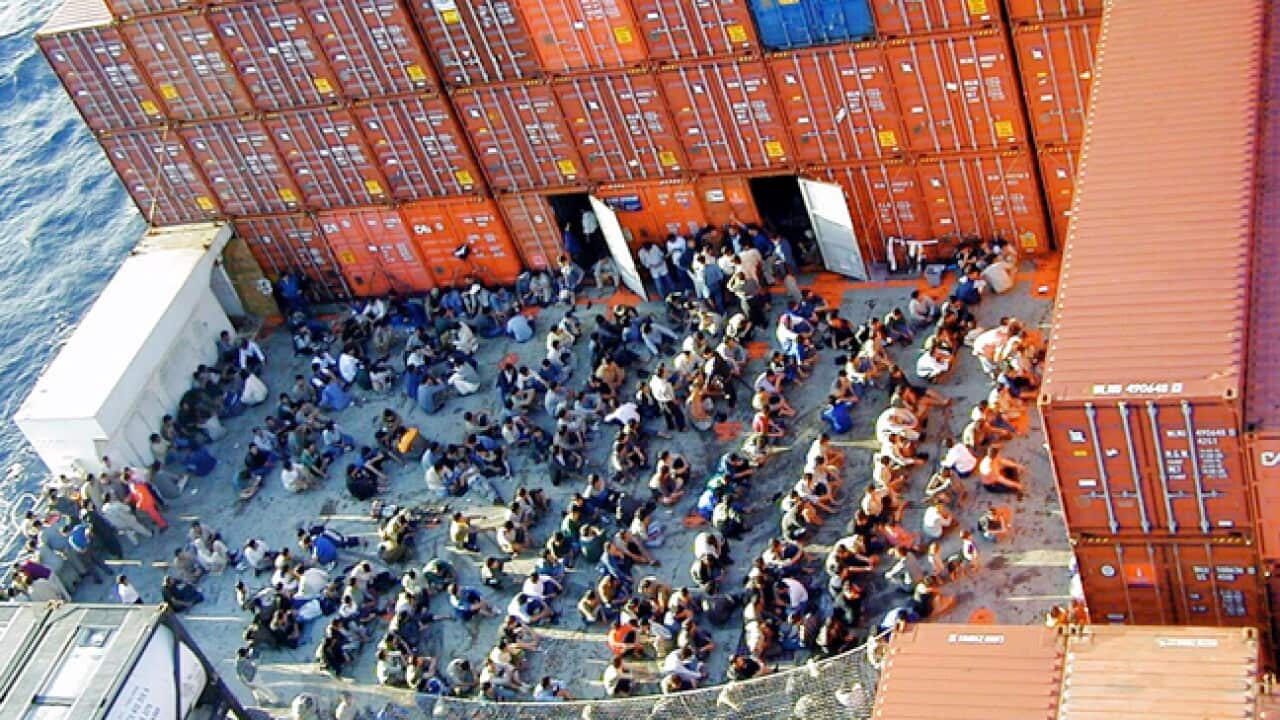
During the 'Tampa crisis' 10 years ago, the Australian government blocked more than 400 asylum seekers from coming to Australia. Many of them were eventually resettled in other countries, some came to Australia while others were sent back to Afghanistan.
The Norwegian freighter Tampa saved the group of asylum seekers from their sinking boat north of the Australian territory of Christmas Island on August 26th, 2001. The Howard Government prevented them from reaching Australian soil, sending them instead to a new detention centre on Nauru.
Some of the Afghans, who were mostly minority Hazaras, eventually agreed to take cash payments from the Australian government to leave Nauru and go back to where they came from.
The Edmund Rice Centre in Sydney has tried to track as many of those who returned as possible. The centre's director, Phil Glendenning, spoke to SBS Radio's Ron Sutton.
LINK: Edmund Rice Centre: Deported to danger
News that makes sense
Your trusted source for staying up-to-date with the world around you. Get free daily news updates and analysis, straight to your inbox.
LINK: Documentary: A Well-Founded Fear
Mr Glendenning says the centre sought to stay in touch with a group of Afghans that spent time in Nauru and Australia. Of those sent back to Afghanistan, he says 22 people, including four children, some of which were on the Tampa, have since been killed in Afghanistan. (Not all the 22 quoted were from the Tampa)
"The ones that were sent back that we were in touch with, sadly we discovered that life for them was extraordinarily difficult and many faced the persecution they sought to escape from," says Mr Glendenning.
He tells the story of one man, an imam who was persecuted in Afghanistan because of the particular sector he belonged to. Members of his family had been killed but he managed to escape and was on the boat bound for Australia that was rescued by the Tampa. Under the 'Pacific Solution' he spent three years on Nauru where he was a block leader.
"He was promised that if he went back to Afghanistan it would be safe," says Mr Glendenning.
On returning to Afghanistan the man received $2,000 but did not receive promised assistance with employment and accommodation. When he tried to get back to his home district, they were chased by the Taliban and the man he was travelling with was shot dead. He now lives between Pakistan and Afghanistan, away from this family and fearing for his life, Mr Glendenning says.
"It begs the question as to what it was going on in Australia at that time that prevented us from recognising those people that were genuine, valid refugees and we sent them back, most into danger and many to their death, whilst other jurisdictions recognised these people as valid refugees," he says.
(Please listen to the audio interview above for more on the Afghans sent back.)







