

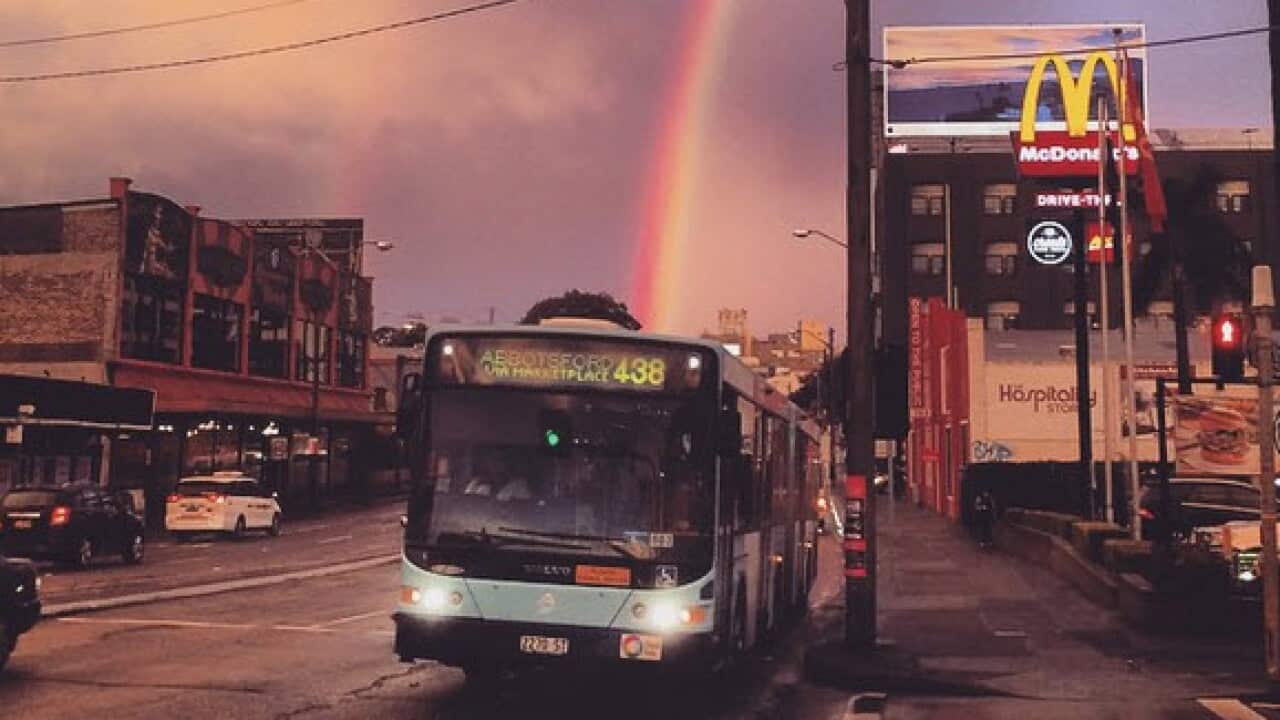
Yesterday Sydneysiders looked towards the sky – or pointed their phones towards the sky, and looked at the screen – as a double rainbow developed over the city.
But what were all those people so fascinated by? What were they looking at?
A rainbow is an optical illusion, where visible light from the sun – which is constituted of seven colours – passes through water droplets in the atmosphere. When the light hits the water particles it enters and bends, or refracts, forcing it to split into its constituent colours – red, orange, yellow, green, blue, indigo and violet – which are then reflected back out of the droplets.
It is not a physical entity of any kind, but simply something that appears when there is enough light in the sky and water in the air, and the observer is standing at the right angle.
News that makes sense
Your trusted source for staying up-to-date with the world around you. Get free daily news updates and analysis, straight to your inbox.
Bureau of Meteorology’s Sydney forecaster Mohammed Nabi said yesterday was close to perfect conditions for a robust rainbow, viewable across most of the city.
“You had clearing rain, but behind the rain you had clear air as well,” he said. “So the setting sun had enough light coming through the clouds for you to see a rainbow.”
“In most instances when the rain is clearing you still have cloud about so the sunlight isn’t getting through the cloud – you need a clear patch of sky for it to work.”
Double rainbows are the same type of phenomena, Mr Nabi said, but it means the light is piercing through two water particles and refracting each time, a process called, aptly, double refraction. It is essentially the same process playing out twice.
“If you had enough light and water particles in the air you could get a triple, or quadruple rainbow, if you were looking at it from just the right angle,” he said.
The reason the rainbow appears as a semicircle arch is fairly straightforward, according to Mr Nabi.
“It’s probably going in a full circle, but because you can’t see below the ground you won’t be able to see the rainbow continuing,” he said.
“You can probably see a full rainbow circle if you take a hosepipe and spray water in an arch in sunlight – you would probably see that it go all the way around.”
The rainbow forms as a circle for every observer, regardless of angle (again it is an optical illusion, not a real physical object). The centre of the circle depends on the angle of your eyesight relative to the sun – when the sun is lower in the sky it is likely the peak of the rainbow will be higher.
While there is a scientific explanation for why double rainbows occur, there is still no scientific explanation for this: