
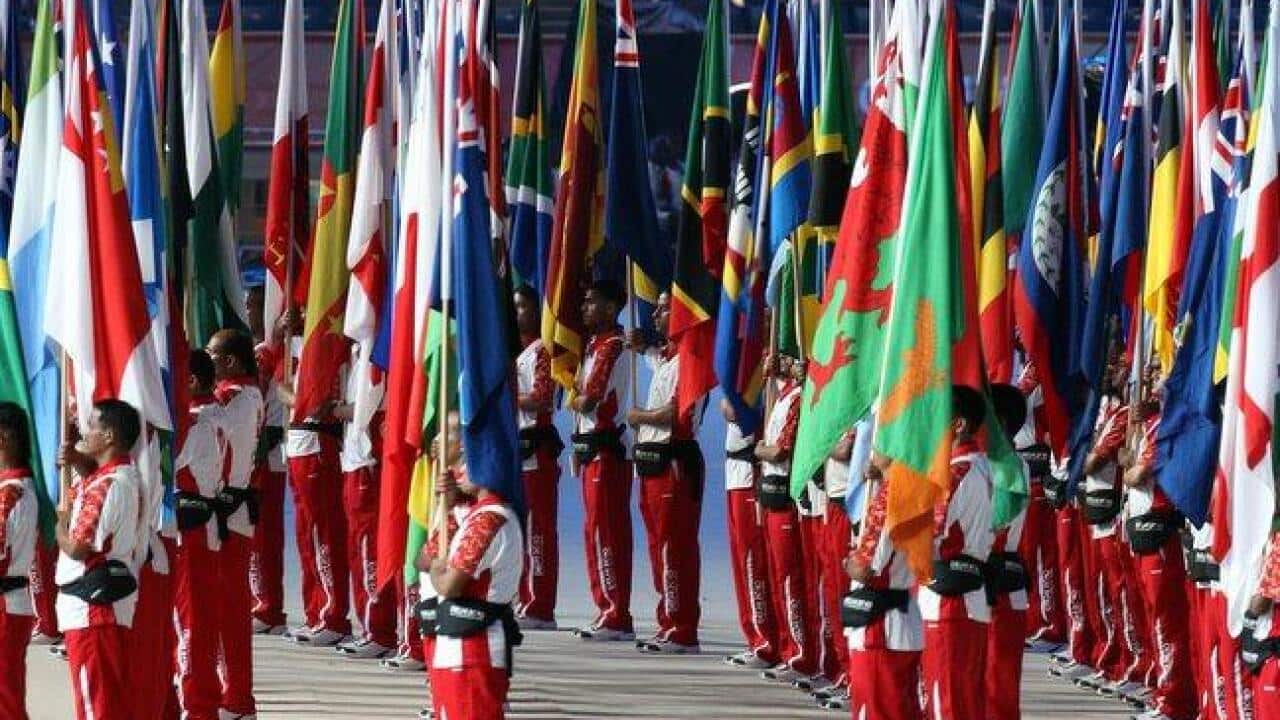
The Commonwealth Heads of Government Meeting in Perth in late October has been described as the biggest-ever gathering of world leaders in Australia.
The meeting will bring together leaders of 54 countries, representing roughly one third of the world's people.
Aileen Phillips reports.
"It has always been easier to hate and destroy. To build and to cherish is much more difficult. That is why we can take a pride in the new Commonwealth we are building. This year, Ghana and Malaya joined our brotherhood. Both these countries are entirely self-governing. Both achieved their new status amicably and peacefully. This advance is a wonderful tribute to the efforts of men of goodwill who have worked together as friends, and I welcome these two countries with all my heart."
Queen Elizabeth, speaking in 1957, eight years after the modern Commonwealth was born.
Even though the vast majority of members of the Commonwealth are now republics, more than 50 years later, Queen Elizabeth remains its symbolic head, and she will officially open the Perth meeting.
The Commonwealth has its origins in the 1880s, when a British politician visiting Australia called the British Empire a "Commonwealth of Nations".
A grouping known as the British Commonwealth was later formed, with Australia as a founding member.
Then in 1949, the word "British" was dropped from the title and it's been known ever since as "the Commonwealth of Nations", or simply "the Commonwealth".
The modern Commonwealth comprises mostly former British colonies, along with Britain.
Critics argue it's a relic of the days of colonialism.
The Secretary-General of the Commonwealth, Kamalesh Sharma, disagrees.
"The modern Commonwealth in any event came into existence in 1949 and it may have been designed in the last century but it is fit for purpose in the way it works for the present time. So it is one of the most relevant, most contemporary organisations that exists."
Former Australian diplomat, and now Canberra academic Hugh Craft also dismisses claims of the Commonwealth being neocolonialist.
"On the one hand representative of such a wide constituency and in that sense it appears to be one thing like for example the inheritor of British traditions, and some would say that it is a hangover of the old boys British club. But it is paradoxical because whilst it retains all of those essential elements that were part of the inheritance of the British empire, like parliamentary democracy and the rule of law, human rights and so on, on the other hand it has moved away from that into what has now become quite a modern, international institution."
Australia was one of just eight countries which formed the modern Commonwealth in 1949, declaring themselves to be free and equal members "co-operating in the pursuit of peace, liberty and progress".
Ever since, membership has continued to grow, even including countries that were never British colonies - including Mozambique, and the 54th member, Rwanda.
The Commonwealth has no constitution or charter.
Instead, member countries have made joint statements of commitment to certain key principles or values - including respect for democracy, human rights, the rule of law, and gender equality.
Commonwealth member countries are also members of the United Nations and a host of other regional and international organisations with the same or similar declared values.
So what has made the Commonwealth survive, and even expand?
Secretary-General Kamalesh Sharma thinks it's the Commonwealth's unique strengths in value setting and giving a voice to smaller and more vulnerable members.
"The biggest strength of the Commonwealth is that it is the only body in the world which if it decides to take a course of action or comes up with an idea, it is so representative of the world in every respect. In terms of the types of countries represented, in terms of geographical spread, the economies represented, in terms of all the religions represented, all the stages of growth and development. It is such a template and microcosm of the world as a whole that if there is any idea which it comes up with, it is already a global idea."
Despite its gradual expansion of membership, questions have certainly been raised over the Commonwealth's continued relevance in the 21st Century.
The question has even been asked by the Commonwealth members themselves.
At the previous Heads of Government meeting in Trinidad and Tobago in 2009, they commissioned a report from a group of so-called Eminent Persons for consideration at this year's meeting in Perth.
The brief was to advise on ways of reforming the Commonwealth to make it more relevant to its times and people.
The sole Australian member of the Eminent Persons Group is former High Court Judge Michael Kirby.
He sees the organisation as well worth preserving - with reforms.
"The Commonwealth is two-billion people. Two billion people - it's a third of the whole of humanity. It is an amazing family of nations and peoples and we have really undervalued it and we have got to make it more valuable and make the most of this association of history and make it relevant for the present time."
The common commitment to democracy is one of the areas in which the Commonwealth has been consistently active.
Teams of Commonwealth representatives regularly act as observers in elections in member countries, particularly in those trying to recover from a period of turmoil.
Their assessments of whether the elections have been free and fair carry considerable weight.
The Commonwealth threatens withdrawal of privileges and occasionally suspends a member when democratic principles are judged to have been severely breached - as has been done with Fiji since 2009.
Commonwealth programs include technical aid, with professionals providing expertise and advice, and scholarships for students to gain further education.
According to the London-based Commonwealth Secretariat, direct citizen-to-citizen links are as important to the Commonwealth as contacts between member governments.
A world-wide network of about 90 non-government organisations bear the Commonwealth name - mostly associations of professionals like lawyers, health workers, engineers and teachers.
One well-known non-government organisation is the Commonwealth Games Federation, which organises the multi-sport athletics event every four years.
There are also various Commonwealth advocacy groups and collectively they comprise the "civil society" element of the Commonwealth.
These work in areas including trade negotiations, gender equality, youth affairs, education, HIV-prevention, and the arts.
The Heads of Government meeting in Perth will be preceded by a gathering of civil society groups called a People's Forum, which will draw up recommendations for action by the leaders.
The Forum has been preceded by a series of regional consultations, with Australia represented at the one focused on the Pacific region.
The Chairwoman of the Commonwealth People's Forum Steering Committee Sue Ash says there have been a number of common issues raised.
"The impact of climate change, particularly on small island developing states, there is a growing theme of really the movement of people, but particularly skilled people around the Commonwealth. There are issues relating to women and women's health and particularly primary health because of the concern about health and wellbeing."
According to the Australian member of the Eminent Persons Group, Michael Kirby, the heads of government meeting should endorse a program that will strengthen the Commonwealth.
"Anything in the world that links people together is prima facie a good thing. Anything that brings people together who have a common history, who use a common language, who have similar institutions, who have strong sporting and other links, strong cultural links, the Commonwealth is a unique international organisation, this is the sort of interconnection in the global community that we should be strengthening, not weakening."
Commonwealth Secretary-General Kamalesh Sharma also thinks the Perth meeting will mark a turning point that will be beneficial for members - and the rest of the world.
"Our leaders have committed themselves to a set of values connected with advancing the democratic culture, rule of law and human rights and it is little known that this has had a very powerful effect across the globe. This is a huge contribution going forward into the 21st century."