
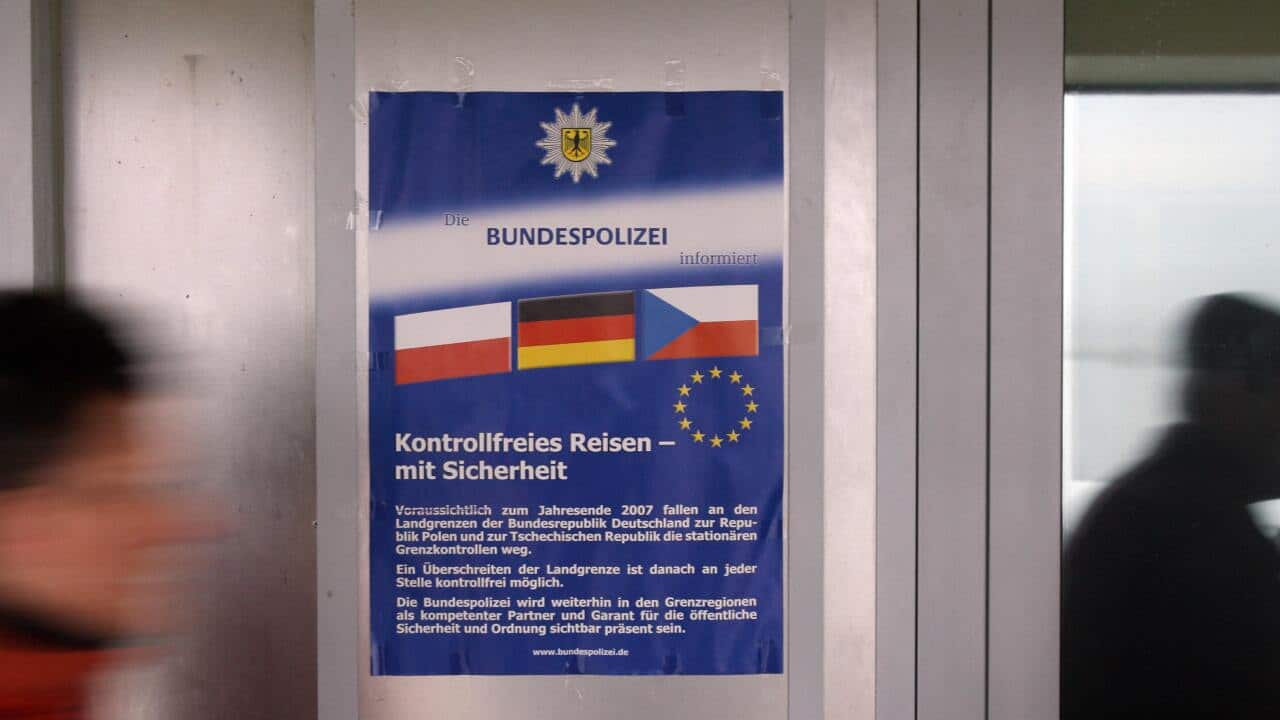
Schengen had enabled citizens of 26 European countries to move freely through other member countries since 1995.
But Germany's decision to intensify passport checks on its border with Austria has been seen by some as the beginning of the end of "border-free" travel in Europe.
Speaking from Vienna, SBS Correspondent Kerry Skyring said the border controls were primarily an attempt to slow the numbers of people moving across Europe.
But he said they were also a warning to the countries who were unwilling to take refugees.
"Part of what the countries like Germany and Austria are trying to do is slow down the flow, so they can catch up with accommodation and processing," he said.
"The other point is to send a message to other European Union countries (about) the consequences of not all European countries pulling their weight in terms of taking refugees.
"That seems to be the signal of German Chancellor Angela Merkel ... a loss of this freedom of movement across borders that Europe has enjoyed."
At its core was a commitment to free movement, upheld as a basic human right.
The Schengen agreement, named after the small village in Luxembourg where it was first signed, came into full effect in 1995.
It eliminated passport and immigration controls at the joint borders of Schengen states, allowing free travel for the citizens of those countries.
At its core was a commitment to free movement, upheld as a basic human right.
Dean of Murdoch University's Law school, Professor Jurgen Brohmer said Schengen was a revolutionary agreement.
And he believed there was little to suggest it was failing.
"I think that's a bit ludicrous," Professor Brohmer said.
"Because if you look at the whole Schengen legal framework it does of course, contain exceptions."
"Legally (it did) foresee the possibility of situations where for limited periods of time, to secure public security, member states can react, and on a temporary basis reinstitute border controls."
The EU had been struggling to reach agreement on what do with the thousands of people arriving in Italy, Greece and Hungary every week.
The Czech Republic, Slovakia and Hungary opposed proposals for a mass relocation.
Hungary took a particularly hardline stance, sealing its border with Serbia with a fence, and introducing new laws making illegal entry punishable by up to three years in prison.
Sealing borders 'not the solution'
European Commission Vice President Frans Timmermans said sealing borders was not the solution.
"To say 'Let's shut all the borders and keep everybody out' is unrealistic, populistic and simply impossible," Mr Timmermans said.
"To say, 'Let's open all the borders and let everybody in' is equally unrealistic because it would seriously harm the European social model," he added.
The former Prime Minister Tony Abbott had said that Australia was not facing a crisis like Europe's, because the Australian government had "stopped the boats".
But International Law Professor, Jurgen Brohmer said the sheer numbers seen in Europe made that impractical.
"They are just overwhelmed, and hence that external border regime does not work," Professor Brohmer said.
"Just as the stopping of the boats policy of the Australian government probably wouldn't work if there was a major civil war in Indonesia and millions made their way across the little bit of water between Indonesia and Northern Australia," he said.
But Professor Brohmer said, in the end, policy solutions would only have limited impact.
"If the water rises too high then the dam won't protect you and I think that is, in essence what we will be looking at," he said.

Share


