(Transcript from SBS World News Radio)
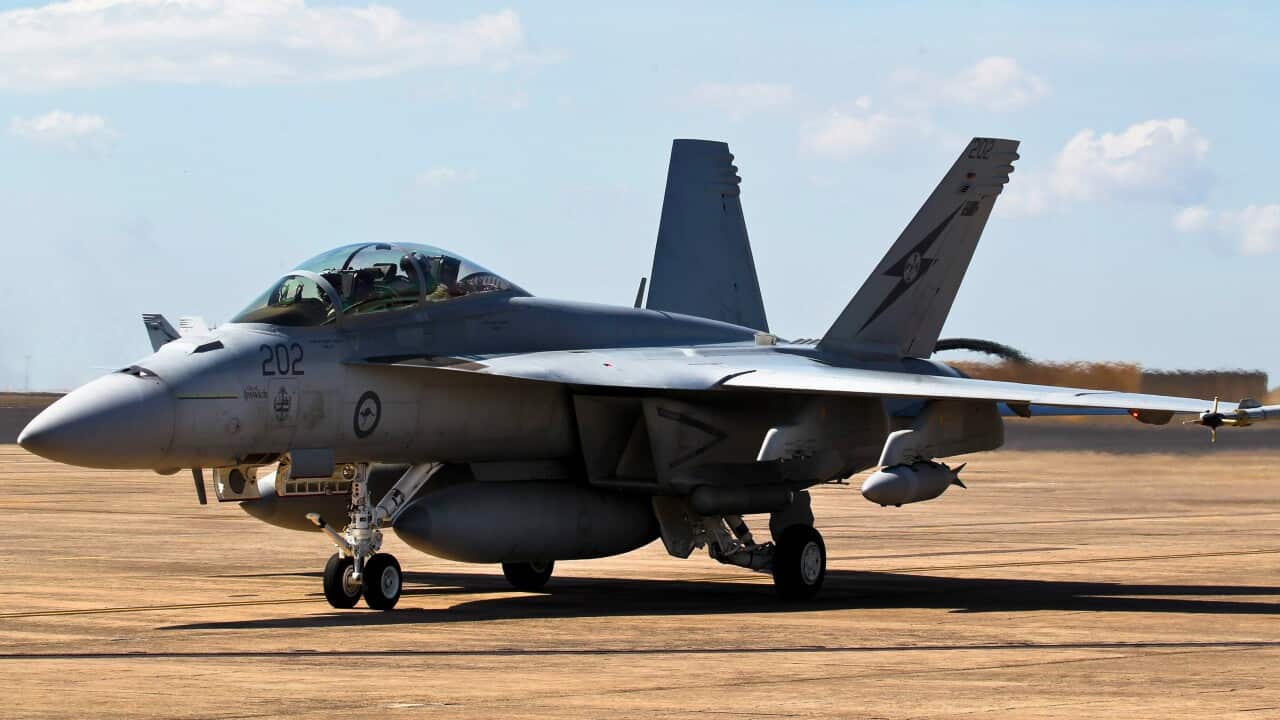
Some observers believe that by joining the US-led international coalition in Iraq, Australia could be risking its own security.
They say Australia could be increasing the likelihood of a terrorist attack at home - or against Australian travellers.
Jessica Minshall reports.
(Click on the audio tab above to hear the full report)
News that makes sense
Your trusted source for staying up-to-date with the world around you. Get free daily news updates and analysis, straight to your inbox.
The decision to send a military force to help fight the Islamic State group in Iraq is not without its supporters.
Peter Leahy is a former Australian Army Chief, now a professor with the University of Canberra's National Security Institute.
He acknowledges there are risks for Australia in getting involved in Iraq.
But he says it's necessary to help tackle Islamic State, also known as ISIS, especially with regional help.
"I think success in this case is that ISIS is stopped. That they're not allowed, not able to continue with their advances. Beyond that I think success is the involvement of regional countries. I'd like to see them taking action on the ground and in the air to resolve a regional problem. And frankly, they're the only ones that can deal with this radical Islamist ideology."
Dr John Blaxland is from the Strategic and Defence Studies Centre at the Australian National University.
He agrees that countries neighbouring Iraq and Syria need to become more involved in the fight against Islamic State.
"Part of the reason for that is that the very neighbouring states that are the ones most affected directly, that most have a stake are only tepid in their support. They're not really wanting to put their shoulder to the wheel on this problem. And unless they do, and until they do, this problem will continue to be perpetuated."
Dr Blaxland questions the amount of planning that has gone into the decision by Australia to get involved in military action in Iraq.
"We are responding effectively to the beheading of two Americans and a Brit. There's been tens of thousands of people die in Iraq and Syria and neighbouring countries that have not been the trigger for this kind of intervention."
And Dr Blaxland is concerned that Australia could be spreading its limited military resources too thinly by committing the Australian Defence Force to the conflict with Islamic State.
"The ADF is actually not very capable of a number of crises at the one time. It can do it, but it's a real stretch and it means that if Australia is going to get more involved in the Middle East then, chances are that if something happens closer to home it will be very difficult to respond appropriately."
Greg Fealy is an Associate Professor with the ANU's College of Asia and the Pacific.
He believes Australia is facing a danger from Indonesians who have fought with Islamic State.
"We know there are lots of small, very inexperienced jihadist groups that are springing up in Indonesia. You only need one or two quite experienced people who have battlefield experience, who've been trained in bomb-making and in running covert operations and you could suddenly and dramatically lift the capacity of those jihadist groups in Indonesia."
Professor Fealy believes it's very unlikely an Indonesian extremist group would launch an attack within Australia.
But he says there could be more attacks on foreigners visiting Indonesia - and Australians could be seen as a particular target because of the military involvement in Iraq.
"It really is a very polarised view of the world that jihadists have and they would tend to see any country which is devoting military resources to the struggle which is launching attacks on jihadists. Even if they agree with the Islamic State itself, they may be inclined to regard this as something they have to oppose because it is viewed as non-Muslims attacking Muslims."







