In Brief
- Pauline Hanson says Australia's migration issues began when the White Australia policy was dismantled.
- Experts say any push to revive parts of the abandoned policy would be difficult in a modern Australia.
One Nation leader Pauline Hanson has sparked a new discussion about the resurgence of a 'White Australia' policy — a controversial series of laws that discriminated against non-European migrants.
Hanson, during an appearance on a podcast with the British far-right, anti-immigration activist and convicted criminal Tommy Robinson last week, suggested that scrapping the White Australia policy was the root cause of apparent migration issues in Australia.
"It started in 1973 with Gough Whitlam, so they opened up and got rid of the White Australia policy, then they started bringing in the different migrants," she said.
She's since insisted that she doesn't support the policy, but a new wave of anti-immigration sentiment has sparked questions about whether Australia risks reviving aspects of it.
What was the White Australia policy?
News that makes sense
Your trusted source for staying up-to-date with the world around you. Get free daily news updates and analysis, straight to your inbox.
White Australia wasn't a single policy, but a series of laws that limited non-British migration to Australia.
"It essentially believed that Australia needed to be a homogenous white culture," Benjamin T Jones, an Australian political history expert, told SBS News.
"It prioritised immigration, especially from white British settlers, who they believed would integrate best into an Australian society."
It began with the Immigration Restriction Act 1901, which included a dictation test of 50 words in any European language, which became the way certain people ended up being excluded from Australia.
"You were never intended to pass it. It's a test that was designed to be failed," Mark Cully, the author of a new book on Australia's immigration economic history, told SBS News.
Even after the test was removed, it remained difficult for those who weren't European or North American to obtain permits to Australia, Cully says, and they were effectively excluded from applying for permanent residence.
The end of the White Australia policy began under Harold Holt in the 1960s, and it was dismantled under the Whitlam government in 1975, when the Racial Discrimination Act was passed, making it illegal to "offend, insult, humiliate or intimidate" someone because of their race.
"It's kind of astonishing in some ways that that policy, which is so ingrained and normalised and seen by many Australians as uncontroversial for 60 odd years, was then unwound, roughly over a decade," Cully said.
"Since then, we've had the embrace of multiculturalism. Australia and Canada really stand out across the world as being exemplar countries for welcoming migrants from anywhere in the world and doing it in a fairly objective and considered and non-discriminatory way."
Does One Nation support a White Australia policy?
Hanson has since clarified her remarks, saying she doesn't support the White Australia policy.
"Never, ever have I advocated that, and I don't believe in that," she said in a video posted to social media over the weekend.
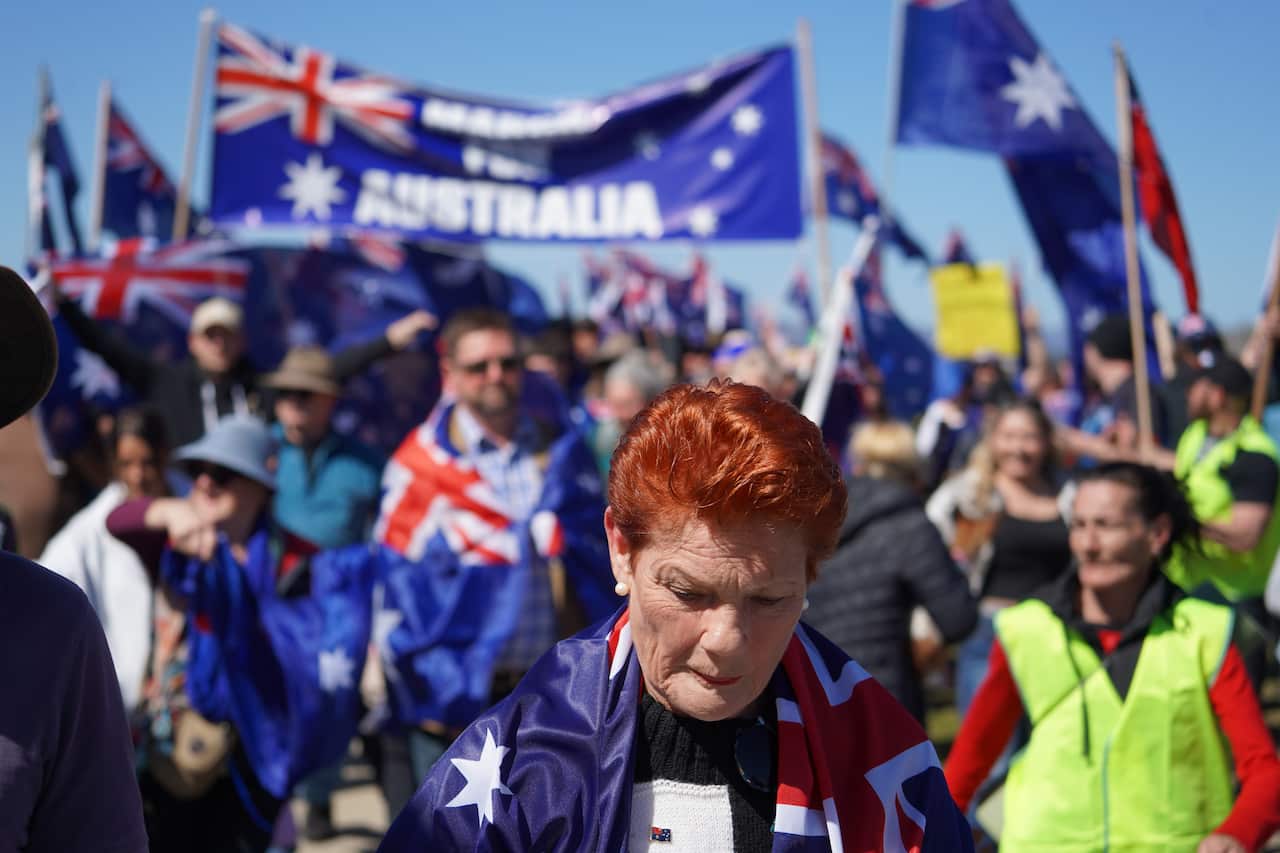
One Nation MP Barnaby Joyce said the party does not support the White Australia policy, but it did not want to replicate "social fissures" he said were happening in the United Kingdom, such as people not speaking English in councils and an "evolvement of a culture" that was not English.
Asked on Channel 7's Spotlight program on Sunday what she thought of the concept of mass deportations in Australia, Hanson replied: "I love it." One Nation's policy is to deport 75,000 illegal migrants.
One Nation, though, does want to exclude some Muslims from Australia. Hanson has advocated for a ban on immigrants from some Muslim-majority countries, adding she's concerned about "radical Islamic ideologies". She has not specified a list of which countries.
In her maiden Senate speech in 2016, she said, without evidence, that Australia was "in danger of being swamped by Muslims, who bear a culture and ideology that is incompatible with our own".
Are White Australia ideals reemerging?
Earlier this year, Opposition leader Angus Taylor vowed to change Australia's non-discriminatory immigration program by "discriminating based on values" — through a binding Australian values test.
He said immigration "standards have been too low", claiming that migrants from liberal democracies are more likely to subscribe to Australian values compared to those migrating from places "ruled by fundamentalists, extremists and dictators".
At the time, the Greens accused Taylor of trying to revive the White Australia policy. Taylor says the policy does not discriminate based on race, religion, or nationality.
Demographer Liz Allen said the spectre of the White Australia policy still looms over Australia — for example, in immigration tests, and the fact that Australia's public holidays don't reflect a multicultural nation.
"Australia is stuck in the past, and we still have this looming rhetoric that Australia is a white country, even though we have a Blak history, and the nation is geographically in the Asian region," she said.
She believes at the heart of the debate is the fact 'Australian values' aren't officially defined.
"We have been so afraid of not fitting in and so desiring of assimilation in this country throughout our history, that we've never ever sat down as a nation and had an earnest reflection on what it means to be Australian and what is Australian identity," she told SBS News.
Cully says reverting to a White Australia policy would seem "almost impossible" given the decades of legal and administrative changes around universal visa entry.
"I can't see politically there's any chance that there could be changes to the kind of fundamentals of Australian immigration that would allow us to return to excluding people by virtue of their country of birth, or their ethnicity, or their religious faith."
Jones said Australia had a history of racism against new migrant groups, which then settles down as the group, too, settles in.
"There tends to be a pattern that over the decades, people see the reality that from whatever country these migrants come from, they invest in Australia, they raise their children here, they contribute to the economy, and you know, in some cases, they go on and play for the Socceroos," he said.
"Especially in an electoral system like ours where voting is compulsory, it's going to be very difficult for One Nation to make much political traction on what I see as a ridiculous proposal that ending White Australia somehow hurt the country, when it has objectively had so many benefits."
Prime Minister Anthony Albanese said it wasn't just a Labor government responsible for moving Australia away from the White Australia policy, but had been a bipartisan approach.
"Modern Australia is made up of, with the exception of First Nations people, people who've come from all over the world to make Australia their home, to have a better life for themselves, but importantly for their children and grandchildren, generations to come," he said on Saturday.
For the latest from SBS News, download our app and subscribe to our newsletter.







