
Most people know, instinctively, whether they are morning people or evening people. Some are hit with a wave of dread whenever they hear a stranger’s iPhone clanging out the same ringtone as their morning alarm. Others can be found yawning into their second beer at 10 p.m. on a Friday. (For those who aren’t sure, countless online questionnaires can tell you whether you should be catching the worm or not.)
Our chronotypes are largely a function of when our bodies start and stop producing melatonin, the sleepiness hormone. Elementary and middle schoolers tend to be early risers, but productivity begins to shift to later in the day as people enter their teens and early 20s. Over time, the body slowly returns to its early-bird state. By the time we’re senior citizens, we’re back up and at Denny’s before 7. Most research suggests that people perform best on various tasks at their “optimal” time of day. The brain is sharper, it’s thought, when the body is fully awake.
At the “wrong” time of day, inhibitions are down and stray thoughts run amok.
But it turns out there are some tasks that benefit from a mind that’s slightly groggy. In 2011, Mareike Wieth, an associate professor of psychology at Albion University, invited about 428 students to take a series of tests in her lab at either 8:30 a.m. or 4 p.m. She first gave them the Morningness-Eveningness Questionnaire, and consistent with general trends in age and wakefulness, there were only 28 morning people among them. The participants then tried to solve several problems. Some of these were analytical, like math problems you might see on the SAT. (One example: “Bob’s father is 3 times as old as Bob. They were both born in October. 4 years ago, he was 4 times older. How old are Bob and his father?”) Others were insight-based, characterized by a problem that seems unsolvable until an “aha” moment dawns. (“A dealer in antique coins got an offer to buy a beautiful bronze coin. The coin had an emperor’s head on one side and the date 544 BC stamped on the other. The dealer examined the coin, but instead of buying it, he called the police. Why?”)
People can use this mind hack to their advantage by, say, scheduling time for creative writing in the mornings, if they’re an evening person, or doing some brainstorming late at night, if they’re usually up at dawn.
The time of day had no impact on the subjects’ ability to solve the analytical problem. But when it came to the insight problem, the participants did better at the time of day when they were less awake. The night owls solved more riddles at 8 a.m., and vice-versa. Having to perform when they were more tired, in other words, gave the subjects about a 20 percent boost.
Problem Solving by Time of Day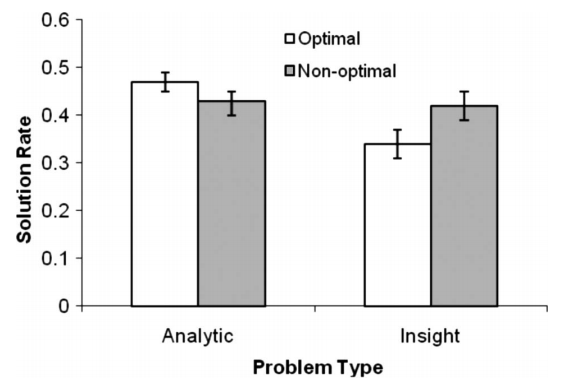 Percent correct by problem type and time of day (Thinking and Reasoning)
The reason might be that solving difficult puzzles often requires overcoming an impasse—which in turn hinges on seeing a problem from a new perspective, Wieth wrote. At the “optimal” time of day, people are really great at focusing—sometimes too great.
“You’re screening out anything that's not relevant,” Wieth told me. “If you're in your office and there's noise, you can screen out everything else.”
Meanwhile, at the “wrong” time of day, inhibitions are down and stray thoughts run amok.
“You're having other random thoughts, like ‘I had a fight this morning,’ or ‘I have to pick up milk.’ That random thought can combine with your main thought and come up with something creative,” Wieth says. “At your optimal time of day, you're not going to have that random thought.”
That might sound far-fetched, but it meshes with other research showing that certain types of creativity flourish when the brain is foggy. A 2012 study (called, delightfully, “Uncorking the Muse”) found that people solved more creative problems when they were just a little bit drunk on a mixture of Smirnoff vodka and cranberry juice.
Wieth cautions that it’s still better to do most types of work at one’s optimal time of day (and, erm, sober.) But people can use this mind hack to their advantage by, say, scheduling time for creative writing in the mornings, if they’re an evening person, or doing some brainstorming late at night, if they’re usually up at dawn.
When it came to the insight problem, the participants did better at the time of day when they were less awake.
Her research made me wonder if we’ll ever be free from the awful societal prejudice against night owls. Wieth mentioned that she had no problem getting the students in the study to come in at 8 a.m. for a test, since even people whose natural bedtime is 1 a.m. are accustomed to being asked to attend early-morning activities, bright-eyed and bushy tailed. Meanwhile, when she tried to do a similar study with a group of older adults whose natural bedtimes were early, many refused to show up for a test that would take place in the evening.
With more companies adopting flexible work schedules, and some parents pushing for high school to start later, we may be seeing the twilight of morning-normativity.
This article was originally published on The Atlantic. Click here to view the original. © All rights reserved. Distributed by Tribune Content Agency.

Share


