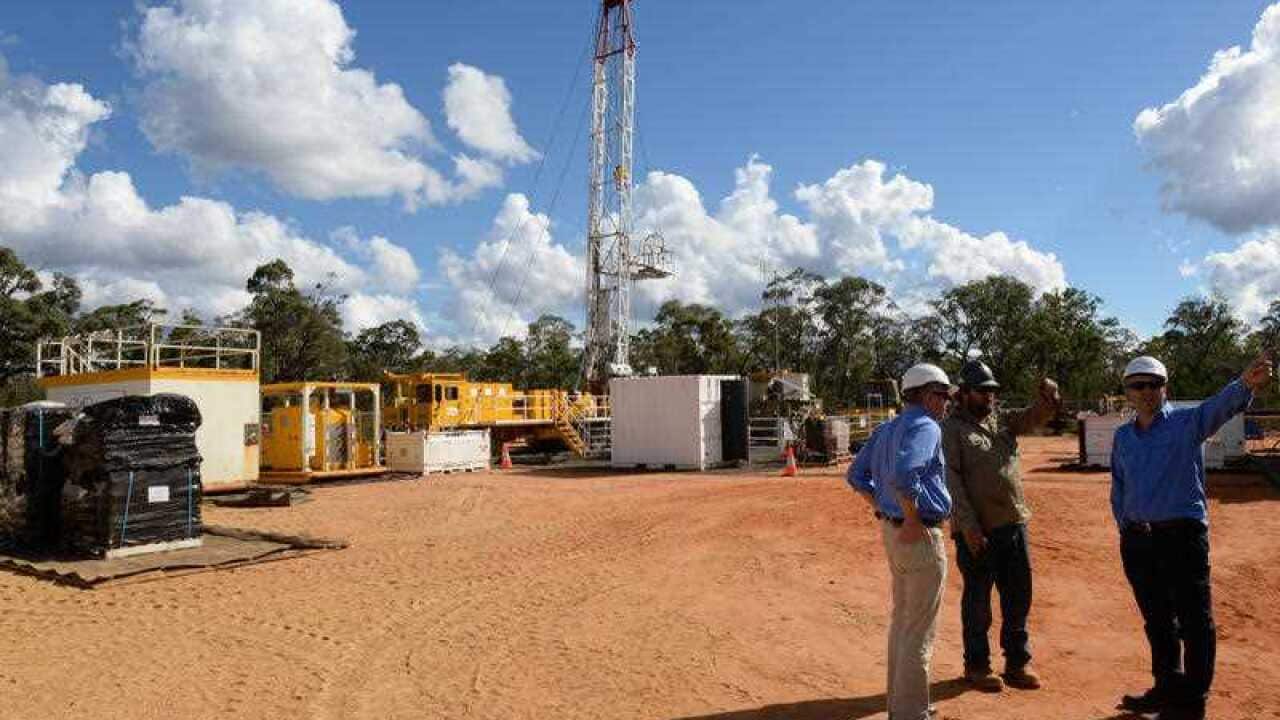
Coal seam gas extraction attracts widespread concern from communities, farmers and environmental groups, but the CSG industry says the practise is safe and sustainable.
Related: Where do the major state parties stand on coal seam gas?
Where are the CSG wells in NSW?
According to a database on the NSW Trade and Investment website, more than 90 production and pilot gas wells were producing gas in NSW in January 2015.
The first exploration hole was drilled in NSW in 1937, which is no longer active, according to the database.Most "production" wells in the government's database were hydraulically fractured, or “fracked”, to extract gas from coal seams.
Most pilot wells on the government's database, which are drilled to test the financial viability of coal seam gas deposits, were not fracked.
Two CSG wells first drilled in 1999 are still producing gas. Gas wells are plugged and abandoned at the end of their use. The steel and cement-lined wells are filled in with cement in stages.The NSW government has a range of fact sheets about CSG wells here.
How is coal seam gas extracted?
Gas is extracted from coal seams by drilling down to the required depth, often through aquifers (water-bearing permeable rock). During the process the wells are lined with steel and cement.
Gas will flow to the surface when water is pumped out of a fractured coal seam, which releases the pressure.
In NSW the coal seams of most producing wells were fracked so gas can escape.
A mixture of sand, water and chemicals is used in fracking.
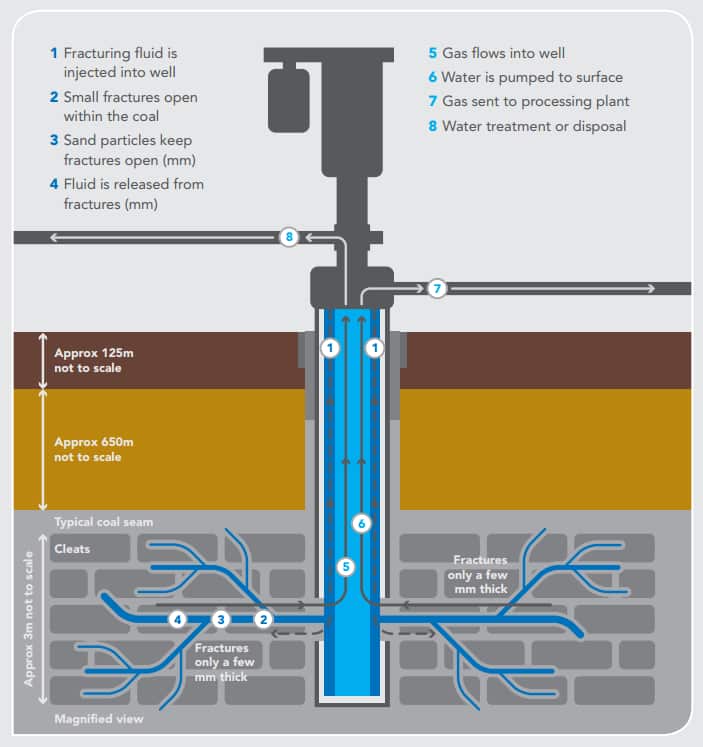
This diagram and other information from the NSW government website.
The water creates pressure while the sand fills gaps, allowing gas to escape when water is pumped back out.
The first fracking in NSW occurred near the town of Appin in 1981, the government's database says.
Once the drilling and fracking is complete, the drilling rig used to create the well is removed and the water used in fracking is placed in storage tanks or dams.Increasingly, horizontal drilling is used to harvest CSG. Drilling into coal seams sideways provides a well to extract the gas without drilling down vertically, which makes the wells more productive.
Sometimes, coal seams are naturally fractured and hydraulic fracking is not needed.
While land-holders own their top soil, the resources underground belongs to the state.
Companies wishing to access those resources pay royalties to the state and must negotiate land access agreements with land-holders.
What are the concerns?
Anti-CSG group Lock The Gate (LTG) has a range of concerns about the CSG industry. The group started when land holders refused to negotiate access to companies exploring fossil fuel deposits underground.
LTG NSW Spokesperson Georgina Woods said concerns included the process of fracking, the integrity of aquifers and ground water and the well-being of people who live nearby.
"It's an unsafe industry," Ms Woods said.
"It's not worth risking people's health and water for the small benefit that it brings."
Extracting gas from coal seams requires the use of large amounts of water, and some farmers are concerned this will affect their access to water allocations.
Meg Neilsen, a farmer from the Northern Rivers region in NSW, said coal seam gas was not as important as food and water.
"The destruction of farm land for coal and gas must stop," Ms Neilsen said.
"The food security of Australia is at stake."
Another concern is the potential for the contamination of aquifers and water supplies due to the chemicals used in the fracking process.
The health effects of leaking gas on people who live nearby is another concern. Exposure to methane is known to sometimes cause headaches, which people in Queensland and Camden in NSW have reported, however the link with CSG wells is disputed.
Last year, the NSW Valuer General told ABC that CSG developments might affect land sales in the Hunter Valley, but said a longer term investigation was needed since a recent probe had been inconclusive.
A Queensland government report about the effects of CSG could not draw a clear link with health complaints, but recommended a community reference group be established to respond to community concerns.
Other concerns are leaking methane contributing to greenhouse gas emissions and the perceived potential for leaking gas to ignite.
Long term effects 'unknown'
A recommendation from the 19-month Independent Review of Coal Seam Gas Activities in NSW was to establish a standing expert advisory body on CSG, to further investigate the effects of CSG in NSW and to commission further research.
The long term effects of CSG wells were unknown, Sara Bice from the University of Melbourne School of Government said.
She said the reason communities sometimes reacted adversely to coal seam gas was a fear of the unknown.
“If we look at the scientific data, it remains inconclusive,” Ms Bice said.
She said the long-term impacts of a "botched project" were yet-to-be-seen.
Professor Mike Sandiford, a geologist from the University of Melbourne, said a common concern was for gas and co-produced non-potable water to leak outside well casings or, as a result of fracking, into aquifers used for irrigation and other purposes.
Despite that concern, companies had a substantial amount of control over what goes on underground during the process, he said.
“Are companies able to control what goes on underground? To a large extent they are, but there will be accidents.”
Fears around coal seam gas wells were often overblown, Prof Sandiford said.
However, the future impacts of CSG wells was a concern for farmers, he said.
“Will [CSG wells] present some problems in the future? In 10 years, certainly not, but in a 100 years, very hard to say,” Prof Sandiford said.
The CSG industry’s perspective
AGL operates most of the producing CSG wells in NSW. Roughly half are listed as operated by Sydney Gas Ltd, which AGL acquired last decade.
A spokesperson for AGL Energy said the company believed it could safely extract coal seam gas without having an adverse impact on the environment.
Santos, which currently does not operate producing gas wells in NSW, has proposed a CSG development in the state - the controversial Narrabri Gas Project.
Last year the NSW government named the project a ‘Strategic Energy Project’, with a streamlined approvals process. In return Santos agreed to provide a high-quality environmental assessment and comprehensive community consultation.
Santos says the Narrabri project could deliver gas without negatively affecting the community, the company's Manager of Energy NSW, Peter Mitchley, said. The project would not involve fracking, since the coal seam has a naturally-occurring fracture, Mr Mitchley said.
On its website Santos says it uses at least two layers of steel and cement in its wells across the Great Artesian Basin, which includes NSW and Queensland.
Chief operating officer of CSG well monitoring company Well Dog, James Walker, said his company monitored a handful of wells in NSW, and many more in Queensland, where wells number in their thousands.
He said coal seam gas wells were well-designed and the danger of gas leaking into aquifers was minimal.
The Australian Petroleum Production & Exploration Association says fracking is safe, and provides a list of chemicals commonly used in the fracking process.
Recent research findings
Last year, the CSIRO surveyed a number of wells in Queensland and NSW.
It found all the tested producing wells leaked small amounts of gas, although leakage was low compared to wells’ gas production. It found no evidence of gas leaking outside well casings.
In September last year, NSW Chief Scientist and Engineer Professor Mary O’Kane delivered a report to Premier Mike Baird, after a comprehensive, 19-month review into the state’s CSG industry.
The report found coal seam gas could pose risks, but those could be controlled through proper management. Professor O’Kane said implementing the recommendations of the report would not be trivial.
SBS asked the NSW government about its progress on those recommendations, which the government had begun to implement, a spokesperson said.
"In implementing recommendation 5, the Government has placed a freeze on the granting of new [petroleum exploration licences] until the new Strategic Release Framework is in place," the spokesperson said.
"The Government will develop a plan to manage legacy matters and ensure no new matters are created through revised industry codes of practice and licence conditions.
"The Government agrees that regulation of the gas industry should be undertaken on a full cost recovery basis and will aim for this over time."
While Australia's communities are concerned about the effects of CSG, and the industry insists CSG wells are safe, the long term effects are unknown. The integrity of aquifers and the ability of plugged and abandoned wells to remain safe in a century from now are untested.