(Click on the audio tab above to hear the full report)
United States-led airstrikes are targeting facilities and personnel belonging to two key jihadist groups in the Middle East.
One of them, the so-called Islamic State, is now well-known.
The other, known as Khorasan, less so.
Prior to this week, few were aware of this shadowy group or of its mandate to strike Western targets.
News that makes sense
Your trusted source for staying up-to-date with the world around you. Get free daily news updates and analysis, straight to your inbox.
Darren Mara examines the al-Qaeda offshoot.
(Click on the audio tab above to hear the full report)
United States President Barack Obama announced the US wasn't only targeting Islamic State in its re-engagement in the Middle East.
"Last night we also took strikes to disrupt plotting against the United States and our allies by seasoned al-Qaeda operatives in Syria known as the Khorasan Group. Once again it must be clear to anyone who would plot against America and try to do Americans harm that we will not tolerate safe havens for terrorists who threaten our people."
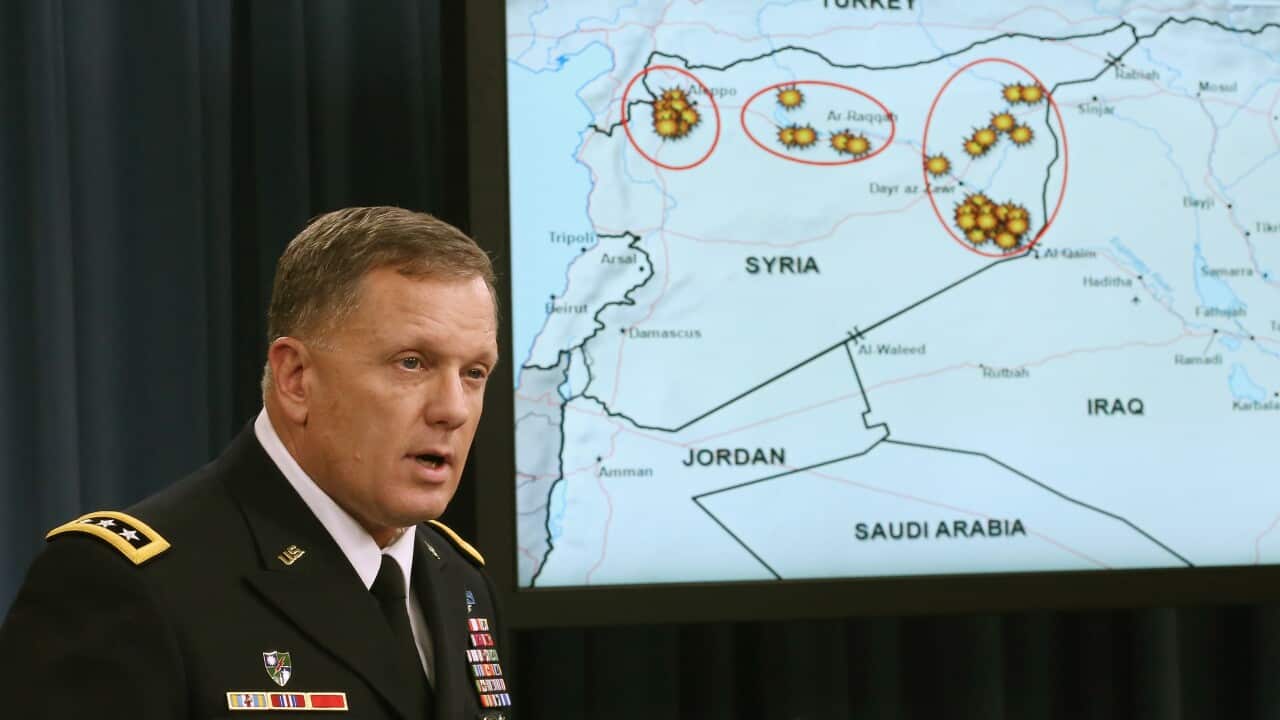
The unilateral American action in the northwest of Syria - in the form of more than 40 Tomahawk missiles fired from naval ships in the Gulf and Red Sea - pounded the Khorasan jihadists.
The action west of Aleppo was clearly separate to strikes against Islamic State targets elsewhere in the region.
It's an indication of the attention Khorasan is garnering among concerned Western governments, particularly the US.
American officials say despite its base in Syria, the al-Qaeda affiliate is not focused on advancing its cause in the country.
Its chief aim, according to US Lieutenant General William Mayville, is to advance attacks against Western targets.
"The Khorasan group is clearly not focused either on the Assad regime or the Syrian people. They are establishing routes in Syria in order to advance attacks against the West and the homeland."
Analysts believe the Khorasan group includes core al-Qaeda operatives from countries such as Afghanistan and Pakistan who've made their way to Syria.
The US says it also includes elements of al-Qaeda in Iraq and the al-Nusra Front as well as recruits from across North Africa.
Khorasan's leader has been identified as Kuwait-born Muhsin al-Fadhli - known as a senior al-Qaeda facilitator and financier.
Professor Amin Saikal is director of the Centre for Arab and Islamic Studies at the Australian National University.
"We do not know a great deal about him apart from the fact that he's been affiliated with al-Qaeda and the Americans have identified him or known about him for some time and they have put a $7 million price on his head."
Professor Greg Barton is national director of the Global Terrorism Research Centre at Monash University.
He believes Muhsin al-Fadhli spent considerable time living in Iran under uncertain circumstances.
Khorasan is the name of a district in Iran and is a Persian word, translated roughly as Land of the Rising Sun.
It's been used historically to suggest Islamic empire.
Professor Barton says while the Khorasan name is new to terrorism and security analysts, the people behind the group are not.
"This is al-Qaeda. It's obviously a bit of corporate rebranding. In many ways, al-Qaeda does operate as a corporation, to some extent as a franchise corporation. But it is accutely aware of its need to win support globally and try and get local causes to come on board with their global vision. It has a global vision. And I think, frankly, they feel they've been outplayed by Islamic State and they're desperate to try and get back and get some of the limelight."
Analysts describe Khorasan as an extremist Sunni Salafist group not dissimilar to Islamic State in their world view.
IS has announced its intention of establishing an Islamic caliphate in the Middle East, whilst the US says Khorasan's attention is fixed on attacking the West.
But Professor Barton says IS could be moving closer to Khorasan in this regard.
IS has recently encouraged homegrown extremists to pick up arms and strike Western countries.
But Khorasan, Greg Barton says, is still ahead in its capacity to carry out these foreign attacks.
"Khorasan group - being the al-Qaeda 'A' team - has the advantage in having likely superior technology, which is something we don't think IS has and they have a much longer presence of doing these foreign attacks. But they're actually not so very different. The difference of course is that al-Qaeda hasn't succeeded in controlling territory, even in Afghanistan. It was always a guest, often unwelcome, of the Taliban. Islamic State has embarrassed it by forming a state and declaring itself a caliphate."
Despite this, Professor Barton says Khorasan's goal in the north-west of Syria is not to control more territory.
He says the group set up in Syria because it's currently the hotbed of jihadism in the Middle East.
"It's in a space where Jabaat al-Nusra, which is an al-Qaeda affiliate, has been strong, so presumably they're depending on al-Nusra to get some cover. It would seem they were figuring they could get some cover, work with al-Nusra, make al-Nusra stronger, have a safe haven where al-Nusra controlled ground and probably focus on attacks outside the region."
So why has the US decided to strike Khorasan now?
Well, it says Khorasan is trying to perfect undetectable explosive devices that can be hidden in clothing, electrical devices, or small non-metallic objects.
The US government says the group was plotting an imminent attack on Western targets and striking now was the only way to prevent it.
The airstrikes hit the group's training camps, an explosives and munitions production site, a communication building and a command and control centre.
The UK-based Syrian Observatory for Human Rights says about 50 al-Qaeda militants - presumably linked to Khorasan - were killed in the attacks.
Professor Barton says the US has been flying surveillance missions over Syria for over a month and it's likely targets were detected that the US military felt it could strike.
The US says it's confident it's been able to disrupt Khorasan's capabilities.
Professor Amin Saikal from ANU says it's possible the group may also have Australian targets in sight.
"Because Australia is a participant in this coalition of concerned, and has deployed forces in the region with the intention of participating in the air campaign against the Islamic State militants in Iraq, Australia would automatically be regarded by these radical, violent groups as a target."







