

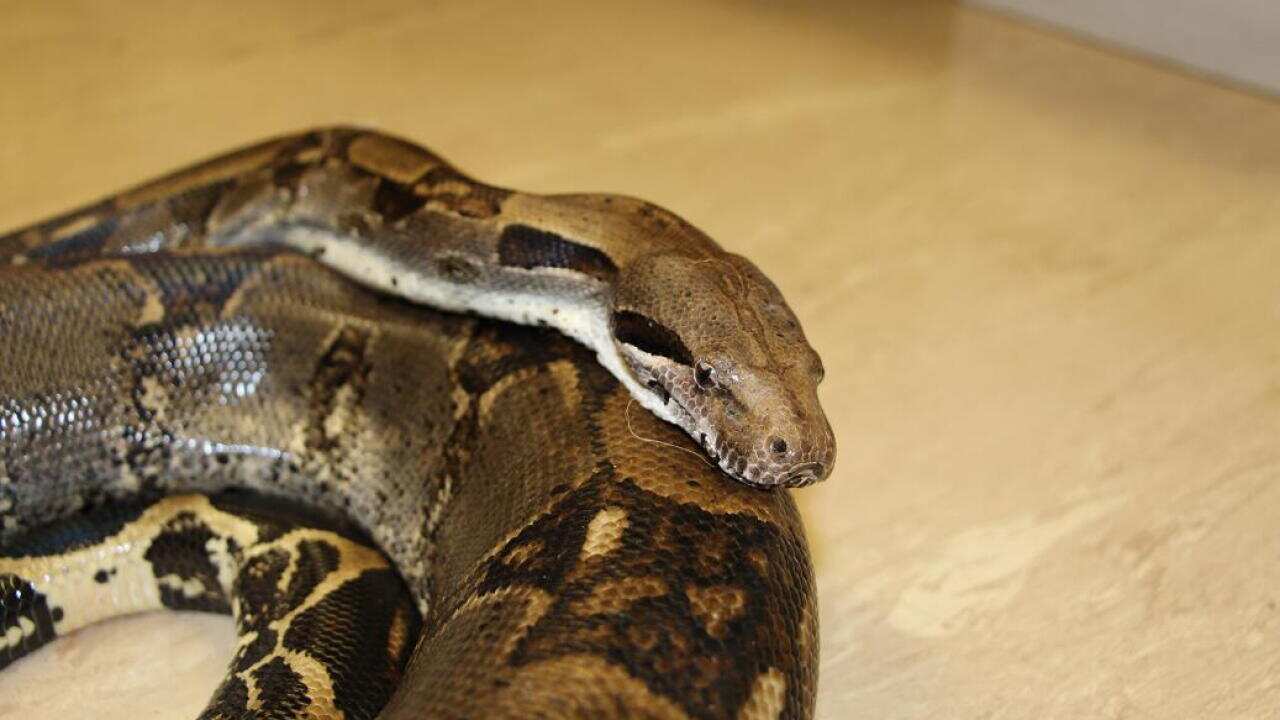
Monster snakes move in on an idyllic beachside community, and before too long they're eating family pets and terrorising small children.
It reads like the plot for a bad Hollywood movie, but authorities say it's not outside the realm of possibility on the Gold Coast.
A dozen biosecurity officers have spent a week combing bushland at The Spit for a predatory South American boa constrictor, unwittingly released by police who believed it was a harmless native python.
The snake, which could grow up to 4m long and weigh more than 40kg, was found in late March at the base of a tree on a footpath in busy Surfers Paradise.
Well-meaning police sent the 2m specimen into the bush, but an ensuing media story quickly alerted authorities that an illegal, exotic pest had been set free.
News that makes sense
Your trusted source for staying up-to-date with the world around you. Get free daily news updates and analysis, straight to your inbox.
Authorities say the animal would have been brought into Australia as part of the black market trade in pets.
The trade is alive and well in Queensland, and while it's improbable the missing snake could find a mate in the Gold Coast scrub, it's not impossible.
"There is a black market trade in illegal reptiles and these snakes are smuggled in either as eggs or as live snakes," says Duncan Swan, of Biosecurity Queensland.
"Boa constrictors and American corn snakes are the two main reptiles we see in the illegal snake trade. We find these snakes maybe once year. It's not common but we do see them."
That helps explain the panicked search for the most recent specimen.
No one wants it meeting others that might have escaped or been dumped when they became too big, or too difficult, to keep.
"Hopefully it can't breed, but the reality is the more these snakes are out there, the more potential there is that they could establish a population," Mr Duncan says.
He points to the US state of Florida to demonstrate the dangers.
"Florida has a very similar environment to southeast Queensland, and over there they don't have the legal controls we have," he says.
"They have 47 exotic reptiles established in the wild there, which is causing huge environmental harm. We're very focused on trying to prevent that from happening here."
There are also concerns about what diseases the snake could be carrying that could take hold in native animal populations.
So exactly how does one search for a fugitive snake in dense bushland? Slowly and laboriously, it seems.
For the past week, a dozen biosecurity officers have been carrying out line searches at The Spit, hoping to flush out the boa constrictor. They've even resorted to using a thermal imager.
Officers were reviewing the search effort at a meeting on Tuesday.
"That's the challenge, isn't it. We can't put resources into this indefinitely," Mr Swan says.
Anyone who keeps illegal snakes such as boa constrictors risks a maximum fine of $90,000.