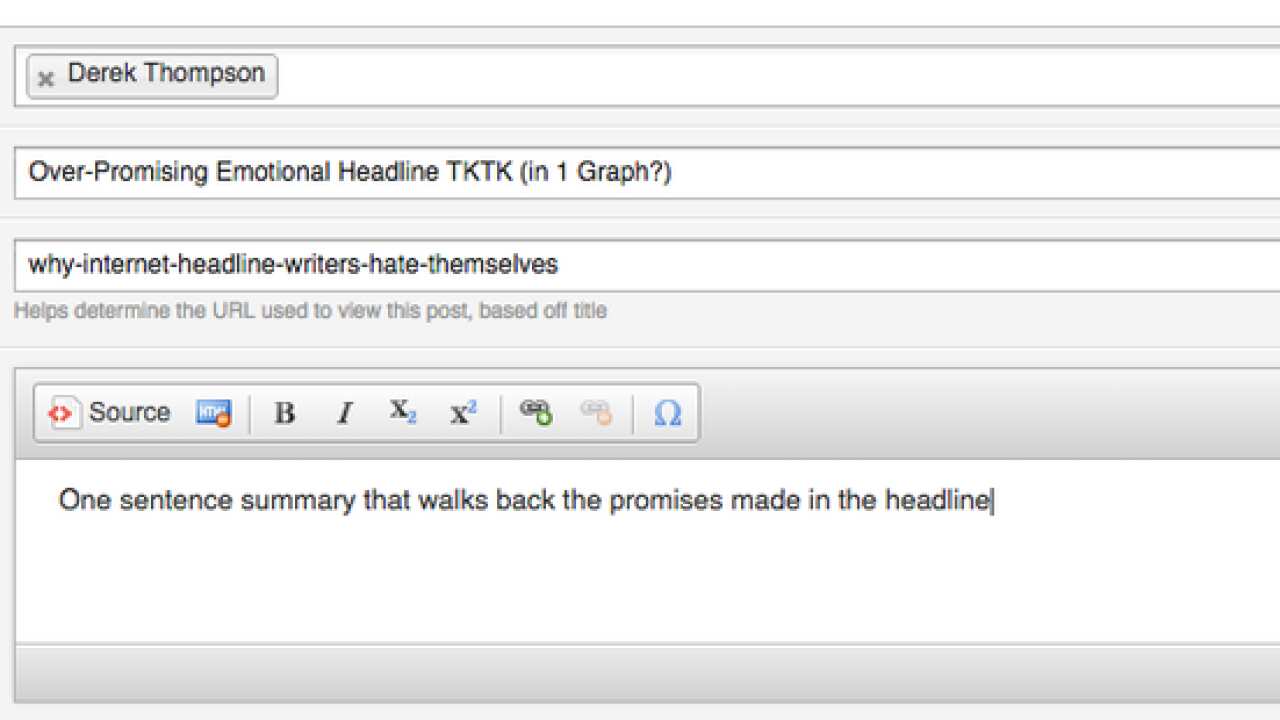
It is my job to read the Internet, and that makes me weird.
Most people are not paid to follow, study, and theorize about web journalism like an anthropologist studying gorilla polygyny, but I am. Although this makes me fortunate in many ways, it also makes my experience of the Internet qualitatively different from the average person's. Along with other digital journalists who are paid to plug into Twitter like it's the Matrix, we see what headline strategies are successful, identify their tendencies, copy them without hesitation, and then blush at their ubiquity faster than most readers even notice that something is happening.
This is how you get headline tropes that multiply like viruses across the News Feed of your life:
- "Everything You Need to Know about [A]"
- "What [B] Tells Us About [C]"
- "The Amazing Truth About [D] in 1 (or 100) Graph(s)"
- "A Celebrity You Already Like Had the Perfect Response to [E]"
- "One Tweet Explains [F]"
- "[G] Occurred. You Won't Believe What Happened Next"
These headline templates are everywhere. They are everywhere because they work. Then journalists (some of whom are directly responsible for their very ubiquity) become embarrassed at themselves for unleashing a flood of so-called perfect responses that are not in fact perfect and become self-loathing about the very thing they were instrumental in making.
"The Amazing Truth About [D] in 1 (or 100) Graph(s)"
As Adam Sternbergh writes in a marvelously clever takedown of the "Perfect Response" genre, "the notion of the Perfect Response recalls immediately The West Wing, a show that relied so heavily—and satisfyingly!—on Perfect Responses that you could classify it as a kind of pwn-porn." Yes, this trope is reductive, simplistic, and likely to entrench the prior opinion of its audience rather than challenge their assumption of an important issue. But what headline structure is optimal for engaging readers in such a way that their minds are prepared to be changed? I would submit: No headline structure! Changing somebody's mind with an article is somewhere between hard and impossible. Plus, Sternbergh only sees this construction as annoying, because he is paid to read so many of them. He is a journalist who has habituated much faster than his readership to these trends. (His job is to read the Internet, and that makes him weird.)
"Everything You Need to Know about [A]"
In many non-public industries, success is like hide-and-seek. Companies find an advantage—a secret sauce, like the Coca Cola formula or a Netflix algorithm—and guard its secrecy at all costs. But web journalism is a radically public business, where writers can see what headline tropes get retweets, which stories blow up on Facebook, and which companies finish the month with the most readers. This business isn't like hide-and-seek. It's like Sardines, the derivative game where one person hides (e.g., under the sink), everybody else tries to find and join them, and the last person who doesn't see the clump of people in the kitchen is the loser. That's web journalism. Ruthlessly maximizing audience means figuring out what's working—for you and for everybody like you—and doing it over and over.
Writers are caught between the commercial instinct to maximize attention to articles that they've spent lots of time writing and the aesthetic instinct to not hate every fiber of their very being after they write the headline and press the publish button. (I'm using web-specific jargon here, but that's not to discount the probability that this tension predates the Internet.)
This business isn't like hide-and-seek. It's like Sardines, the derivative game where one person hides (e.g., under the sink), everybody else tries to find and join them, and the last person who doesn't see the clump of people in the kitchen is the loser. That's web journalism.
Media critics are spot on that the most saccharine headline tropes often confirm readers' prior opinions with exaggerated headlines. But to prove that repetitive headline genres are actually harmful requires proving that there is a good reason to work hard on a story and then give it a headline that you suspect might limit its readership. For businesses in the audience-maximizing world, that's a hard case (but not impossible).
Media companies are desperately trying to get your attention and the headline tropes you see the most tend to be the headlines readers click the most. We are all in this together, one perpetual spin cycle of perfect responses, all-explaining graphs, and amazing truths, and you know exactly what's going to happen next.
This article was originally published on The Atlantic. Click here to view the original. © All rights reserved. Distributed by Tribune Content Agency.

Share


