
IN BRIEF
- Experts have warned Ebola cases as part of the current outbreak may be significantly undercounted.
- While there is no vaccine for the rare Bungibugyo strain, researchers say post-COVID technology could make development faster.
Fever, vomiting and severe diarrhoea are among the symptoms of the highly infectious and extremely deadly Ebola virus, which has claimed thousands of lives in a series of outbreaks in Africa since 1976.
The World Health Organization (WHO) has declared the Ebola outbreak currently unfolding in the Democratic Republic of the Congo (DRC) a global health emergency, amid fears the virus may already be spreading more widely than official figures suggest.
More than 130 people have died, and over 500 suspected cases have been identified since the outbreak was first detected in April.
But researchers now believe the true number of infections could be significantly higher, with modelling from the London-based MRC Centre for Global Infectious Disease Analysis suggesting there may already have been more than 1,000 cases.
News that makes sense
Your trusted source for staying up-to-date with the world around you. Get free daily news updates and analysis, straight to your inbox.
Professor Catherine Bennett, chair in epidemiology at Deakin University, told SBS News that the outbreak is particularly difficult to contain because it is unfolding in a conflict-affected region with damaged hospitals, large population movements and limited testing capacity.
"A high number of displaced people who are struggling to survive has made it challenging to provide care in the midst of a severe outbreak," Bennett said.
One confirmed death has also been recorded in neighbouring Uganda.
Australian National University associate professor Sanjaya Senanayake, an infectious diseases specialist, warned that the virus could have circulated undetected for "some weeks" before health authorities identified the first cases.
He said investigating the outbreak was especially difficult because it is unfolding in a remote region affected by conflict and instability.
"We still don't know what the index case was, so that is one big problem … We will only start to know the number of deaths as investigation teams get on the ground and look really closely at communities that have been infected," Senanayake said.
The World Health Organization's emergency declaration is designed to unlock funding, international support and medical resources as authorities try to slow the spread of the virus before it worsens.
Unlike previous major Ebola outbreaks, this one is being driven by the rare Bundibugyo strain, a form of the virus for which there is currently no approved vaccine.
It is a far rarer form of the virus than the better-known Zaire strain that caused the devastating West African Ebola epidemic between 2014 and 2016 that killed over 11,000 people.
Why health authorities are so concerned
Associate professor Paul Griffin, director of infectious diseases at the University of Queensland, told SBS News that several factors are making the current outbreak more dangerous than a typical Ebola flare-up.
"There are a few very concerning factors … There are already a number of cases in Uganda which are not necessarily related. We're seeing cases in densely populated areas, meaning it's certainly likely there are many more. We've seen healthcare worker cases, which tells us there have not been sufficient measures in place and health centres may actually be locations of amplification," he said.
Senanayake told SBS News that the DRC has successfully managed Ebola outbreaks in the past, and noted it is experienced in navigating the challenges associated with the disease's containment "despite being a developing country".
The virus appears to have circulated undetected for weeks before the first known case, a nurse in the country's east, was identified in late April.
By then, infections had likely already spread through communities and across provincial borders.
With the outbreak taking place in a region heavily affected by armed conflict and displacement, cross-border movement between the Congo, Uganda and South Sudan remains high.
Aid agencies have reportedly warned that overwhelmed health systems and poor sanitation conditions are increasing the risk of transmission.
The Red Cross has also raised concerns about funeral practices, which historically have played a major role in spreading Ebola because the virus can remain highly infectious after death.
Senanayake said traditional burials in this region usually involve very close contact with the bodies of the deceased.
"In previous Ebola outbreaks, a lot of mourners have been infected," he said.
"In the past, health authorities instituted dignified but safe burial measures, so those will have to be put in place as well."
What is the Bundibugyo strain, and why is it different?
Bundibugyo is one of six known species of the Ebola virus, and one of four capable of causing disease in humans, but it has only triggered two recorded outbreaks before now, in 2007 and 2012.
Because those outbreaks were relatively small, vaccine development was never prioritised in the same way it was for the Zaire strain, which has caused most major Ebola epidemics over the past 50 years.
That means there are currently no approved vaccines or targeted treatments specifically designed for Bundibugyo Ebola.
Griffin said existing Ebola vaccines work by targeting proteins on the virus' surface, and those proteins differ substantially between strains.
"We have really only seen a small number of outbreaks of this particular type of Ebola ... This is the one that is a little newer and a little rarer than some of the other more common types of Ebola that we have seen over a longer period of time," Griffin said.
Investigations are underway to determine whether vaccines developed for the Zaire strain may still offer some cross-protection, but there isn't enough evidence yet to know whether they will work effectively against Bundibugyo in humans.
Despite the lack of a vaccine, experts stressed to SBS News that the virus is far less transmissible than airborne diseases such as COVID-19 because it spreads through close contact with infected bodily fluids rather than through the air.
What are the symptoms of Ebola?
Ebola initially causes symptoms that can resemble other viral illnesses, including fever, headache, muscle pain, fatigue and weakness.
As the disease progresses, patients can develop severe vomiting and diarrhoea, dehydration and organ complications. Some patients also experience internal or external bleeding, although not all cases involve haemorrhaging.
The virus spreads through direct contact with infected blood or bodily fluids, including vomit and saliva, as well as contaminated surfaces and materials.
"In many ways, this strain is very similar to others, in that it starts off with very non-specific flu-like symptoms and sometimes some gastro symptoms and progresses into a more severe hemorrhagic fever where people bleed from basically everywhere," Griffin said.
Senanayake also said early diagnosis and supportive medical care can significantly improve survival rates.
Treatments such as intravenous fluids and intensive monitoring can help patients recover, but access to even basic healthcare remains limited in many affected areas.
Could a vaccine be developed quickly?
Researchers say advances in vaccine technology since the COVID-19 pandemic mean a new Ebola vaccine could potentially be developed faster than in previous outbreaks.
"Our ability to make vaccines for emerging pathogens has come a really long way … So with platform technology that is able to be adapted rapidly, we should be able to make a vaccine from scratch for something like this quite quickly," Griffin said.
But experts caution that producing and distributing a vaccine still requires significant funding, international coordination and clinical testing.
Scale and speed of this outbreak
Health authorities say they are increasingly concerned about both the pace of the outbreak and the possibility that the true number of infections is being underestimated.
This week, WHO director-general Tedros Adhanom Ghebreyesus said he was "deeply concerned" by the speed at which cases appear to be spreading, as suspected infections and deaths continue to rise.
The United States has also strengthened its travel advice for the region, urging Americans to avoid travel to the DRC, Uganda and South Sudan while the outbreak continues.
US officials say they will fund up to 50 Ebola response clinics in affected regions of the DRC and Uganda as part of efforts to contain the virus.
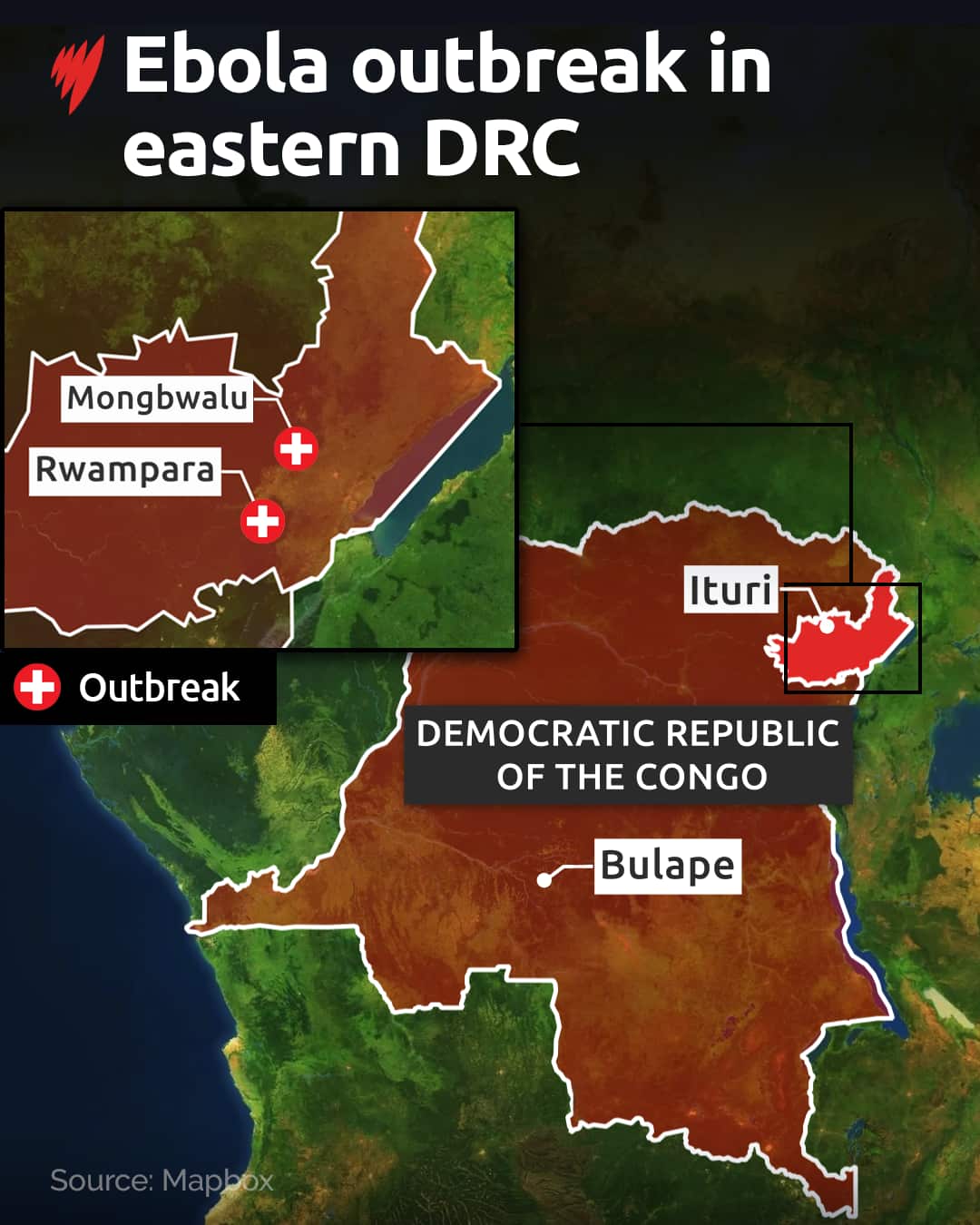
Many infections have been concentrated around gold-mining towns in eastern DRC, where frequent cross-border movement has complicated containment efforts.
Cases have also been identified hundreds of kilometres away in the city of Goma in addition to neighbouring Uganda, raising fears the outbreak may already be more widespread than initially thought.
Griffin said that mobility, combined with limited testing and fragile healthcare systems, has made it difficult to establish the true scale of the outbreak.
The Bundibugyo strain responsible for the outbreak has only caused two previous epidemics, in Uganda in 2007 and in the DRC in 2012. According to the WHO, those outbreaks had estimated fatality rates of between 30 and 50 per cent.
For the latest from SBS News, download our app and subscribe to our newsletter.







