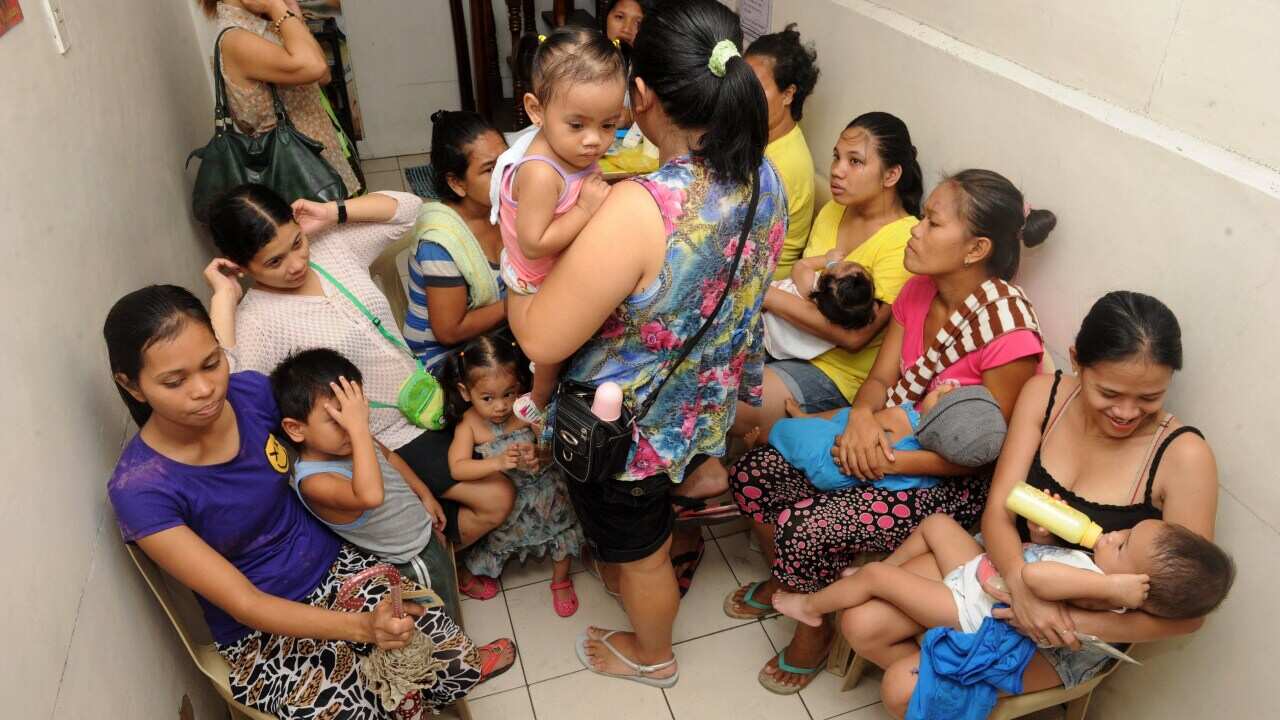
Back in 1994, a landmark international conference was held in Cairo to discuss long-term measures to simultaneously address sustainable development and population growth.
The International Conference on Population and Development established a 20 year program of action for countries to follow.
Now that target period is ending, but targets relating to women's health are among those that have not been met.
(Click on audio tab to listen to this item)
The program of action set by the International Conference on Population and Development in 1994 marked a milestone.
For the first time, a global strategy to deal with population growth was adopted, with human rights and gender equality as the basis.
Almost all United Nations members, a total of 179 countries, including Australia, signed up to comply with the objectives and actions.
Delegates from around the world recently met at UN headquarters in New York to review progress made in the two decades since then.
While there was general agreement that there has been progress in some areas, numerous gaps remain in achieving the Cairo agenda.
UN special adviser Nafis Sadik says one area of disappointment is women's sexual and reproductive health.
"The ICPD program of actions reflected the understanding that for all women, good health, especially good sexual and reproductive health is the foundation for everything else. For their decisions on fertility which influences all their other choices in life. For their self-respect, for their education, for their economic possibilities and prospects. For their claim to be treated as equal human beings."
Child marriage was identified at the New York meeting as another area where the ICPD objectives are far from being achieved.
According to the UN Population Fund, over the next decade 50 million girls worldwide will be married before their 15th birthday.
Executive Director of the Fund, Babatunde Osotimehin describes this practice as a human rights abuse.
"An eleven year old girl, just still a child, most likely does not fully understand the changes taking place in her body, married to a stranger, shut off from her family and without any social support, she's unable to access the information and services she needs. She doesn't even know that her rights are being abused."
Dr Osotimehin says child marriage creates a cycle of poverty that lasts throughout the girls' lives, and beyond.
"Early marriage leads to early pregnancy, closing the door to education, life skills and economic opportunities. Risking her health and wasting her human potential. This in turn jeopardises the health, education and future of her children by perpetuating a vicious cycle of poverty and exclusion. When multiplied by millions of marginalised adults and girls, this creates a ripple effect that puts global development at risk. I always use the example of the fistula, which little girls develop when their body is not ready to have children, as a failure of society to look after the health and the rights of these girls."
Dr Osotimehin says most United Nations members have supposedly committed themselves to ending child marriage, but haven't done enough to try to end it.
"Despite near universal commitment to ending child marriage, we actually have evidence that 140 countries in the United Nations system have laws that actually stipulate that girls should marry at 18, but there is impunity around that law. One out of every nine girls are married before their 15th birthday. Most of these girls are poor, less educated and living in rural areas. Nine out of ten adolescent pregnancies take place in the context of early marriage and pregnancy and child birth are the leading cause of death amongst adolescent girls 15-19 in low and middle income countries."
The ICPD program of action also aimed to help women across the world achieve universal access to family planning, and sexual and reproductive health services.
But the New York meeting heard that unwanted pregnancy and childbirth is another area where the world has fallen well short of meeting targets set in Cairo.
The World Health Organisation estimates that 220 million women worldwide want to prevent childbearing, but do not use contraception.
It says the reasons include limited access to contraception, as well as cultural and religious barriers.
Special UN advisor, Nafis Sadik, says millions of women have to undergo unsafe abortions each year - even in countries where it is considered legal.
"Unsafe abortion now kills an estimated 47,000 women every year and injures many more. Abortion still remains a very controversial subject. It is very restricted by law still in many countries. Even when it is broadly legal, it is often without strong support, including from services providers and access is often limited. This is a prescription for unsafe abortion for all its attendant risks."
Dr Sadik says better access to safe abortions is necessary because pregnancies are sometimes unavoidable.
"Abortion still remains a highly sensitive matter and that is quite understandable. But we must also understand that in some cases abortion cannot be avoided. Contraception is neither universal nor perfect and human beings are fallible. Complications of pregnancies can make abortions necessary and increases in the incidence of gender-based violence, and especially rape, increases the need for interventions."
Dr Babatunde Osotimehin, from the United Nations Population Fund, says the reproductive rights of girls need to be better supported.
"Discriminatory laws, practised and attitudes continue to keep young people, particularly adolescent girls, from accessing sexual reproductive health services, including contraception and realising their reproductive rights. In essence, what are we saying to these girls? It's ok for you to be married, it's ok for you to have sex, it's ok for you to have children, but you are not old enough to access contraception. You are not old enough to have access to comprehensive sexuality education. You are not old enough to have control over your own body. This simply does not make sense and we cannot shy away from this issue any more."
French diplomat Alexis Lamek was among those calling for greater support for the ICPD's focus on reproductive rights - and says girls need better education on how to exercise them.
"All of these risks can be averted by guaranteeing that everyone has access to sexual and reproductive health services, products and information. Sexual and reproductive rights, particularly access to all family planning methods and a full range of contraceptive methods. Young people's access to sex-education and gender equality education and access to safe abortions. All of these are part of the Cairo Program of Action that must be comprehensively implemented."
Special adviser Nafis Sadik argues that a lack of access to contraception and abortion is not generally caused by funding barriers.
She says often it's discriminatory laws - and she emphasises that cultural values can not be an excuse for discrimination.
"How can any cultural value worth the name possibly defend female genital mutilation or ignore sexual assault in the home or violence outside of it or justify child marriage? Or deny any girl, married or not, the maternity care that would save her life? These are not cultural values. These are the means by which one group keeps another in subjugation."
Despite the expiry of the 20-year period to achieve the Cairo agenda, the New York meeting ended by urging governments to keep addressing gender equality gaps.
Share


