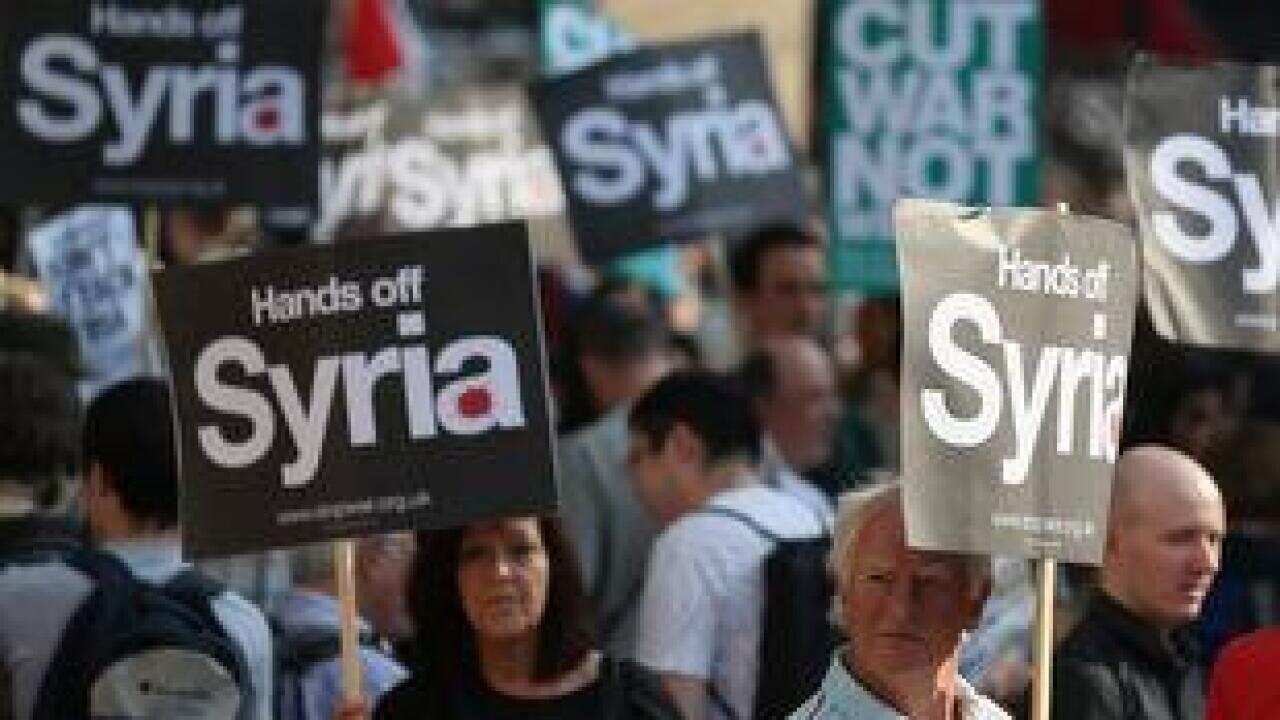
As some nations continue to build a case for military intervention in Syria, international opinion on how to react to the crisis remains divided.
The government of Syrian President Bashar al-Assad has denied any responsibility for an alleged chemical weapons attack and has vowed to resist any military intervention.
It comes as a vote endorsing military action against Syria was narrowly defeated in the British parliament.
Hannah Sinclair reports.
The vote result in the British parliament was a stunning defeat for a government which had seemed days away from joining the US in possible attacks on Syrian government forces over an alleged chemical weapons attack.
British Prime Minister David Cameron lost a vote endorsing military action against Syria by 13 votes.
Speaking to parliament, Mr Cameron said it was clear to him that the British people don't want to see military action.
"I strongly believe in the need for a tough response to the use of chemical weapons. but I also believe in respecting the will of this House of Commons. It is very clear tonight that while the House has not passed a motion, it is clear to me that the British parliament, reflecting the views of the British people, does not want to see British military action. I get that, and the government will act accordingly."
While the vote wasn't binding, in practice the rejection of military strikes means Mr Cameron has no mandate for action.
British Secretary of State Philip Hammond told the BBC it was defeated because of suspicion following recent conflicts.
"I'm disappointed. I'd hoped we would carry the argument. But I think we understand that there is a deep well of suspicion about military involvement in the Middle East. Stemming largely from the experiences of Iraq in 2003, and that's a reality that we have to face, and that in term has affected parliamentary opinion."
In the United States there have been indications that the White House is prepared to act alone in Syria, despite the defeated vote in the UK.
President Barack Obama says the Syrian government will face international consequences for what he calls a deadly chemical attack, but that any military response would be limited.
White House spokesman Josh Earnest says President Obama will decide whether to attack Syria on the basis of national security and after legal consultation.
"The President has been very clear that he is not contemplating an open-ended military action. He is contemplating, what we are talking about here is, something that is very discrete and limited. We cannot allow a totalitarian dictator to use weapons of mass destruction like that with impunity."
Earlier, a meeting of the permanent United Nations Security Council members in New York ended with no apparent breakthrough.
It comes as a team of UN inspectors continues investigations into reports that last week's attacks outside Damascus killed more than 300 people.
The UN says the team has collected considerable evidence and will brief UN Secretary General Ban Ki-Moon after they leave the region on Saturday.
Syrian leader Bashar al-Assad has denied any responsibility and is vowing to respond to any military intervention.
Speaker for the Syrian Government Jihad Al-Laham told the BBC world leaders should resist starting what he calls, another war.
(translated) "I want to remind you that the first and second world wars started like this. Instead of standing against terrorism, the American government and its partners are supporting the terrorists. Syria won't surrender in the face of attack. We'll use all our powers to defend ourselves."
Both Iran and Russia are opposing military interference, while Argentina's foreign ministry says any military intervention would be adding 'new horrors to horrors.'
Russian officials say they will be sending an anti-submarine ship and a missile cruiser to the Mediterranean, in the event of possible strikes on the region.
Foreign Minister Bob Carr says he is waiting for further confirmation on details of the attacks.
Senator Carr says he respects the decisions of the US and the UK governments.
"Like people in those two governments, we're carefully weighing the evidence and carefully considering the appropriate response. There has been chemical weapons use. We believe with a high level of confidence it came from the regime in Syria and there is a case to be made for an international response to that."
Opposition leader Tony Abbott has told the ABC all the facts need to be clear before Australia backs any military intervention.
"If it can be worked out that the regime is responsible for this unspeakable atrocity, it's right and proper that there should be some consequences."


