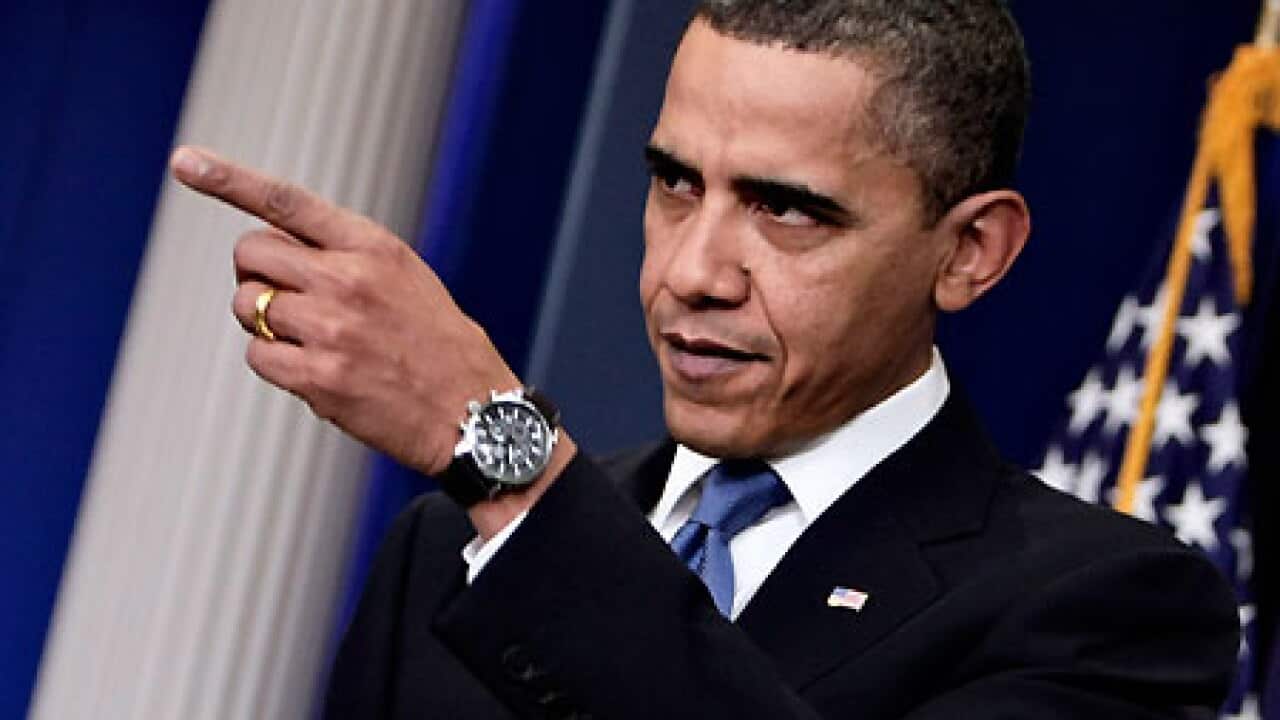
US President Barack Obama says the international community is moving "fairly quickly" to impose new sanctions on Iran after Tehran started enriching uranium to a higher level.
The president made his remarks as his administration marked major progress in persuading Russia to overcome its traditional resistance to imposing new sanctions on Iran, even if the move still faces opposition from China.
In a rare, impromptu appearance in the White House briefing room on Tuesday, Obama was asked how quickly the six key world powers were moving to toughen a regime against Tehran given Iran's enrichment activity.
News that makes sense
Your trusted source for staying up-to-date with the world around you. Get free daily news updates and analysis, straight to your inbox.
"It's moving along fairly quickly," Obama said, referring to the negotiations involving the US, Russia, China, France, Britain and Germany.
"Despite the posturing that the nuclear power is only for civilian use... they in fact continue to pursue a course that would lead to weaponisation, and that is not acceptable to the international community," he said.
In Moscow, the powerful head of Russia's national security council, Nikolai Patrushev, said Tehran's announcement that it has started work to produce 20 per cent enriched uranium cast doubt on its claims not to be pursuing weapons.
'Patience wearing out'
Patrushev indicated the Kremlin's patience in trying to seek dialogue with Tehran was wearing out.
"Iran claims it is not trying to acquire nuclear weapons," Patrushev was quoted as saying by Russian state news agencies.
"But actions such as starting to enrich low-enriched uranium up to 20 per cent raise doubts in other countries and these doubts are fairly well grounded," Patrushev added.
"Political and diplomatic methods are important for regulating, but everything has its limit," Patrushev was quoted as saying.
His comments were an unusual expression of concern from Moscow, which has long said there was no evidence that Iran was pursuing anything other than a civilian nuclear energy program.
China was alone among the six powers in calling for more talks to resolve the impasse.
"We hope the relevant parties will exchange views on the draft deal on the Tehran research reactor and reach common ground at an early date which will help solve the issue," foreign ministry spokesman Ma Zhaoxu said.
Plea for diplomatic solution
Ahmet Davutoglu, the foreign minister of Turkey, a country with good ties with both Iran and the West, is to visit Iran next week to push for a diplomatic solution to the stand-off.
Washington has called the latest Iranian moves "provocative" and is pressing ahead with moves at the UN Security Council for a fourth sanctions resolution against Iran.
US Defense Secretary Robert Gates "thinks this is a matter of weeks, not months", Pentagon spokesman Geoff Morrell told reporters in Paris, where Gates met French President Nicolas Sarkozy.
"He thinks that we need it and that we can do it in that time," Morrell added. "In all his meetings he discussed this sense of urgency."
State Department spokesman Philip Crowley said the Iranian decision to further enrich uranium "puts us in a much stronger position" to move ahead with plans to put "pressure" on the Iranian government rather than its people.
US officials have discussed sanctions targeted on Iran's Revolutionary Guard, which is responsible for the country's nuclear program and is behind the crackdown on anti-government protests.
Iran 'increasingly isolated'
"Iran is increasingly isolated," Crowley told reporters in Washington.
The loudest call for sanctions came from Israel where Prime Minister Benjamin Netanyahu called for "crippling" measures against Tehran during a gathering of European Union ambassadors in Jerusalem.
In a further sign of rising tensions over the nuclear issue, around 100 pro-government militia members tried to storm Italy's embassy in Tehran, Italian Foreign Minister Franco Frattini told a Senate hearing.
Similar protests took place outside the French and Dutch missions in Tehran, Frattini said.
On Monday, Sarkozy and Gates agreed to push for "strong" new anti-nuclear sanctions against Iran, which insists its atomic drive is to produce energy.
Brazil, which enjoys good relations with Iran and is among the non-permanent members of the 15-member UN Security Council, on Tuesday resisted moves to sanction Iran.
"We don't believe that sanctions will prove effective," Brazilian Foreign Minister Celso Amorim told reporters.







