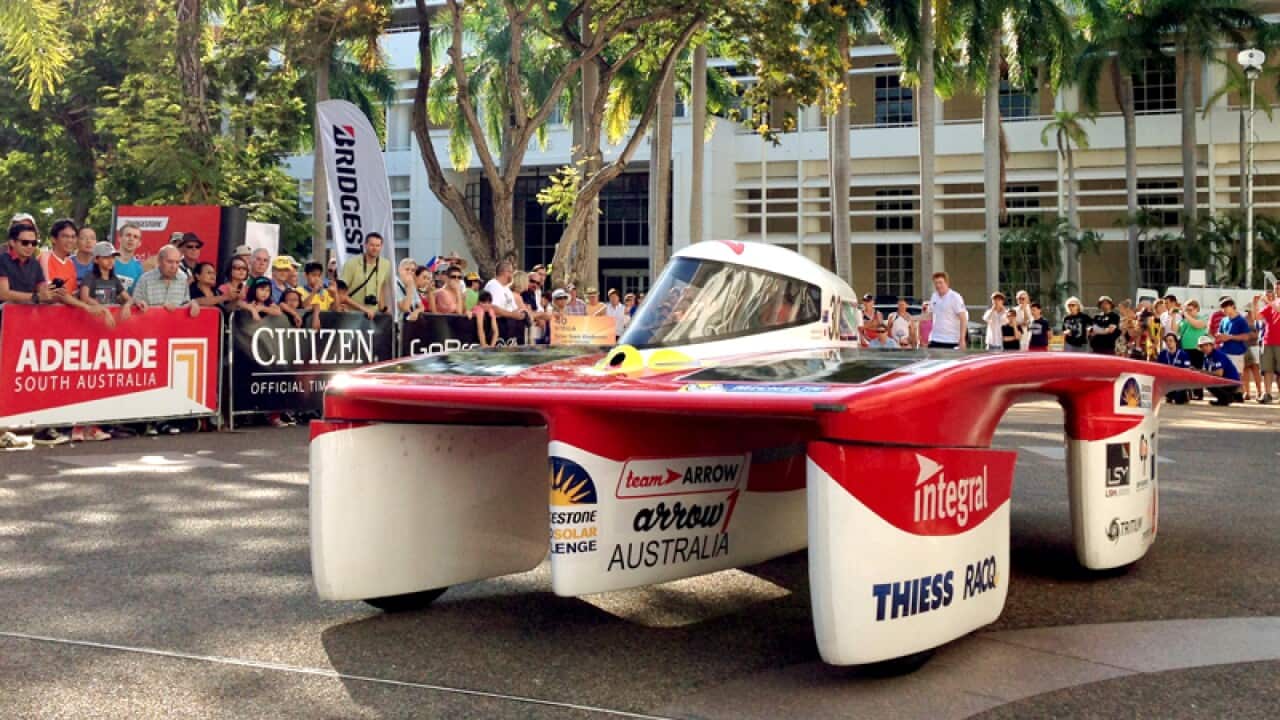
It was a strange sight in Darwin's prime square as 39 futuristic style three and four-wheeled vehicles rolled their way through the city.
Several hundred people had gathered at State Square on Sunday to send off the World Solar Challenge.
Teams from around the globe race 3000km from Darwin to Adelaide, pushing the boundaries of design and energy efficiency with strange looking vehicles - some long and flat, others pointed like rocket ships.
Queensland's Team Arrow took pole position in the Challenger class, with former Formula Ford race car driver Chris Ahern behind the wheel for the first leg, where drivers race as far as they can south until 5pm, when they camp wherever they are for the night.
"It's nice to be finally out and doing the real thing," he told AAP.
News that makes sense
Your trusted source for staying up-to-date with the world around you. Get free daily news updates and analysis, straight to your inbox.
Despite winning the prime spot, Team Arrow hasn't got much on-road experience, with car building finished only last week.
"We're going to learn a lot today, and that's what this race is about: learning how to run the solar team effectively through the race, how to set up the car and be competitive in future years," he said.
Kelvin To, from Hong Kong's IVE Solar Car team, broke a Guinness world record for fastest solar car when he raced with the University of New South Wales team in 2011.
He's driving the first leg of the Adventure class race to Katherine in the team's three-wheeled vehicle, which he acknowledged is "UFO-looking".
The 180kg car is the Hong Kong team's first entry in the challenge, and can reach speeds of 100km per hour.
Which would be necessary to get air circulating in the cockpit.
"Hopefully it's not going to get too hot - the air holes don't work until the car hits 40 to 50 kilometres," Mr To said.
Innovation was key to the challenge, said event director Chris Selwood.
"We try to do better every time; every edition of the World Solar Challenge is different because we evolve our regulations in line with technology," he said.
"We're not same-old same-old, we're pushing the boundaries of technology."