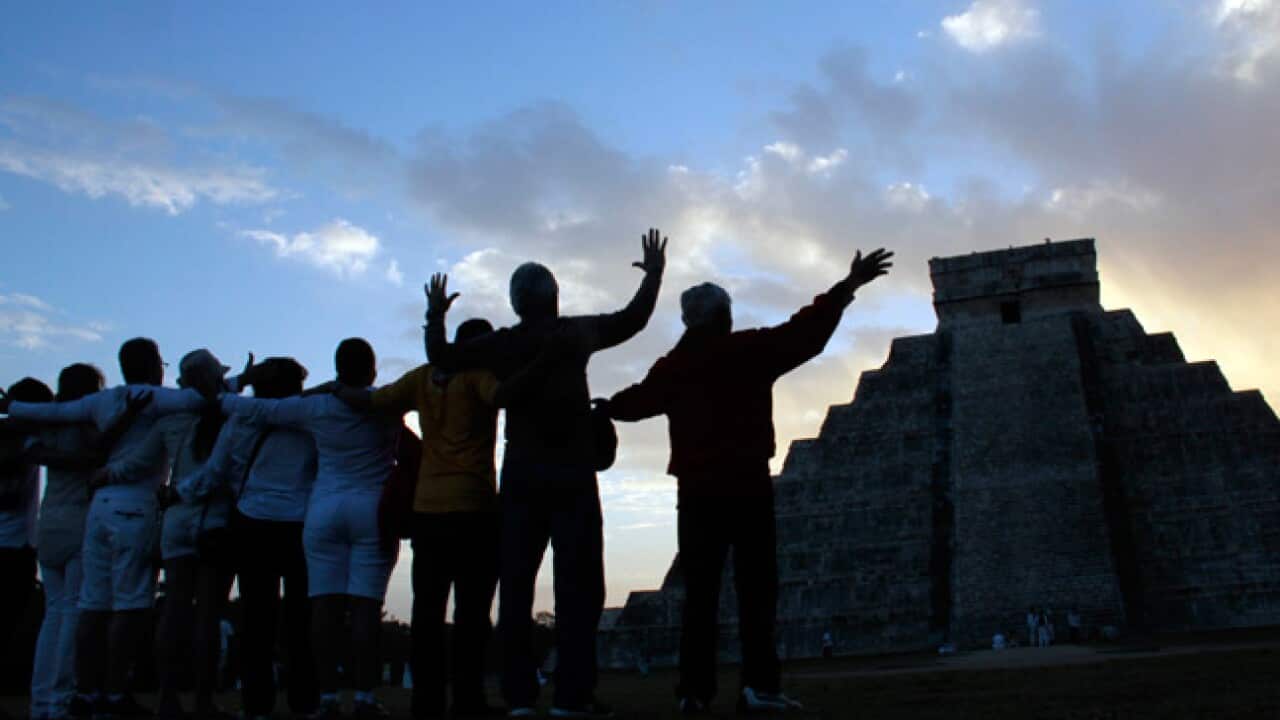
A global day of lighthearted doom-themed celebration and superstitious scare-mongering has culminated in the jungle temples built by the Mayan people of Central America, whose calendar sparks fears of apocalypse.
December 21 marks the end of an era that lasted more than 5000 years, according to the Mayan "Long Count" calendar.
Some believe the date, which coincides with the December solstice, marks the end of the world as foretold by Mayan hieroglyphs.
Scholars scoff at the idea - it just marks the end of the old Mayan calendar and the beginning of a new one, they say.
But that didn't stop some 3000 people from gathering at this ancient Maya stone pyramid in the Guatemala jungle, where actors in costumes and head-dresses staged elaborate dances to a mournful pan-pipe tune.
Native Maya priests then lit fires as the first rays of the new day's sun appeared through the jungle canopy.
The ceremony was held to mark a new 5200-year era of the Maya calendar.
Critics however complained that the event was to benefit tourists, and had little to do with the real Mayans, who reached their peak of power in modern-day Mexico and parts of Central America between the years 250 and 900 AD.
"For us this isn't a show and isn't about tourism, it is something spiritual and personal," said Sebastian Mejia, of the Conference of Maya Ministers, who was at Tikal with other Maya priests to celebrate a more serious parallel ceremony.
Another Maya indigenous leader, Alberto Marroquin, said the Mayas felt they were marginalised at the official event.
"This is illogical," Marroquin said.
"This is like celebrating something when the main person has not been invited.
"We are not magicians or warlocks ... we are scientists with our own way of thinking," he said.
Forty per cent of Guatemala's 14.3 million residents are indigenous Mayas, and most live in poverty.
The central American region where the Mayans lived, which include parts of Mexico and Honduras, saw a tourism bonanza in the run-up to the fateful December 21 date, with tourists snapping up all-inclusive excursions to Mayan holy sites.
Around the world, doomsayers hunkered down to prepare for The End, but most took a lighthearted view of the Mayan "prophecy" of the world's destruction.
"If you're in an underground bunker with a lifetime's supply of baked beans how stupid do you feel now?" asked one person on Twitter, which saw dozens of posts every minute joking about the failure of the world to end.
In the southern French village of Bugarach - rumoured to be one of the few places that will be spared when the end comes - journalists from across the world were bitterly disappointed at the lack of New Age fanatics to interview.
Police however arrested two men who had gas masks and machetes in their car as they approached the Pic de Bugarach, a nearby mountain.
Police had wrongly anticipated a mass influx of visitors and blocked access to the village and the mountain, which some say will open on the last day and aliens will emerge with spaceships to save nearby humans.
Reporters also wandered aimlessly around the tiny village of Sirince in Turkey, hoping to grab a mystic taking refuge there.
Doomsayers identified Sirince - said to be the site from which the Virgin Mary ascended to heaven - as a safe haven that will be spared destruction thanks to the positive energy flowing through it.
In Serbia, a pyramid-shaped mountain believed by some to be a source of unusual electromagnetic waves that could shield it from catastrophe, attracted record numbers of visitors.
Australia was one of the first countries to see the sun rise on December 21, and Tourism Australia's Facebook page was bombarded with posts asking if anyone had survived Down Under.
"Yes, we're alive," the organisation responded to fretting users.
There was also a darker side: in China, authorities arrested some 1000 people in a crackdown on a Christian sect that spread doomsday rumours.
If the world would have ended, Chinese furniture maker Liu Qiyuan had his own safe haven, a fibre-glass pod he designed that can carry up to 30 people and withstand towering tsunamis and devastating earthquakes.
A Dutch Christian had meanwhile painstakingly prepared a lifeboat in his garden capable of saving 50 people ahead of the biblical floods he expected on Friday.
Share


