Roy 2029
by Jana Wendt
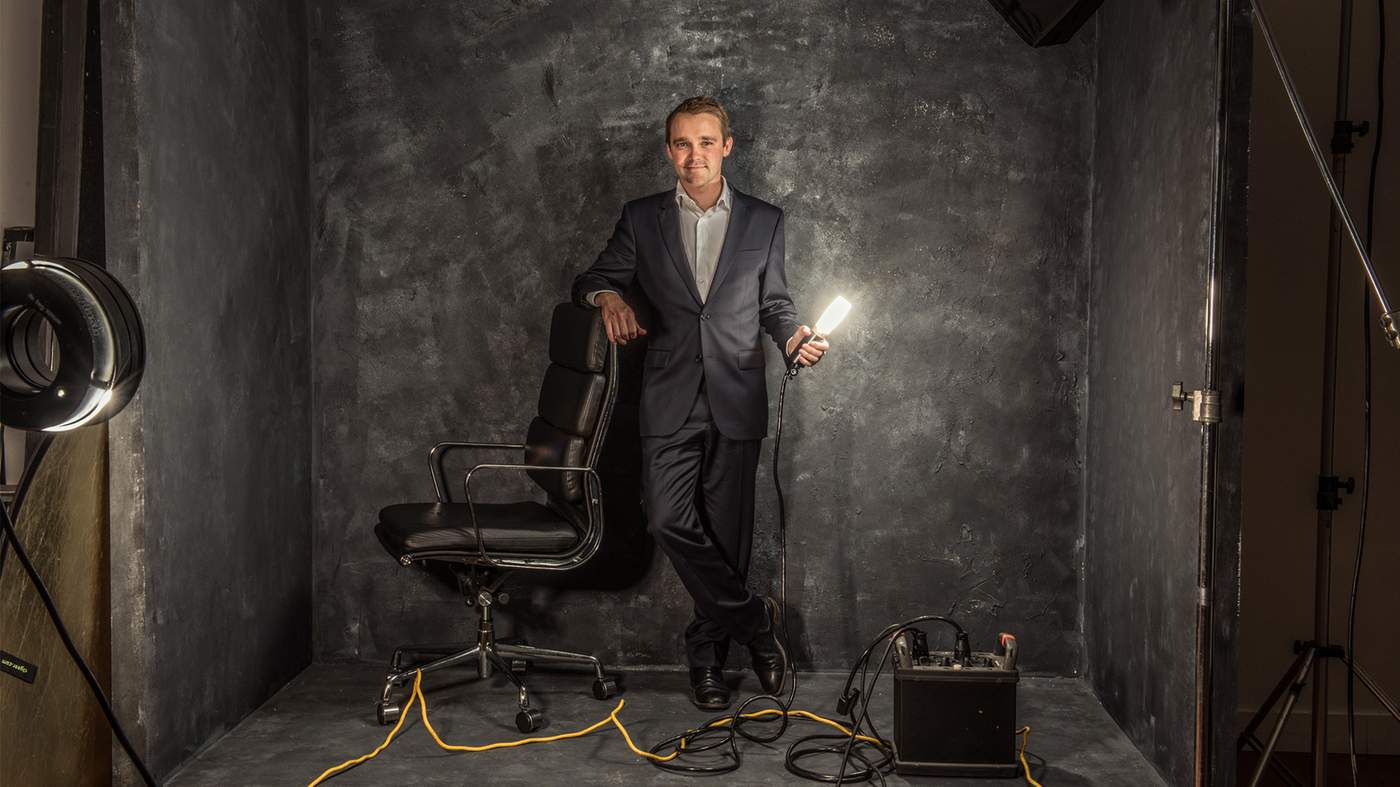

"I will leave that up to Prime Minister Wyatt Roy in 2029," Foreign Minister Julie Bishop once predicted. Who is the 25-year-old Member for Longman? How did a boy from a strawberry farm become the Turnbull ministry's rising star?
by Jana Wendt, November 2, 2015

The Assistant Minister for Innovation settles into an armchair, as if readying for a night of pizza and binge-watching.
Wearing thick-striped socks in black and white, below blue suit pants, Wyatt Roy looks as comfortable and relaxed on stage as Liberal scion John Howard once wished for the entire nation.
Just eight days after his elevation from the backbench to a post in the Turnbull government, Roy is a late addition to the speakers’ list at a ‘Future Summit’ hosted in Melbourne by the ADC, or Australian Davos Connection ‘leadership group’.
The audience abounds with venture capitalists, innovation consultants, and start-up entrepreneurs, including the current rock stars known as ‘disruptors’. The Honourable Wyatt Roy MP, 25, is at home with many key figures in the room. He has been working to acquaint himself with the big names in the field for a long time, as if preparing for the day when the familiarity might pay.
Roy puts on an energetic display of ‘getting it’, addressing the representatives of the ‘entrepreneurial ecosystem’. He is here to tell innovators, incubators, accelerators (and velociraptors?) that brisk passage past regulatory roadblocks is something the junior minister and the Prime Minister wish to uncork, like a bottle of sparkling in a nimble new world order.


“We need a culture change,” Roy declares. The tall poppy syndrome must be cut down and risk-taking redefined as a virtue, he says. Australia has “seriously failed to crack the commercialisation nut”.
There is just enough – not too much – politics in the pitch: a blissful future is within reach for those who dare to be bold under Canberra’s new management. The Assistant Minister delivers a finely tuned appeal to a collection of savvy schemers.
Calling for questions, Roy urges: “Be brutal, if need be!”
I have landed in a kind of unearthly zoo: there is talk of gazelles, angel investors and unicorns. No-one flinches, least of all Roy, a fluent speaker of the peculiar argot of this ‘ecosystem’. He mixes easily with the likes of Seek job website founder and venture capitalist, Paul Bassat, and with Sam Chandler, the Australian CEO of Silicon Valley Adobe challenger, Nitro.

Sitting on office tables, feet swinging, Roy is the relaxed, informal Millennial.

On stage with Roy, Israeli politician and innovation guru Professor Manuel Trajtenberg, 65, believes he has misheard the MP’s age. Having confirmed, via Google—what else?—the figure of 25, the innovation authority is jubilant: “I’m incredibly optimistic about Australia because of that”.
Turning to Roy, he declares, “What innovation requires is something you can do better than I can”. Two other politicians sharing the stage, one each from federal Labor and the Victorian Greens, are powerless against the torrent of love. Both are “very excited” about the young Queensland LNP member’s appointment.
On a stroll away from the ‘Future Summit’, Roy and I had earlier taken stock of his past—a place where nothing is too far away. His frame slight as a child’s, the politician could still be the boy on the family strawberry farm in Beerwah, in the hinterland of the Sunshine Coast. But his father’s life, explains Roy, could never be his life.
“I love dad. But farming is very hard,” he says. Instead, on the terrace of a café in the big end of town, Roy surefootedly lays out his political and personal convictions. “I’m an open book,” he says.
In the days I watch him at work, Roy is either talking as though his life depended on it, or listening to those bending his ear, with what looks for all the world like actual interest. Sitting on office tables, feet swinging, Roy is the relaxed, informal Millennial.
Friend and fellow Liberal MP, ex-tennis champ John Alexander, has a repertoire of stories he tells at Roy’s expense. He recalls a 20-year-old Roy coming into parliament late one morning, during his first working week in the capital, after a night out.

“I wouldn’t say I’m naive about the risk... it’s like I’m walking a high rope and everyone’s waiting to see if I fall”.

“Wyatt, where’ve you been?” snapped Alexander. “Your dad’s been calling me all morning.”
Roy is alert to the less amusing hazards of being the youngest ever person elected to the parliament and promoted, just five years later, to a position many of his colleagues would covet.
“I wouldn’t say I’m naive about the risk... it’s like I’m walking a high rope and everyone’s waiting to see if I fall,” he says.
I wait for something to kill the image of a small, blonde man plummeting earthward.
“But you have to find peace in that,” says Roy. “I don’t approach this job saying: ‘I’m the smartest person, therefore I’m right’… I approach it in the sense that you have an amazing ability to learn in this job; every day you can learn.”
Why, I ask, should voters be tolerant of Roy learning on the job?
“Because every politician does,” Roy answers. “It’s no different for me. When you walk into parliament, it doesn’t matter what your professional background is, what your gender, your age, ethnicity, whatever.
“This is a unique job ... And while some people who are fantastic in business have made great contributions in political life, or great union reps have been good political representatives, not all of them have.”
I venture that the fact he brings so little life experience to the table cannot be ignored – and is likely a liability.
“Politics is not just about the individual, right?” counters Roy. “It is not just about me; it is about my ability to work with other people… So while those things that you say may very well be true, as long as I’m working with other people who are more experienced.“
Roy abruptly strikes out for a bolder defence: “But I’d also argue that while those things are true, it may also mean that I’m not cynical in the way that someone who’s been around for a long time is.”
“I’m not pessimistic; I’m not cranky and angry, I’m not railing against the world; I want to change the world for the better. I’m not lazy. I’m not apathetic. So there are other things that they can criticise politicians for that I think are way worse than this.”
Now assisting senior minister Christopher Pyne, Wyatt Roy has landed in the policy area favoured by the new Prime Minister. He could be seen as a malleable recruit for the new regime, not to mention a conveniently youthful mascot. But Roy already practises retail politics with assurance. He engages easily with everyone he meets—businessmen, students, farmers, scientists and vice-chancellors.

and I don’t want to be here forever.”


“If your favourite topic is not yourself, then you actually get on with people all right,” Roy says.
There is no chance, however, that Roy as a topic will escape attention. Standing in the shadow of the UN building in New York and looking ahead to a distant future, Foreign Minister Julie Bishop uttered the words “Prime Minister Wyatt Roy”. What’s a 25-year-old to do with such invitations to immortality?
Roy, the new generation politician, comes media-ready. He responds to text messages and phone calls with blistering (and welcome) speed. He repeats the story of his short life, illustrative anecdotes flowing, for persistent enquirers like me.
Talking to video cameras is as instinctive as scratching. He is alive to Facebook photo opportunities. He adapts to the required tone for television interviews, from matey to analytical, with ease. A few well-worn phrases are preceded by a cautionary “This is a terrible cliché, but—“.
Yet Roy insists he does not see Canberra as a lifelong job: “I don’t see politics as a career and I don’t want to be here forever.”
Nor is he coy about his ambition, one he believes he shares with each of his colleagues. However, “you can’t pick your timing in politics either, right? The reality is I could lose, or my seat could be abolished, or anything could happen.“
Being driven in a Comcar as we talk, the trappings of the job are hard to ignore and, arguably, hard to forfeit. But Roy rejects the lure of perks.
“If you’re worried about losing any of that stuff, then immediately that will change how you think, and your willingness to do things differently,” says Roy. “So the idea that you have nothing to lose is actually really important.”
Roy often stands on the ‘nothing to lose’ credo. He fuels self-belief with strongly-held principle. The politician claims to possess a solid non-political core.
His girlfriend Hilary Weeks, an accounts officer, is “not political at all” and he thinks “it’s a very big thing to ask somebody in their early 20s to put up with all this”. At home on Queensland’s Bribie Island, the “constantly on demand” role of the politician sometimes fights with the need for uninterrupted time with a close group of mates (among them miners, an architect, an optometrist and a military man).
“When I hang out with my mates, I really like it when we go out on the boat. It’s just us.”

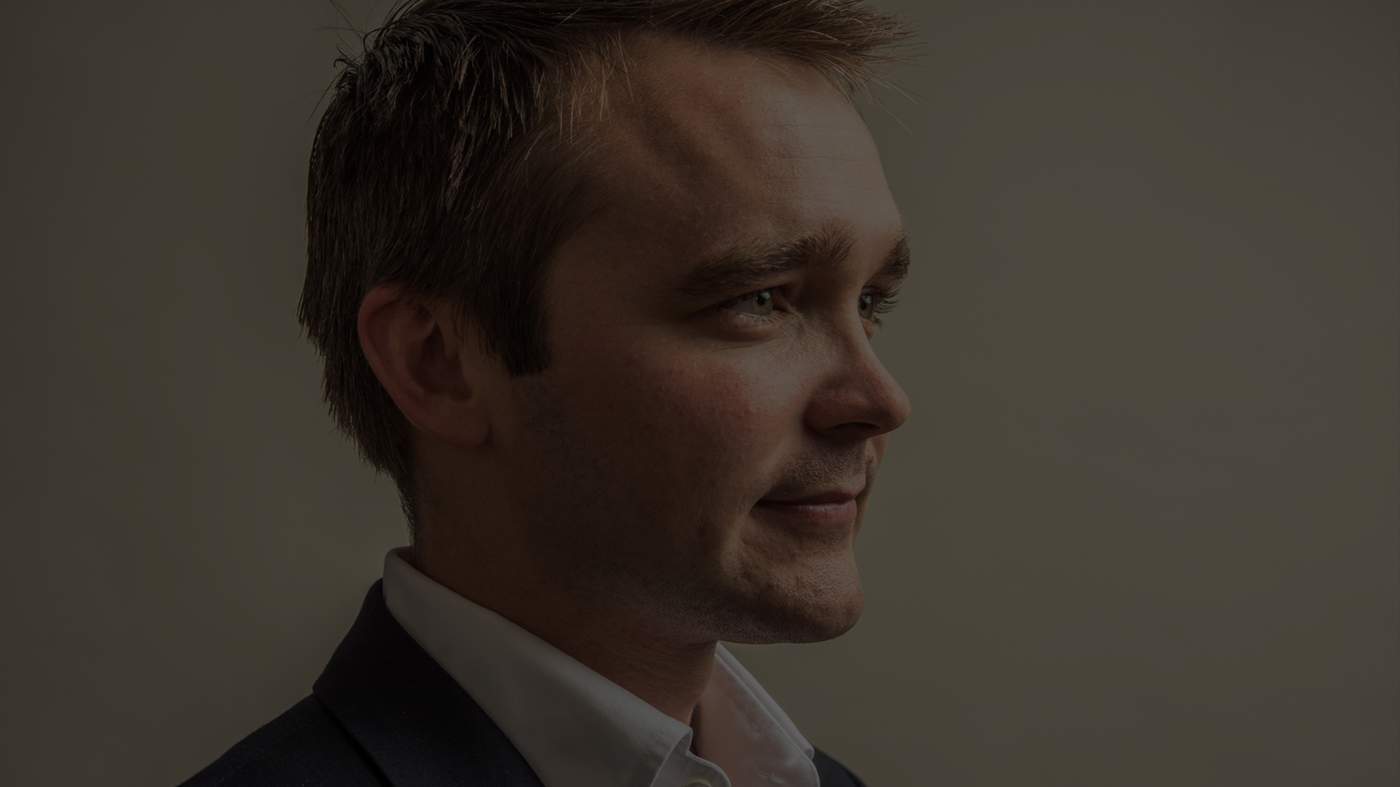

There is a sweetness to Roy that mixes oddly with political savoir faire. But as his rapid rise attests, Roy is very far from a little boy lost. He was among a core group of Liberal dissidents agitating for the disposal of his former leader, Tony Abbott.
Roy says involving himself in the process carried with it “a high political risk”. In apparent contradiction, he also claims, “I just think, what do you have to lose if it didn’t work out? ... If you walk out [of the party room] and it’s gone a different way, at least you wouldn’t wake up the next morning and go, ‘jeez, I wish I had tried to do something’.”
As for soliciting votes for Turnbull from colleagues, Roy says, “People aren’t honest with you the way you’d like them to be…” By way of compensation, Roy has been richly rewarded for his exertions. Going in for the kill, he adds “To be honest, the person that solicited the most votes for Malcolm was probably Tony.”


Wyatt Roy accompanies Federal Liberal leadership challenger
Malcolm Turnbull to the party room spill on September 14, 2015.
(AAP Image/Sam Mooy)

Defending himself against the charge of inexperience in his new innovation responsibilities, he says: “I can assure you, in this space, Malcolm will have a very heavy hand—and no one can deny his experience.”
The ‘Malcolm’ theme returns often and is indicative of a tight connection between the young politician and the man who seized leadership of the country on September 14. As Turnbull strode toward the party room meeting that would anoint him, alongside hovered the Member for Longman, Wyatt Roy. How did he come to be in that place at that time?
The moment he finished school in 2007, Roy took off from the family farm. He backpacked through Europe with a mate and, when he landed back in Australia, turned to the study of international relations at Melbourne’s La Trobe University. He had a brief early dalliance with grassroots politics, working in the office of Victorian Liberal MP Nick Wakeling, and later moved back to his home state to continue studies at the University of Queensland.

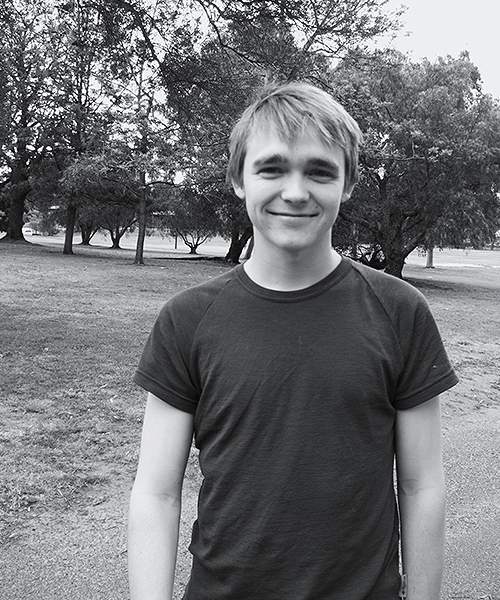
Wyatt Roy at the University of Queensland

When it was suggested he run for the southern Queensland seat of Longman, Roy at first resisted: “I don’t think they expected me to win, but it was to get that experience—because preselection’s a horrible experience—and then to run later.”
He decided to run, Roy tells me again, because he had nothing to lose.
Until around the second-last year of high school, Roy, who took flying lessons, planned a career as a pilot. At Matthew Flinders Anglican College in Buderim, he was introduced to the study of economics by teacher Mary Spring. She says it was “a discipline that allowed him to connect up a whole lot of things” and recalls Roy having an “innate” desire to change things.
“Physically, he was quite a small student,” Spring says. “I think part of him was ‘I want to make a difference, I want to have influence’. Along came this social science—he could see the power there.”

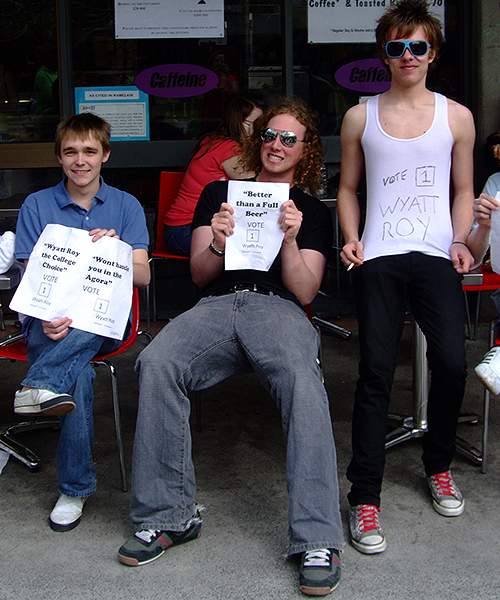
Wyatt Roy, 18, at student elections at
Melbourne’s La Trobe University

In interviews, Roy styles his life as a Liberal economic parable.
“Dad was a labourer,” he says. “He worked his way up to foreman in an earthmoving company. He went into business for himself, going back to the family business, farming. That became his business.
“He was able to give me a lot of opportunities, and I was able to take hold of those and work hard. I think, to me, that’s very much a Liberal story, right? The great equaliser in our society is equality of opportunity, not subsidy.”
Mary Spring’s classes unlocked a realisation, Roy says, that “if you understand social justice and you understand economics, you can actually make a difference. If you understand one and not the other, you can’t do anything.”
One day, Roy mentions a very early interest in disability policy. Rapid fire, he adds that the interest arose from “helping out my mate Pat”.
Spring recalls the relationship between Roy and his friend, Patrick Hall, wheelchair-bound and suffering from birth from the wasting condition, spinal muscular atrophy.
“They were almost an odd couple,” Spring says, “because Patrick was of a vastly different political persuasion. Patrick was quite irreverent.”
Spring remembers Hall’s physical weakness and intellectual strength.
“You looked at Patrick in this wheelchair— quite weak and feeble— [but] it was just this almighty mind… Patrick was going to make sure that… he was going to have a damn bloody good life… He didn’t want to be strapped in. He wanted to be able to have some level of chance at just being a normal kid…. From the time they started together, Wyatt [had the attitude of] ‘Yep, that’s fine’.”
Roy’s grief for the friend who died last December is raw. Eyes shining with tears, Roy says “I never saw his disability, I suppose… he was always there and part of everything. We would do whatever it took to get him involved… We would argue about everything, and I think often we would disagree so that we could argue.
“We challenged each other a lot—economics, politics, love life… Whenever things were difficult in my life… I would have these very long chats with him. And he would relish the opportunity to make fun of you in those moments when no one else would. It just put things into perspective… It was a very important friendship.”
As Roy spent time with his friend’s family in September, a couple of days after what would have been Pat Hall’s 25th birthday, Malcolm Turnbull called to ask Roy to serve as Assistant Minister.
Roy is the first person in his family (which includes two older half-brothers, Ben and Shannon, from his father’s earlier marriage, and younger sister, Dayna) to finish high school. Both brothers work in earthmoving.
The family was solidly Labor until John Howard’s election in 1996. Roy says his father Henry became a “Howard battler” (though brother Shannon remains, immovably, a Labor man). A ruptured relationship with his mother is the only subject on which Roy’s “open book” slams shut.
“I’ll talk about anything else but that.”

He is keen to be known as a ‘contemporary Liberal’, standing for a mix of views including support for gay marriage.

Although the definition is disputed territory among some Liberals, Roy adopts Robert Menzies’ “progressive”, “in no way conservative, in no way reactionary” characterisation of the party. The grounding for Roy’s beliefs is evidently practical rather than theoretical. In our conversations he does not once reach for the expected JS Mill or Edmund Burke references.
He is keen to be known as a ‘contemporary Liberal’, standing for a mix of liberal social views—including support for gay marriage—and free market economics. Roy declares this combination of attitudes the majority view.
“I think that’s pretty much mainstream Australia—to be socially contemporary or progressive, and economically conservative.”
This puts him in a happy position with the new establishment in Canberra. How does his stance compare with the Prime Minister’s?
“I think it’d be pretty similar,” Roy says cheerily. “That’s partly why we get along, I imagine.”
Roy and Turnbull have been meeting and talking, according to Roy, for a very long time. Their conversation topics have included the subject of his age.
“He and I have spoken a lot about this over many years. If you look at innovation… a lot of the amazing innovators are people my age. The founders of Facebook, the founders of Google, the founders of Uber, the founders of any of these great technology companies were young people when they started.
“And Malcolm, when he was my age, was doing some pretty significant things as well. We’ve formed a friendship, a bond, over those years. And this policy area is something that I’ve focused on very heavily.”
Has Turnbull been ‘incubating’ Wyatt Roy?
“I would say you never know where politics may lead you… For me, this is a dream job and he knows that.”
It is tempting to see Roy as Turnbull’s understudy. In the days Roy and I attend the ADC conference in Melbourne and visit financial technology hub Stone and Chalk in Sydney, there is indecent rapture around the new PM and the Assistant Minister. The head of something called StartupAus (disruption evidently demands losing the spaces between words) declares that Roy is “a great friend to the start-ups ecosystem”.
He proclaims that under the “visionary” Turnbull “everything that we seem to be asking for is finally coming true.” (He adds: “When you wish upon a star, your dreams come—”. Just kidding.)
Roy transmits the same faith in the innovation pot of gold as the boss. Their understanding also runs to reforming the nature of political debate.
“There’s a difference,” says Roy, “between a contest of ideas and a character assassination.”
Turnbull, claims Roy, has already transformed politics by abandoning the aggressive partisanship of recent times. When I suggest Turnbull’s past is replete with aggressive contests and that the PM has been a heavyweight antagonist in Australian public life, Roy tells me Turnbull’s battles have been “in defence of an ideal”.
“We can disagree with him, but he has been a passionate advocate for ideas. Which is very different to waking up and saying ‘my idea is I’m not the other side.”
Turnbull and Roy’s simpatico has taken them to unexpected places. Like searchers for the secret to long life, they have sought out the company of an aged grand master. While dismissing the parliamentary blood sport of Paul Keating as “ridiculous,” Roy declares: “I love Bob Hawke. I’ve met Bob Hawke a few times. Malcolm and I spent some time with Bob, and I think he’s fantastic.”


In Canberra, Roy walks the talk. Veteran Labor MP, Kelvin Thompson, served with Roy on the parliamentary Joint Standing Committee on Treaties, which Roy chaired.
“I think from the time he took it on,” Thompson says, “he showed a willingness to listen to advice and to learn … He could have said ‘you’re from the other side of the House, and I’m not interested in what you’ve got to say’. He didn’t take that view at all.”
In the parliament, speaking to the committee’s final report on the politically highly contested issue of uranium sales to India, Thompson said of Roy: “In this very adversarial place, I am probably not going to do him or his career any favours by speaking well of him, but I will all the same.”
While negotiating the bear traps of political life, the Assistant Minister is still trying to finish the University of Queensland degree that his precocious political success interrupted. This has presented a conundrum for the authorities, as the degree requires that students complete an internship in a politician’s office. In a hard-won concession, it was finally agreed Roy could instead submit a policy research paper. He hopes to do another subject next semester.
Roy quotes a precious piece of advice regarding his early entry into politics, from a “very wise old person” who counselled: “Don’t worry. A bigger idiot than you has gone before you and done it.”
On the other hand, he surprises with the view that the youthful inexperience of too many of Kevin Rudd’s advisors contributed to that former prime minister’s problems. And when it comes to his own side’s recent difficulties, he defies many of his colleagues by reporting good relations with Tony Abbott’s demonised chief staff, Peta Credlin.
Roy and I arrange to meet one morning at the Sydney CBD headquarters of BlueChilli, a start-up incubator, which brings together entrepreneurs, investors and corporates. Its website trumpets the stories of start-ups such as StarPower (“great new ways to interact with your favourite celebrities”) and GiggedIn (“revolutionising the way gigs are booked”).
BlueChilli is to run one of the new minister’s first initiatives—a policy ‘hackathon’. Roy’s idea is to brainstorm ideas to progress the course of Australian innovation policy by bringing together bureaucrats, specialists, and the hip innovator class. The concern is we are lagging behind successful innovator nations like Israel. And there are competitors—the UK a particularly threatening one—circling Australian entrepreneurs with streamlined capital-raising and other wicked lures.
As I arrive, Roy announces there has been a change of schedule: “We’re going to see Malcolm!”.
The Assistant Minister has had a sleep-deprived night. Sydney is hot and at 2am Roy was still striding the floor of his hotel room, trying to open windows.
We set off in the direction of Sydney’s Commonwealth Parliament offices. Roy, scheduled to fly out after the day’s numerous activities, is pulling a small suitcase, on which sits a satchel overloaded with policy material he will present to Christopher Pyne that evening in Canberra.
We are going to see Malcolm. We do not take the shortest route. And we are late for our appointment with Malcolm. Which building is it again? Is it the round one?
In the enormous lobby of the round building, Roy stops to greet John Alexander. The muscular former sportsman shakes hands with the diminutive Assistant Minister. Roy says his greatest support in the parliament is their ‘class of 2010’ and he regards Alexander as one of his close confidantes.
“He and I,” says Roy, “are going through the exact same thing.”
Alexander says their friendship has grown from their first days as parliamentary newbies: “I’ve got daughters his age. In dating, sometimes, he has sought fatherly advice.”
We cross paths with a number of ministers including Treasurer Scott Morrison. Roy laughingly assures him ideas arising from the ‘hackathon’ will not damage Morrison’s budget.
“‘Hackathon,” chips Morrison, “sounds like a place I play golf.”
Eventually, having passed through several security points, Roy and I reach our destination, negotiate the Jetsons-style lifts boring through the tall building, and attend a crowded app launch graced by the PM. Afterwards, in Turnbull’s office suite, the harried keeper of the prime ministerial diary warns Roy and a couple of advisors: “If you guys need to see the PM now, it's not going to happen.”
A few minutes later, the PM emerges and beckons us into his office. It happens.
There is more than a geographical distance between the tall, parliamentary office building in the metropolis of Sydney and the beauty around the Pumicestone Passage from which Roy hails. The contrast between strawberry farming and visiting Malcolm must strike the young politician.
“He’s got that sense of the connections to the simplicity of his family,” his old teacher Mary Spring says. “At times, he’s struggled with that disconnect. But I also think that’s very much a part of him, of which he’s very proud.”
Strawberries are a sensitive crop, Roy says. They can be ruined by unexpected turns of nature, or by the mishandling of inexperienced pickers.
Roy’s early life on the farm should serve him well.

Photography by Tim Bauer