Above Video: Murderers, rapists and Nazis. These dairy farmers have heard it all from animal rights activists. Watch more here.
One of the many difficulties faced by the pioneers of Australia’s sheep industry was finding a reliable shepherd. Among the convict labour available, for every two experienced farm labourers there were five convicted sheep, horse, cattle or poultry thieves.
The conditions were demanding. Convicts returning from pasture with fewer sheep than they left with faced a penalty of up to 100 lashes – close to a death sentence. Going bush was the only option for those unwilling to submit to the punishment back “inside”, as the settlements were called. Sheep were lost through negligence and misadventure, others to hungry dingoes.
Eradicating dingoes therefore had a double benefit for the graziers: they would reduce stock losses, and eliminate the need for (unreliable) convict labour.
News that makes sense
Your trusted source for staying up-to-date with the world around you. Get free daily news updates and analysis, straight to your inbox.
Reverend Samuel Marsden announced the first plan for the destruction of the native dog in Sydney Town, 1811. On offer was a generous bounty of one gallon of spirits for each complete skin of a fully grown native dog.
(Incidentally, Marsden went on to introduce sheep to New Zealand, followed by the mysterious disappearance of the Maori kuri dog in following decades.)
Three years later, the first instance of using poison to eradicate the dingo was recorded in the Sydney Gazette. A “gentleman farmer” with extensive stock in the Nepean District initiated the operation. By applying arsenic to the body of a dead ox on his property, he managed to eradicate all the wild dogs from his landholding. The technique gathered a quiet following, though there were concerns that in the wrong hands this venture could inadvertently backfire on the penal colony.
Revolutionising toxicology
In 1818 French scientist Pierre Joseph Pelletier successfully extracted beautiful but sinister crystals from the plant nux vomica. This discovery revolutionised toxicology: it enabled mass production of a highly toxic, stable and cheap poison known as strychnine.
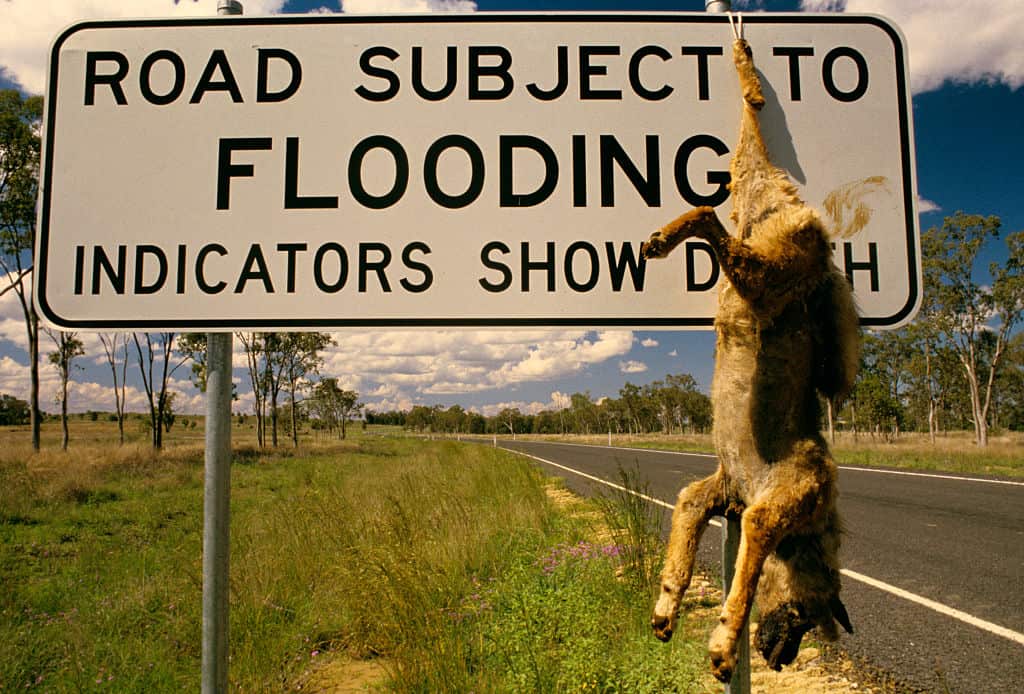
The crystals were soon to be exported en masse around the world. Strychinine became an essential item in the Australian farmer’s toolkit, and by 1852 its use on landholdings was mandatory to control unwanted wildlife. In 1871 author Anthony Trollope wrote in his observations of Australian life:
On many large runs, carts are continually being taken round with (strychnine) baits to be set on the paths of the dingo. In smaller establishments the squatter or his head-man goes about with strychnine in his pocket and lumps of meat tied up in a handkerchief.
Over the course of the 19th century, the Australian economy became irreversibly dependent on this industrial agrochemical farming system.
The pace of Australia’s agricultural revolution was rapid; between 1822, when fine wool became NSW’s major export product, and 1850, the national flock numbers increased from 120,000 to 16 million. By 1892 the Australian sheep flock numbered 106 million.
A central Australian dingo extermination campaign was launched in 1897, to eradicate dingo and rabbit populations from South Australia’s arid zone. Described as the “Party of Poisoners”, the team travelled from Gawler Range to Wilpena Pound, covering an area 1,000km long by 480km wide. It took five months.
The poisoners dispensed phosphorised pollard and strychnine sticks and laid poisoned grain in lightly covered furrows. Meat baits were placed around the bases of the red and white mallee bush. Billabongs were poisoned. All species that might have competed for the scarce resources were effectively eliminated – carnivore and herbivore. Farming ultimately failed in the region. The natural biodiversity never recovered.
The legacy of Australia’s chemical-dependent farming over the past 200 years remains largely unacknowledged in conversations about the current biodiversity crisis. Australia has around 500 threatened animal species, and our rate of mammalian extinctions is unparalleled anywhere in the world. The main drivers of the crisis are attributed to introduced species, changed fire regimes, and land clearing.
In the history of agricultural expansion, it was the dingo that was the initial target of eradication campaigns. Land clearing worked in concert with the broad scale application of vertebrate pesticides. The expansion in the application, range, methods of delivery and quantity of poison and poisoned baits applied was rapid, using increasingly sophisticated machinery.
The effects reverberated throughout Australia’s ecosystems: the removal of the dingo, the top order predator, lead to the explosion of herbivore populations, more poisons, the establishment of introduced species and destabilising of the native ecosystem.
In the 1870s newspapers were reporting on the impact of herbivore populations including the introduced rabbit.
In the 21st century, more vertebrate poisons are dispensed by air in National Parks, than on private land – in efforts to protect biodiversity from invasive species.
Applying more vertebrate pesticides to the environment to try and solve the problem, is arguably an extreme case of mistaking the poison for the cure.
Justine M. Philip received funding from the Federal Government. This research was completed while on an APA scholarship with UNE.

Dateline is an award-winning Australian, international documentary series airing for over 40 years. Each week Dateline scours the globe to bring you a world of daring stories. Read more about Dateline

Have a story or comment? Contact Us







