Above: Watch the emotional story of Greg Kelly’s struggle with early onset dementia via SBS On Demand.
Dementia is the is the leading cause of death among Australian women and the third most common cause of death among men.
While dementia is not a normal part of ageing, the biggest risk factor for dementia is advancing age. Given ours is an ageing population, estimates suggest dementia cases are set to almost triple by 2050.
The brain is our control centre
Everything we do is controlled by the brain. It generates the instructions that tell our body parts what to do, as well as facilitating our complex behaviours, such as personality and cognition (our ability to think, understand and do things).
News that makes sense
Your trusted source for staying up-to-date with the world around you. Get free daily news updates and analysis, straight to your inbox.
When a person has dementia, neurons in various parts of their brain stop communicating properly, disconnect, and gradually die. We call this process neurodegeneration.
Dementia is caused by progressive neurodegenerative diseases. This means the disease starts in one part of our brain and spreads to other parts, affecting more and more functions in the body.
Certain causes of dementia will impact different parts of the brain, and the symptoms a person with dementia develops will depend on what part of their brain is affected.
Memory loss
In the early stages of dementia, a person may experience issues with memory, attention, or personality.
One of the most common things that occurs in dementia is memory loss. It may not be the first change that happens, but it’s often one of the first things people notice. Memory loss begins when neurons in a part of the brain called the hippocampus degenerate and die.
The hippocampus is a bit like a diary – it keeps track of what you do from minute-to-minute. This is why a person with dementia might have trouble keeping track of what they are doing, remembering where they are and how they got there, or forming new memories.

Memory loss can be confronting for sufferers of dementia and their families.
A person with dementia might also experience regressive memory loss, as the disease erodes the neurons storing long-term memories in various locations in the brain’s cortex. As more recent long-term memories are lost, this could mean their most vivid recollections might be from decades ago. This is why a person with dementia might feel like they are existing in another time.
As more parts of the brain succumb to disease, people with dementia will ultimately lose control of functions in the body such as speaking and swallowing, and may eventually fall into a coma.
Dementia doesn’t refer to one specific disease, but to a collection of similar symptoms. It can be caused by Alzheimer’s disease, Parkinson’s disease and many other diseases, or triggered by heart disease, stroke and head injuries. To make things more complex, people can have more than just one type of dementia.
Dementia affects people differently
There are different types of dementia. Each one is characterised by different patterns of symptoms, though every person with the same type of dementia won’t necessarily exhibit the same set of symptoms, especially early on. Just as our personalities can be incredibly diverse, the way dementia may affect personality and behaviour can be very different between individuals.
For example, a person with Alzheimer’s disease will have two main brain regions affected: the hippocampus and the entorhinal cortex. The entorhinal cortex is a specialised part of the brain that works together with the hippocampus to form long-term memories. Together, they take the input from all our senses to help orientate us in space and time, and also help us form declarative memories - things like facts and memories of events.
The changes in the brain of a person with another type of dementia, known as Lewy body dementia, are less established. But they include damage to a slightly different part of the hippocampus, and a loss of neurons that produce the neurotransmitters dopamine and acetylcholine. These neurons are especially important for various aspects of movement, visual perception, and cognition. Because of this, people with Lewy body dementia might experience hallucinations and difficulties with movement.
A person with frontotemporal dementia will experience degeneration that affects the frontal and temporal lobes of the brain, though the exact location can vary between people.
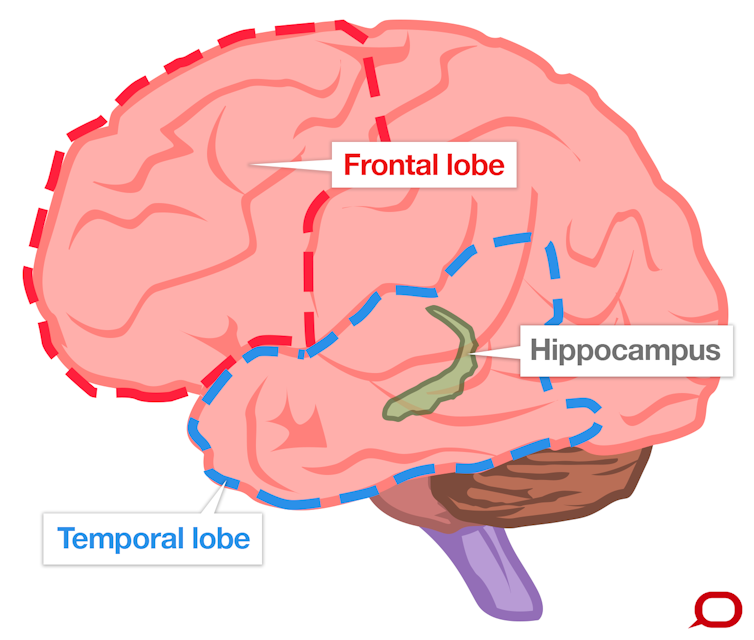
The frontal lobe, temporal lobe and hippocampus can all be affected by different types of dementia. The Conversation, CC BY-ND
The frontal lobe is the part of the brain responsible for our ability to make judgements and decisions, including interpreting what is socially acceptable. So a person with this type of dementia may act on their impulses or vocalise their opinions or thoughts without realising this may be inappropriate. You could say that the loss of behavioural filters means some people with dementia are expressing humanity and emotion in its most raw and true form.
The temporal lobe (which also contains the hippocampus), is the part of the brain that helps us process faces, sounds and scenes, as well as form memories.
Eventually, the disease will spread to other parts of the brain. For example, the neurons in the part of the brain involved in recognising faces (called the fusiform gyrus) may degenerate, resulting in the inability to recognise people. This can happen even when a person with dementia still remembers who you are. For this reason it can be helpful to reintroduce yourself when you talk to a person with dementia.
People with dementia deserve compassion. They don’t have control over their behavioural changes, but we have control over how we react to these changes. Through education and understanding, we can all play a part.

Lila Landowski receives funding from The Royal Hobart Hospital Foundation, and has previously worked for the Wicking Dementia Research and Education Centre.

Dateline is an award-winning Australian, international documentary series airing for over 40 years. Each week Dateline scours the globe to bring you a world of daring stories. Read more about Dateline

Have a story or comment? Contact Us







