
What we learned today
We are closing our live coverage of the Reserve Bank of Australia's (RBA) second board meeting of the year.
Here's what we learned:
- The RBA's Monetary Policy Board raised the official cash rate from 3.85 per cent to 4.10 per cent in the board's first non-unanimous decision since July last year — and one that was decided by just a single vote
- RBA governor Michele Bullock said that, while higher energy prices triggered by the war in the Middle East would contribute to inflation, they weren't the reason behind today's decision: "Inflation was already too high, reflecting the fact that demand is outstripping supply. Higher fuel costs will not slow demand enough on their own to address this"
- Bullock also said that, while the RBA doesn't want to raise interest rates to the point it would suppress growth to the point of inducing a recession, that was not out of the question: "We don't want to have a recession, but if it's hard to get inflation down, then we're going to have to deal with that, possibly"
- Treasurer Jim Chalmers acknowledged that today's decision would be "really tough news" for borrowers and said Australia's pre-existing inflation challenges had been exacerbated by the war in the Middle East
- Meanwhile, Coalition Treasury spokesperson Tim Wilson said Chalmers' "active inflation agenda" was to blame for the RBA rate hike today, saying: "The treasurer will blame international factors, but Australia's inflation problem was reported in the December data from Canberra, not March in Tehran"
- Australia's largest business advocacy group — the Australian Chamber of Commerce and Industry — has said today's rate rise would be a hit to businesses, especially small businesses, and could be the "final nail in the coffin" for some
- Financial Counselling Australia warned that the rate hike would heap further pressure on the organisation that is already dealing with rising demand for its National Debt Helpline and urged lenders to "respond constructively when customers ask for help"
- The Greens urged Treasurer Jim Chalmers to prevent the interest rate hike by overriding the RBA's decision through the country's 1959 Reserve Bank Act.
— Zacharias Szumer
Greens urge treasurer to override RBA rate hike decision
The Greens have urged Treasurer Jim Chalmers to prevent the interest rate hike by overriding the Reserve Bank of Australia's (RBA) decision through the country's 1959 Reserve Bank Act.
Section 11 of the act states that, if the government and RBA board disagree over whether a central bank policy is "directed to the greatest advantage of the people of Australia", and the two parties are unable to reach an agreement, there is a mechanism through which the treasurer can "determine the policy to be adopted by the bank".
"People are already hit by price gouging at the supermarket and petrol pump. They shouldn’t have to contend with another rise in their mortgage or rent as well," Greens leader Larissa Waters said.
She added that parties from across the political spectrum had "driven this wartime economic crisis" by supporting the US and Israel's military actions against Iran.
"They've worsened it by sending troops, and now millions of Australians are paying the price," she said.
— Wing Kuang
How does Australia's inflation rate compare?
In its latest report, the Organisation for Economic Co-operation and Development (OECD) reported an average consumer price index (CPI) of 3.3 per cent.
While the average CPI among OECD countries has been dropping, Australia's has been on the rise, which could put the it at somewhat of an economic disadvantage to comparable global economies.
Economists have told SBS News that Australia's response to conflicts in the Middle East and Europe plays a part in heightened inflation, warning CPI could increase to almost 5 per cent in the weeks ahead.
SBS News' Cameron Carr has more here:
Financial counselling group flags rising debt helpline demand, urges lenders to 'respond constructively'
Financial Counselling Australia has warned that today's rate hike will heap further pressure on the organisation that is already dealing with rising demand for its National Debt Helpline (NDH).
"In February, there were 15,857 calls and online chats to the NDH, the highest number recorded for the month of February since 2020," the peak body for financial counsellors, which coordinates the NDH, said in a statement today.
"The figure represents a 9 per cent increase compared with February 2025," the group said, adding that mortgage stress is the leading reason people contact the NDH.
Financial Counselling Australia CEO Domenique Meyrick advised people who are struggling financially to "contact their bank or lender as soon as possible and ask about hardship options".
"We’re hearing from people who are making incredibly tough decisions, and it's critical that banks and lenders respond constructively when customers ask for help," Meyrick said.
Meyrick also encouraged anyone experiencing financial stress to seek help from a financial counsellor.
"Free and independent help is available, and financial counsellors can help people understand their options and deal with creditors," she said.
— Zacharias Szumer
Why didn't the RBA 'get the job done' with a higher rate increase?
Headline inflation is at 3.8 per cent, far higher than the Reserve Bank of Australia's (RBA) 2-3 per cent target range, with a preference for the midpoint of 2.5 per cent.
During her press conference this afternoon, RBA governor Michele Bullock was asked why the board didn't hike the rate by 50 percentage points rather than 25 to "get the job done".
Bullock said there was a lot of uncertainty at the moment.
"We think that we can get into restrictive territory and bring it down in a reasonable time," she said.
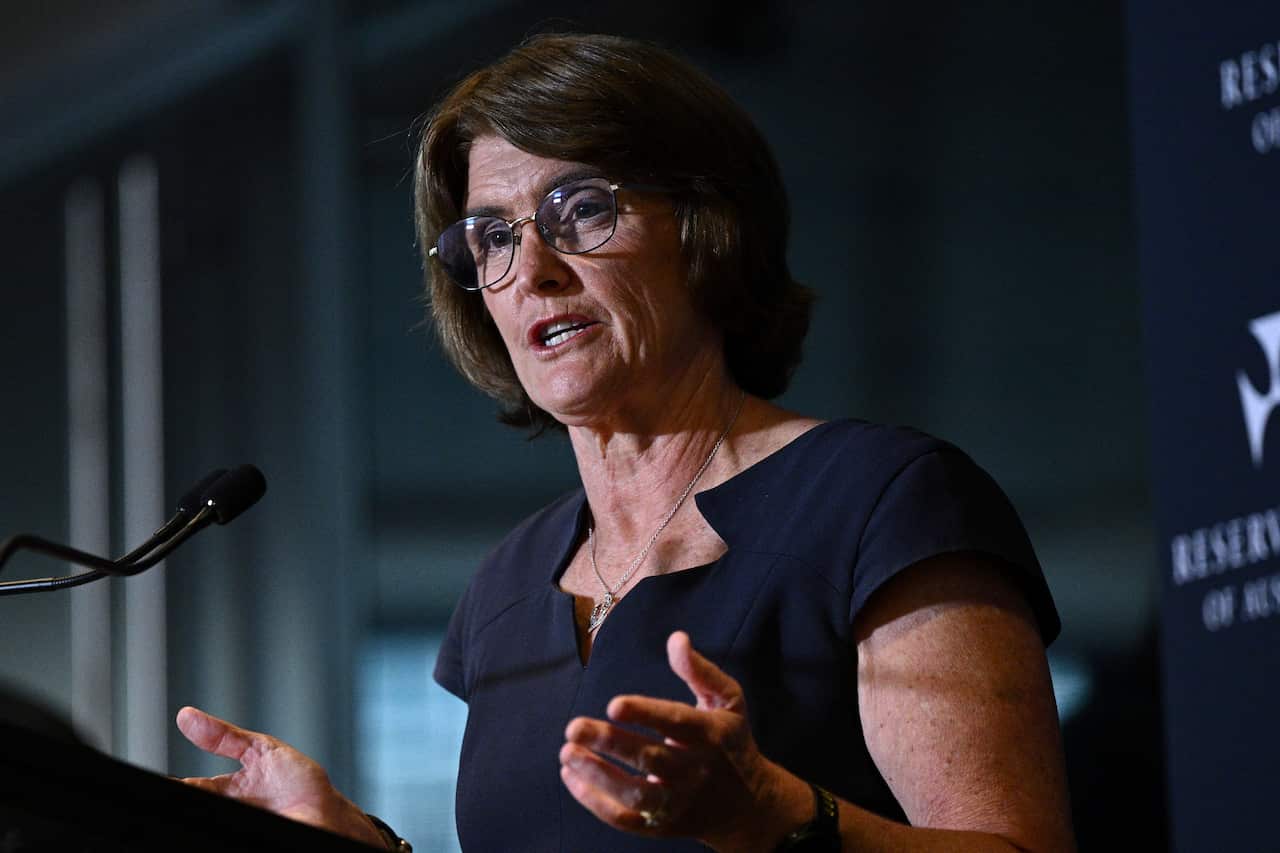
"We do need to do something to bring [inflation] back down, which we are doing — 50 is a lot. We're trying to do this in a way, as I said, the strategy being bringing excess demand down without giving up a lot of the gains in the labour market, keeping a reasonably stable labour market. That is still the strategy."
Bullock said the uncertainty of the conflict in the Middle East was "just another reason to be a little bit cautious".
The majority of the RBA's rate hikes or decreases since 2022 have been by 25 points, though it raised it by 50 points four times in a row that year. The most recent time it was increased by 50 points was in September 2022.
— Alex Gallagher
By how much could your mortgage repayments increase?
Assuming the banks pass along the Reserve Bank's cash rate hike, those with a mortgage will be facing higher repayment costs.
Financial comparison site Canstar said that for someone with a $600,000 mortgage with 25 years remaining, the hike will translate to a $91 increase in their minimum monthly repayments, according to its modelling.
Finder, another financial comparison site, said that for someone on the average loan of $736,259 with 30 years to go, their monthly repayments would increase by $118 to $4,410. For someone on a $1,000,000 loan, their monthly payment would rise by $160 to $5,989.
— Alex Gallagher
RBA rate hike 'all pain, no gain', Australia Institute economist says
The decision by the Reserve Bank of Australia (RBA) to hike interest rates today will inflict unnecessary pain on households, Australia Institute senior economist Matt Grudnoff has said.
The progressive think tank's economist said the RBA's board's decision was a case of "all pain, no gain" for Australians.
He said the energy supply shock caused by the war in the Middle East would naturally push up inflation, but the RBA had said it shouldn't respond to such shocks by lifting rates.
"Inflation caused by a supply shock cannot be brought down by increasing interest rates. How can increasing Australian interest rates open the Strait of Hormuz?" he queried.
"The increase in fuel prices is already acting to reduce demand in the Australian economy. Higher petrol and diesel prices mean people have less to spend on other things, and as these fuels are largely imported, all the extra revenue is flowing overseas.
"At a time of great economic uncertainty, now is not the time for the RBA to be tapping the brakes, trying to slow the economy down."
RBA governor Michele Bullock has said that, while higher energy prices triggered by the war in the Middle East would contribute to inflation, they weren't the reason behind today's decision.
— Zacharias Szumer
Australia may face recession if inflation doesn't drop, Bullock warns
Reserve Bank of Australia (RBA) governor Michele Bullock has been asked if she would be willing to put Australia into recession if that's what it takes to bring inflation down.
She said that, while the RBA doesn't want to do that, it's not out of the question.
"The strategy is still the same. We still want to bring the output gap down at the same time as we bring inflation down. We've been trying to do that, and we think we've had some success, but inflation has sprung up again," Bullock said.
"I wouldn't say we want to do that, but in the end, if we don't have low and stable inflation over time, we won't have full employment. It doesn't work like that. The best contribution we can make to full employment, and in fact things like investment, productivity and so on, is to have low and stable inflation.
"So we do need to keep our eye focused on that ball. We don't want to have a recession, but if it's hard to get inflation down, then we're going to have to deal with that, possibly."
— Alex Gallagher
Bullock explains reasons behind split decision
Michele Bullock was asked, given the split five-four vote at today's meeting, what the arguments were for holding the cash rate.
"The things that all the members agreed on were that inflation is too high, that there are still inflationary pressures from excess demand in the economy, and that inflation expectations, we need to make sure they're anchored. Where the difference was, was in the timing," Bullock replied.
She said the members that voted to hold were doing so in a "hawkish sense", and still believed that there would probably need to be another rate rise.

Bullock said one of the arguments for holding was uncertainty around the length and potential impact of the war in the Middle East.
"It wasn't quite certain what was going to happen there. It could be quick and it could all be resolved, or if it wasn't, what the potential implications of that might be for growth in the world economy and growth in Australia. So, maybe it was prudent just to wait for another few months [until the next board meeting] and just see."
"The second thing was [wanting] some more confirmation in data from labour market and inflation in particular that we are where we thought we would be."
— Alex Gallagher
Bullock says higher petrol prices not behind today's decision
Reserve Bank of Australia (RBA) governor Michele Bullock is giving her standard post-cash-rate-decision press conference.
"The economy grew faster than its potential growth rate over the second half of last year, the labour market has tightened a little recently, rather than being stable, as we expected, and underlying inflation remains high," Bullock said.
"Taken together, the data suggests there is slightly more excess demand in the economy than we thought in February, and inflationary pressures are therefore somewhat greater."
The economy grew 2.6 per cent in the December quarter from a year earlier, far above the RBA's 2 per cent estimate of potential growth.
Underlying inflation rose to 3.4 per cent in the year to January, up from 3.3 per cent in the year to December 2025. The jobless rate has also held at a historic low of 4.1 per cent.
Bullock said that, while higher energy prices triggered by the war in the Middle East would contribute to inflation, they weren't the reason behind today's decision.
"Inflation was already too high, reflecting the fact that demand is outstripping supply. Higher fuel costs will not slow demand enough on their own to address this. If we do not act, these price pressures will spread and the eventual adjustment would be harder."
— Alex Gallagher
Wilson pins blame on treasurer's 'active inflation agenda'
Jim Chalmers' Opposition counterpart has said the treasurer's "active inflation agenda" is to blame for the Reserve Bank of Australia's rate hike today.
"The treasurer will blame international factors, but Australia's inflation problem was reported in the December data from Canberra, not March in Tehran," Coalition Treasury spokesperson Tim Wilson said.
He also seemingly zeroed in on government borrowing and spending, saying Chalmers "doesn’t understand that by pouring debt petrol on the inflation fire, he is stoking it".
"Australians are living the consequences of the treasurer's inflation denial. When Australians pay their mortgage or go to the supermarket, they feel the consequences of Jim Chalmers' active inflation agenda, whether he acknowledges it or not."
— Zacharias Szumer
Business body warns rate hike could be 'final nail in the coffin' for some
Australia's largest business advocacy group has said today's rate rise would be a hit to businesses, especially small businesses, and could be the "final nail in the coffin" for some.
Australian Chamber of Commerce and Industry chief executive officer Andrew McKellar said: "Even prior to the fuel shortage crisis, inflationary pressures had grown to unsustainable levels."
"The surge in fuel prices is flowing through to freight, production and material input costs," he said in a statement issued by the group.
"Higher interest rates will only add to the burden on businesses already under extreme cost pressures of doing business.
"This may be the final nail in the coffin for many businesses already stretched after years of weak economic activity and tight margins."
McKellar also said inflation had been made worse by a "high level of government spending" and productivity increases not keeping pace with economic growth.
— Zacharias Szumer
Treasurer says war in Middle East behind today's 'really tough news'
Treasurer Jim Chalmers has acknowledged that today's decision will be "really tough news" for the millions of Australians with a mortgage.
Chalmers said in a statement that Australia's pre-existing inflation challenges had been exacerbated by the war in the Middle East.
"Inflation has moderated significantly from its peak, but it is higher than we would like, and conflict overseas has put upward pressure on global fuel prices," Chalmers said.
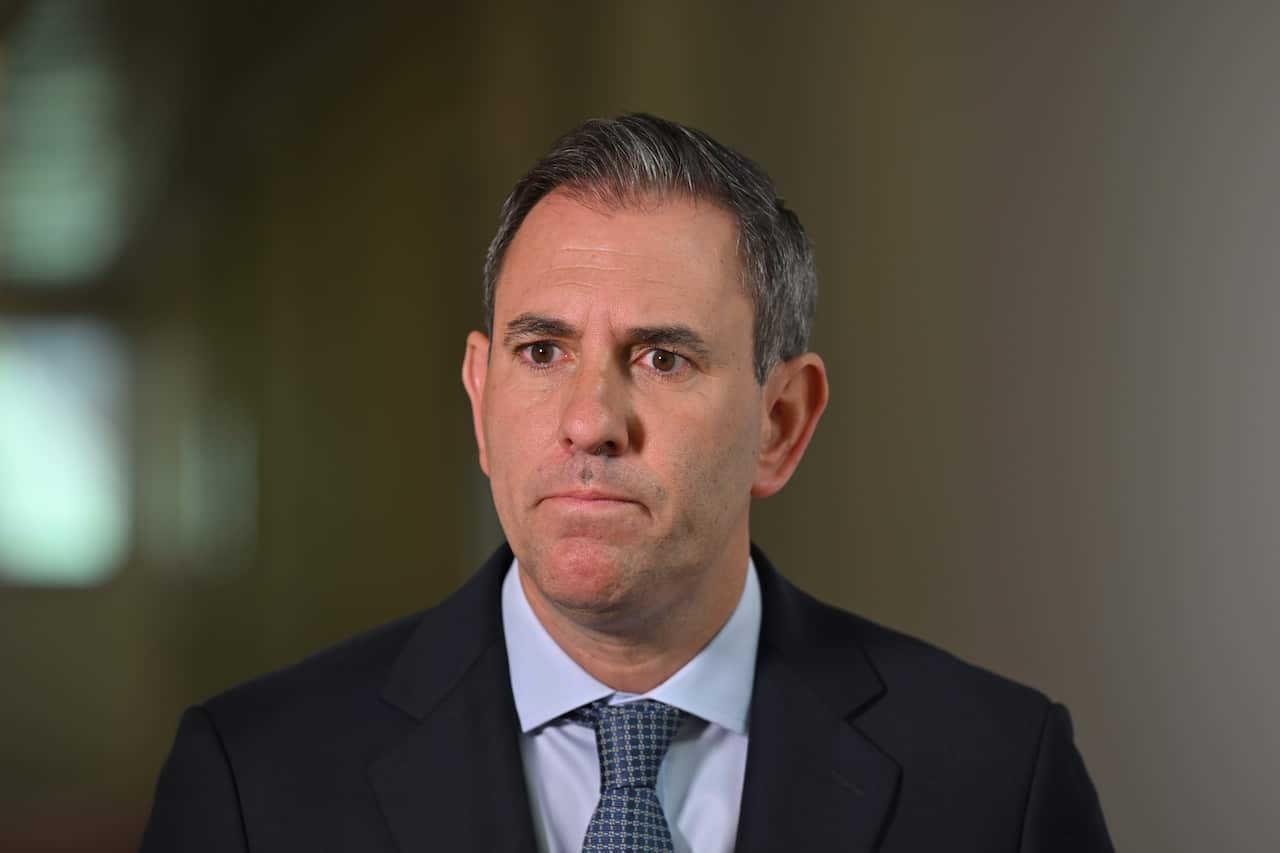
"Many Australians were already doing it tough and are now feeling the impact of conflict in the Middle East through higher petrol prices as well."
Chalmers added that the duration of the conflict would determine how much pressure it adds to global inflation.
— Alex Gallagher
The RBA's first divided decision since July 2025
Notably, today's cash-rate call is the first non-unanimous decision of the Reserve Bank's Monetary Policy Board since July last year — and was decided by just a single vote.
Five members of the board voted to increase the cash rate to 4.10 per cent, with four members voting to leave it unchanged at 3.85 per cent.
In July 2025, six board members were in favour of leaving rates on hold at 3.85 per cent, after lowering it from 4.10 per cent at its previous meeting, with three against.
Since August 2025, the board has been united in all of its decisions.
— Alex Gallagher
Why did the Reserve Bank increase rates?
The Reserve Bank of Australia (RBA) has said that, while inflation had fallen substantially since its peak in 2022, it picked up materially in the second half of 2025.
Information received since its last meeting in February indicated that the increase in inflation partially reflected "greater capacity pressures", it said in a statement announcing its decision to raise the official cash rate from 3.85 per cent to 4.10 per cent.
It added that the conflict in the Middle East had led to sharply higher fuel prices that, if sustained, would add to inflation.
As a result, the board determined that there was a material risk that inflation would remain above target for longer than it had previously anticipated, making it appropriate to increase the cash rate target.
— Alex Gallagher
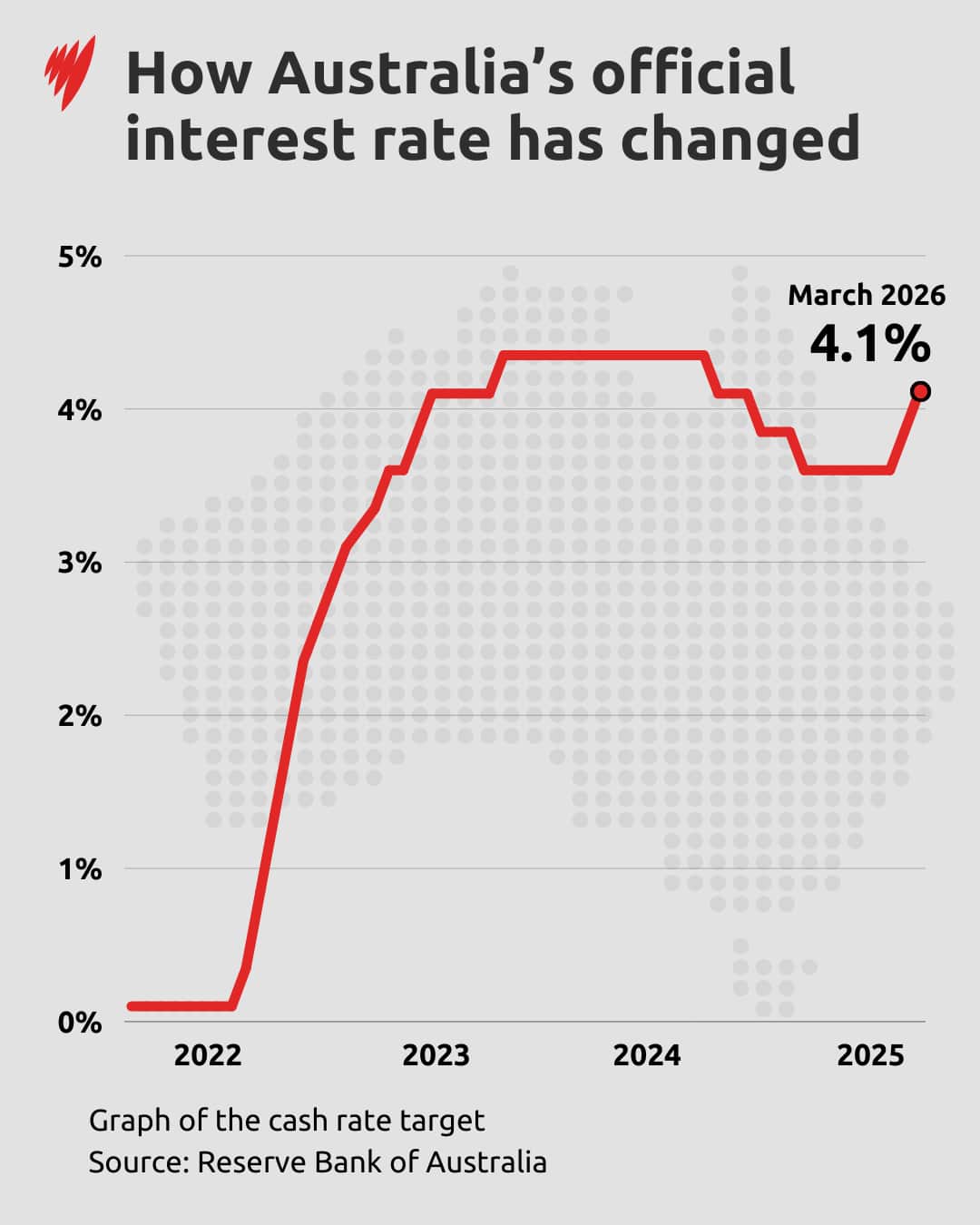
The Reserve Bank has hiked rates again
The Reserve Bank of Australia (RBA) has raised the official cash rate from 3.85 per cent to 4.10 per cent at its second board meeting of the year.
It's the central bank's second rate hike in as many months, and was predicted by the 'big four' banks amid concerns about inflation and war in the Middle East.
RBA governor Michele Bullock will be speaking to the press about the decision in an hour's time.
— Alex Gallagher
SBS On the Money on the factors facing the RBA
SBS Finance Editor Ricardo Gonçalves recently spoke with Mathan Somasundaram from Deep Data Analytics about today's Reserve Bank of Australia (RBA) interest rate decision.
Somasundaram talked about how the war in the Middle East and the current strength of the Australian dollar could affect the central bank's decision.
He also discussed what markets are expecting and how central banks around the world are reacting to the current geopolitical and economic environment.
Listen to the full interview here: Markets brace for rate rise and can you trust AI for financial advice
— Zacharias Szumer
RBA could be facing its 'most complicated' rates call in years
The Reserve Bank of Australia (RBA) will today face one of its most challenging interest rate decisions in years, experts say.
Until a week ago, the central bank was widely expected to keep interest rates on hold at its March board meeting.
But that's changed with the war in the Middle East, which has blocked the passage of oil through the Strait of Hormuz, sparked turmoil in energy markets and sent fuel prices soaring.
While the RBA's decisions are often unanimous, AMP chief economist Shane Oliver told SBS News that this month's meeting is the "most complicated" in years.
"With uncertainty from the war in the Middle East and fuel costs, there could be members who want to wait for the dust to settle before a rate hike," he said.
"But I think ultimately the decision will be to raise rates again to head off concerns that they're going to lose further control of inflation."
Read more: The RBA faces its 'most complicated' rates call in years. What could it mean for you?
— Zacharias Szumer
Welcome to the live blog
Thanks for joining our coverage of the Reserve Bank of Australia's (RBA) second board meeting of the year, which began yesterday and will wrap up today.
The central bank is widely expected to raise the cash rate again, after lifting it from 3.60 to 3.85 per cent at its February meeting — its first rate hike in more than two years.
All of Australia's 'big four' banks believe another rate hike is imminent, amid concerns around inflation and the potential impact of war in the Middle East on domestic pressures.
As usual, the decision will be announced at 2.30pm, with RBA governor Michele Bullock giving a press conference an hour later.
We'll bring you all the important developments as they unfold.
— Alex Gallagher







