
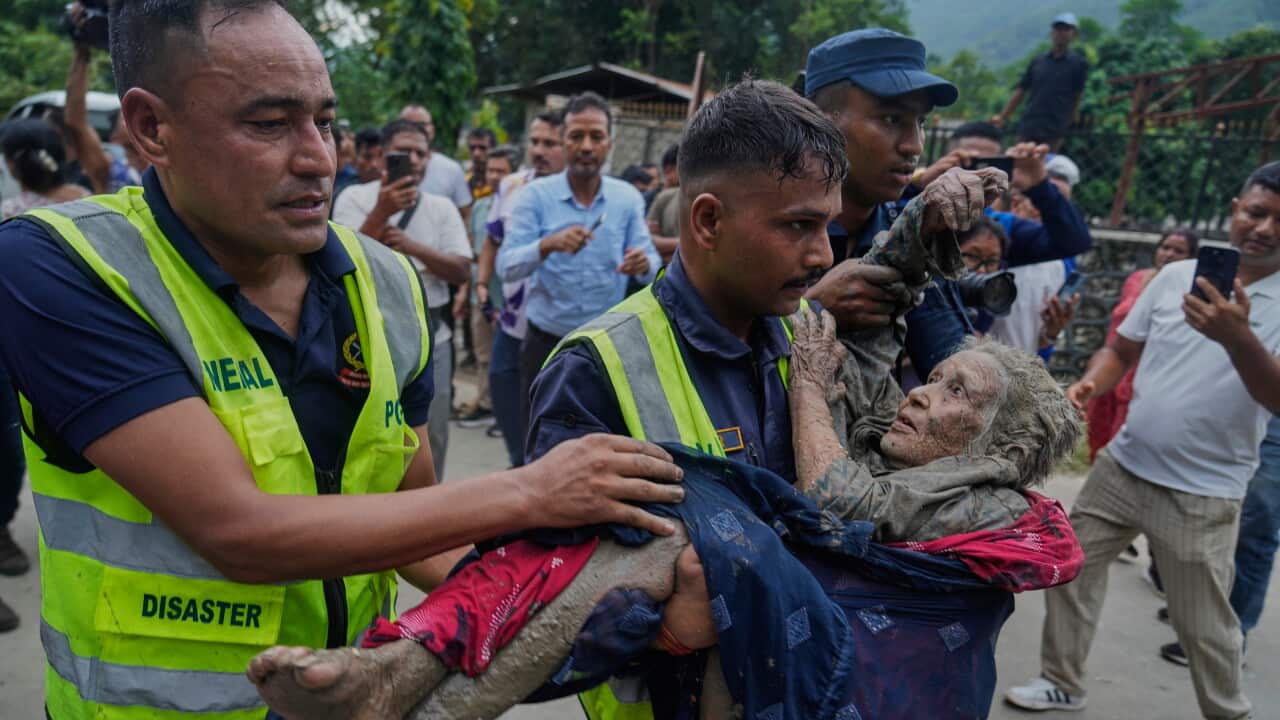

At least 160 people have been killed, and hundreds including tourists and 34 Australians are missing, following the deadly flash floods on the Nepal-Tibet border. Local authorities say more than 150 bodies have been recovered. Foreign Minister Penny Wong says those missing are part of separate pilgrimage and tour groups. As the search continues, questions are being raised about what triggered the flood, and the risks of a new flood.
Listen to Australian and world news and follow trending topics with SBS News Podcasts.
Australians seeking emergency consular assistance can contact DFAT's 24-hour Consular Emergency Centre on 1300 555 135, or from overseas on +61 2 6261 3305.
TRANSCRIPT
“When I reached Dhunge bazaar, in half an hour, the flood came and damaged all the market. People were preparing to go to office then. How many people are missing or dead- we don’t know.”
That's a local resident Shoyam Rajbhandari [[shoh-yam rahj-bhan-dah-ree]] in hard-hit Nuwakot district of Nepal.
At least 160 people have been killed in Nepal and China following flash flooding along the Nepal-Tibet border.
Local police earlier reported 157 bodies were located, and officers are working to move families in flood-risk areas to safer locations.
Homes, roads and bridges have been swept away by mud and floodwaters.
Hundreds remain missing, including 34 Australians, as confirmed by Prime Minister Anthony Albanese.
"A truly horrific event. At this point, there are 34 Australians who are missing. We are asking for those with information ... can contact our consular people. At this point, Nepal, you know, is a developing country. It doesn't have the resources that an event like that would have in Australia. So information is difficult."
That includes two young boys aged 11 and 14 among the Australians missing.
Foreign Minister Penny Wong says those missing are part of separate pilgrimage and tour groups.
"I've spoken this morning to the ambassador for Australia to Nepal, Simon Ernst, and I've also spoken to Scott Dewar our ambassador in Beijing. I've conveyed to them our support. My request that they do everything that they are able to ascertain the welfare of any Australians, and I've invited them to contact me if they need further assistance. We are currently deploying further DFAT personnel including crisis response personnel to the region."
She says they are coordinating with the Nepali government and other humanitarian response.
Earlier, the Nepal Tourism Board said among 403 tourists - majority of them are missing foreign nationals.
Among the missing foreigners are Indians, others from Australia, Britain, Malaysia, the Netherlands, Portugal, South Africa, South Korea and the United States.
The Department of Foreign Affairs and Trade says they are urgently working to confirm the welfare of Australians in the area and are liaising with local authorities and tour operators.
This survivor, Keshav Prasad Baral says he manged to escape to the roof of his home, but is traumatised that his wife was swept away.
"I was at the terrace and the flood hit the top floor as well. It only subsided after an hour or so. My wife was already buried in the mudslide while we stayed on the terrace for safety. After four or five hours I was rescued by a helicopter."
In a statement on social media, Nepal's Prime Minister Balendra Shah assured those affected that they are not alone in this difficult time, promising an all-out response.
Across South Asia, monsoon rains from June to September usually trigger deadly floods and landslides.
The disaster has cut out communications in one of the world's most difficult environments for rescue operations.
The Nepal head of the International Federation of Red Cross and Red Crescent Societies, David Fisher says entire villages and market areas have been wiped out.
Tara Gautam is from the Nepal Embassy in Australia.
"Given the extremely difficult terrain of Nepal and, those districts which are affected are very difficult to reach, inaccessible. We have heard that it's raining in the area, and the communication lines have been cut off. So it is difficult to get to the people who are looking for help. We've heard that more than 400 tourists are trapped, pilgrims are trapped in the area. They were trying to reach, to go to Gosaikunda, holy place in Rasuwa district."
But many are asking what caused the floods in the first place?
According to Nepal's disaster authority, satellite data indicated that a snow-rock landslide on the Nepal-China border may have caused the flood.
Nepal's Foreign Minister Shishir Khanal believes an earthquake likely triggered a landslide, which in turn blocked a river, sending water gushing downstream.
The cause of the flooding was not immediately clear, but experts have cautioned that a lingering blockage in a river could produce an additional flood.
And a remote sensing and geo-information analyst at the Kathmandu-based International Centre for Integrated Mountain Development (ICIMOD), Sarthak Shrestha says a preliminary assessment showed "no anomalies" from China's side of the border.
Scientists say climate change is increasing the frequency and intensity of extreme weather events in the region.
The International Centre for Integrated Mountain Development has warned of the potential for a second flood.
Meanwhile, the Nepal cricket team is in Darwin as part of the Top End Series T20 cricket tournament.
Today, Northern Territory cricket will be holding a minute's silence before each game.
As rescue teams continue to wade through mud in search for survivors, and emergency teams dispatch aid, that uncertainty can be agonising for families in Australia.
For those caught in the situation, the hope is the same - that the next call brings good news.