
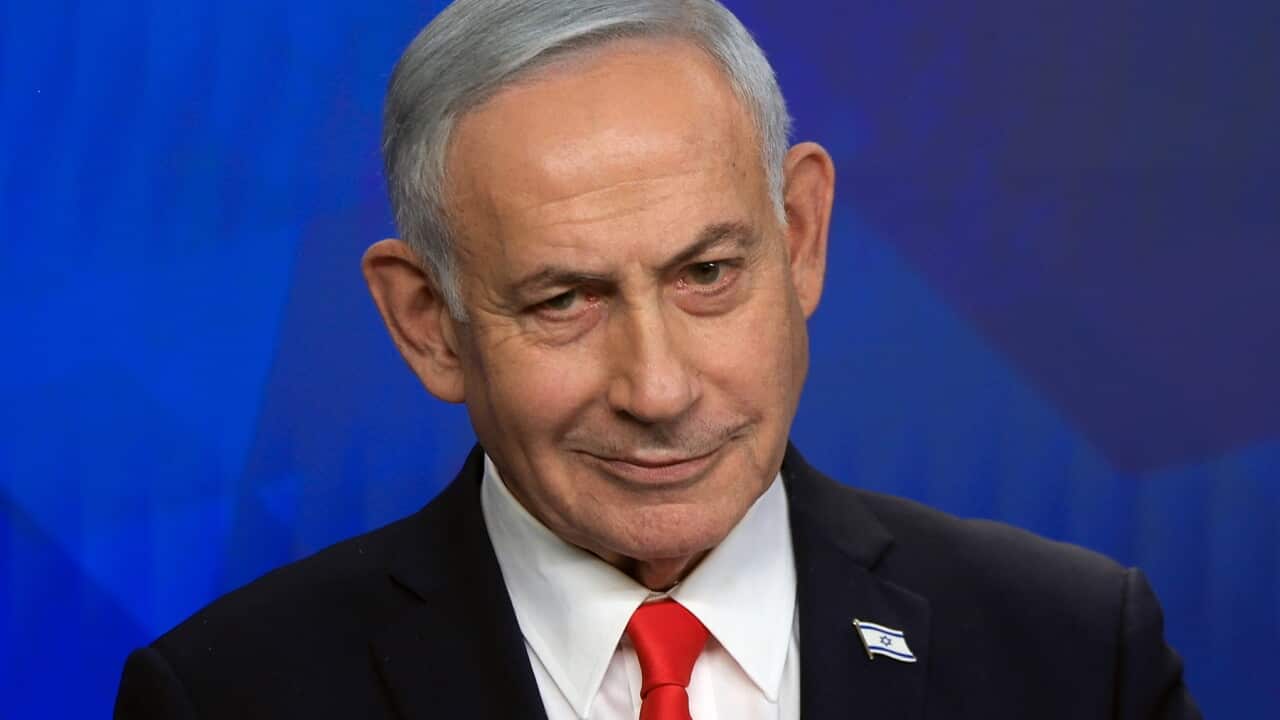

A crucial election is looming for Israel and its prime minister, Benjamin Netanyahu. It's shaping up to be less a fight between right and left than a contest between Netanyahu's supporters and rivals. The initial peace deal between the U-S and Iran has seen angry reactions across Israel, with many angry at Netanyahu for what his opponents say is a 'shocking failure'. So, where does the nation's longest-serving prime minister stand as the vote approaches?
Listen to Australian and world news and follow trending topics with SBS News Podcasts.
TRANSCRIPT
There's an enormous amount at stake for Israelis — and their prime minister, Benjamin Netanyahu — as the country prepares to head to the polls later this year.
Things look very different in Israel since its last elections. The country suffered the deadliest attack in its history on October 7, 2023, precipitating a two-year war in Gaza that has been followed by a wider regional conflict in the Middle East.
And Benjamin Netanyahu, embroiled in a long-running corruption trial domestically, is also the subject of an International Criminal Court arrest warrant over alleged war crimes in Gaza.
Dr Ran Porat, an expert in Israel and Middle Eastern affairs at Monash University's Australian Centre for Jewish Civilisation, says many Israelis feel it's time for a change.
‘The bottom line is that everything changed from the previous elections to this one. Israel's standing in the world is facing major challenges. Israel's security is facing major challenges across several fronts ... The next elections are seen by many Israelis as very much crucial. A lot is at stake.’
Polls suggest Netanyahu, who has served nearly 19 non-consecutive years in office since he was first elected in 1996, remains a dominant political figure, but is vulnerable as he enters the election period.
Dahlia Scheindlin is a political scientist and public opinion researcher who's advised on nine Israeli electoral campaigns.
She says while Netanyahu's Likud party generally leads in the polls, it can't form a government alone, and an alliance of new and existing opposition parties could end up with more seats than a future Netanyahu coalition.
Currently, Netanyahu's party is in government with a coalition of four other conservative and far-right parties.
‘You don't need to be the biggest party in Israel to form the coalition. You just need to be the party that has a majority of the parliamentary seats who are willing to support or vote in favour of establishing your coalition. So the coalition building puzzle is quite a bit more complicated. Netanyahu's loyalist parties, the ones who form the current coalition, are not getting a majority in any credible survey right now.’
Benjamin Netanyahu's frayed coalition government, considered the most right-wing in Israel's history, moved to dissolve parliament and trigger early national elections.
So, who are his key rivals expected to be?
To answer that, it helps to first understand Israel's electoral system, which is quite different to Australia's.
Israelis don't vote directly for any individual candidates or elect a representative for the area they live in. Instead, the entire country is treated as one electorate, and voters cast their ballots for a political party.
The 120 seats of the Israeli parliament, known as the Knesset, are then allocated based on each party's share of the national vote.
After the election, parties negotiate with others to try to form a government. The leader who can assemble a majority coalition becomes prime minister.
That means the key question isn't just which party wins the most votes, but who can forge the deals needed to assemble a coalition of at least 61 seats.
Scheindlin says the numbers don't currently stack up for Benjamin Netanyahu to form a coalition.
‘In all of the surveys -- and we have many of them -- for the last two years, they're only getting between 49 and 55 or 56 seats out of the 120, so not a majority, not 61.’
But the path to a majority for the parties that oppose him is also unclear.
‘The opposition parties, obviously mathematically, they're getting between 65 and 70 seats. And they are too divided amongst themselves, primarily between the Jewish or Zionist parties, who have basically announced or promised, in more or less explicit terms, not to form a coalition with other opposition parties who represent Arab and Palestinian citizens of Israel.’
In the lead-up to this election, Israel's political parties can broadly be divided into two camps: those willing to serve in a government led by Netanyahu, and those who aren't.
Earlier this year, two of Netanyahu's former allies, centrist Yair Lapid and right-wing Naftali Bennett, joined forces, merging their parties to form a new one, called Together.
It's been polling within striking distance of Netanyahu's party.
‘The closest party that is either tied with him or just a little bit lower than him right now is a merged list of two different parties. One of them is currently the head of the opposition, that's the second biggest party in the outgoing Knesset. It's a sort of centrist party led by former Prime Minister Yair Lapid, which has merged with another former Prime Minister, Naftali Bennett, who comes from the further right. But nevertheless, they formed a government in 2021 together without Netanyahu.’
Bennett is considered one of the main contenders to succeed Netanyahu. His appeal, in part, is that he can attract some right-wing voters who oppose Netanyahu.
Another popular name in the mix is former Israeli Defence Force chief of staff Gadi Eisenkot, who founded the Yashar party last year after resigning from another party in the Knesset.
‘People have always appreciated the chiefs of staff. We have a long tradition of army people, former career military people, joining politics once they're out of the army. And Gadi Eisenkot in particular, this former chief of staff, has always been very well received. People find him somehow honest, they see him as a person of integrity, as a professional. Again, somehow above politics.’
Eisenkot's Yashar party, which roughly translates from Hebrew as straightfoward or honest, does not currently hold any Knesset seats, but it has been making gains in the polls.
‘His star is on the rise right now. He's also a bereaved father. Not only his son, but also his nephew, were killed in these recent wars.’
Together and Yashar are both part of the broader anti-Netanyahu camp and would most likely need to cooperate to form a government.
Dr Shahar Burla is a contributing editor at the Jewish Independent, who holds a PhD in political science from Israel's Bar-Ilan University.
He says the definitions of left and right have become blurry in Israel during Netanyahu's time in power.
‘At the moment, the camps are not left versus right. It's basically Bibi, just Netanyahu, versus no Bibi, or nothing to do with Bibi. So that's the two main camps, that's the opposition. And the coalition is parties that willing to sit with Bibi and actually see Bibi as someone that they can use or is actually a good prime minister, and the other see him as a corrupt leader that there is no chance they will sit with him.’
He says several talking points will be front and centre in this election.
"The main thing I would say, is the rule of law and the respect for the democracy, the respect for the Supreme Court. And so that's one thing. The other thing that will be very prominent is the ultra-Orthodox army draft law. At the moment there is an exception of ultra-Orthodox men and women to join the army if they decide to study religious studies. After October 7, this has become unsustainable because the army needs more soldiers, and there is a big pressure by the Supreme Court and by the Israeli public that changes to the draft law will be made, so more ultra-Orthodox in young people will join the army.’
Netanyahu's ultra-Orthodox coalition partners are fiercely opposed to the change.
Security, responsibility for the October 7 attacks, and Netanyahu's leadership will also be key election issues.
With the prime minister facing legal challenges at home and abroad, it raises questions about the personal implications of an election loss.
In 2019, Israeli prosecutors charged Netanyahu with bribery, fraud and breach of trust. He rejects the allegations and characterises the case against him as a witch hunt.
His ongoing criminal trial began in 2020, but it has faced repeated delays due to the size and complexity of the case and the prime minister's official duties.
Burla says it's going to be much more than just a political fight for Netanyahu.
‘It will be a disaster for him if he will lose the election because all his leverage at the moment in the trial is him being the prime minister. It gives him a lot of a lot of leverage and ability to also use the international community, people like Trump, to try to press President Herzog to give him a pardon or to press these judges. He used his role as a prime minister to change his testimony days.’
If Netanyahu loses, he could still serve as opposition leader.
But Scheindlin is sceptical that removing him from office would result in a jail sentence.
‘He'll have a nice long life, making a great deal of money on the private speaking circuit. He'll probably build a big career being involved in various businesses and boards, but he won't be in power. ... Remember, he's been prime minister for most of the time since he was indicted, save for the 18 months when you had a different government, and it did not stop his trial. I think that we might be overstating the case to assume that he has to stay in power in order to stay out of jail.’
As for the war crimes charges in the International Criminal Court, an international law expert says losing the prime ministership would not change how Netanyahu is viewed by the ICC, but it could make him more vulnerable to arrest or prosecution by other countries.
It's due to a blanket protection called personal immunity, which applies to sitting heads of state and government.
‘That means that no foreign national court can prosecute him for any crimes, including war crimes, crimes against humanity, genocide.’
That's Rosemary Grey, director of the Sydney Centre for International Law and a senior lecturer at the University of Sydney's law school.
She says there is some dispute in the legal community over whether personal immunity protections apply in the ICC, making some of its 125 member states reluctant to arrest indicted officials who travel abroad.
In effect, that could make international travel riskier for Netanyahu.
‘If he loses the election, there are two effects. First, he could be exposed to prosecution in another country, and second, states that are parties to the ICC might be more inclined to arrest and surrender him to the Hague because they could be certain that there's no immunity that could protect him even before that international court.’
While it's not yet clear what path the prime minister has to hold on to his job, Porat notes that Netanyahu is a political survivor.
‘Never bet against Netanyahu. If I learned anything, is never to bet against him. He's the ultimate comeback kid.’