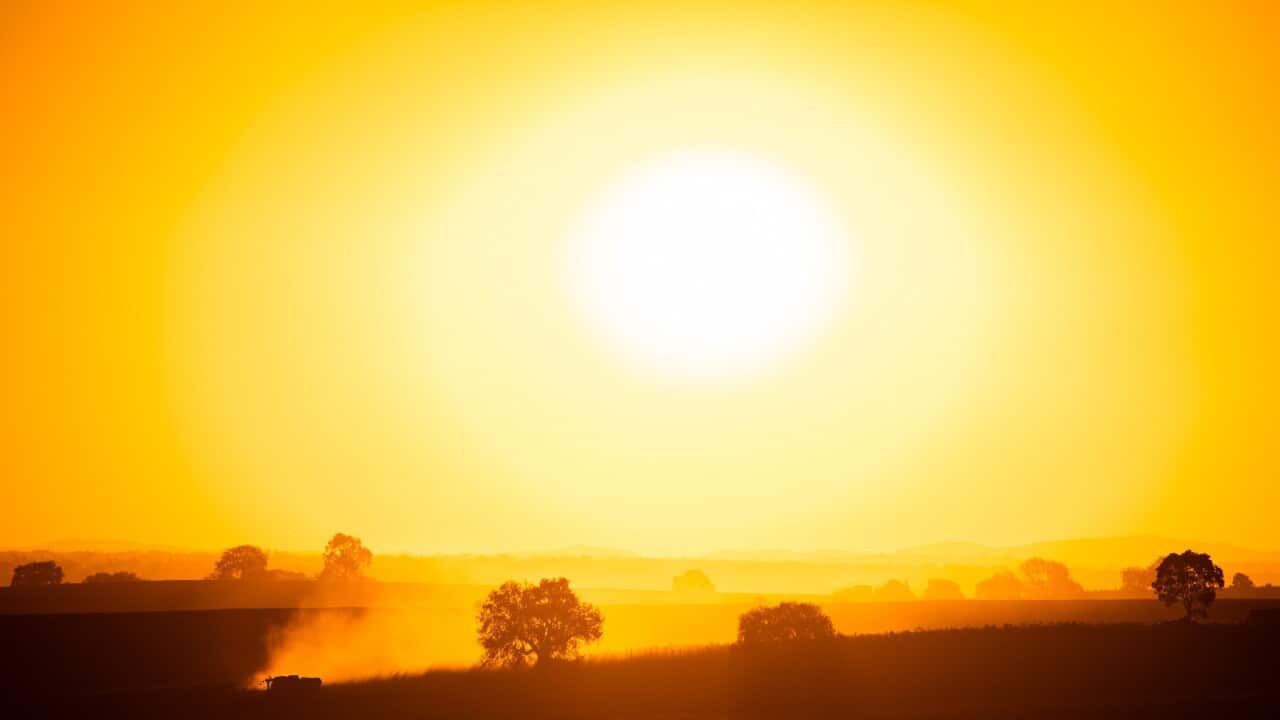

As climate change causes large parts of the northern hemisphere to experience high heat and raging wildfires, forecasters are warning it is a preview of what is to come for Australia. A very strong El Nino system is in play for the first time in a decade - and it's combining with other weather patterns to present a steamy forecast for spring and summer in the Asia Pacific.
Listen to Australian and world news and follow trending topics with SBS News Podcasts.
TRANSCRIPT
For months, we have watched from afar as swathes of the northern hemisphere burn.
Hundreds of thousands of acres destroyed in France, Spain, hundreds of thousands of homes, evacuated.
This week, tourists in Madrid have been caught off guard by the unusual heat.
"We checked what the weather is like when you usually come here at this time of the year and yes, it is a lot warmer than we expected. But you know, we come from a place in the United States that has a lot of weather like this, so we thought we would escape that weather coming here, but we did not."
Scorching temperatures are plaguing parts of North America and bringing fire: in Spokane , Washington state and parts of Canada.
Bureau of Meteorology climatologist Zhi Weng says soon, much of Australia will likely swelter, too .
He says there is a high chance much of the nation's south-east and southwest will experience one of the warmest springs on record.
"So, western parts of Western Australia, extending into southern Queensland and parts of south Australia, there is a strong indication that temperatures will be in the top 20 per cent of historical records for spring."
But Australia's expected spring and summer heat aren't driven by the same factors that are driving temperatures skyward in Europe and North America.
Those continents have experienced the impact of climate change in the past few months, with record high temperatures and subsequent high fire danger.
El Niño is an event measured by the sea surface temperature of the Pacific Ocean - it has a strong impact on the Asia Pacific - but far less on Europe and North America.
This year, El Niño is in play, bringing hotter temperatures and less rain.
And it is a stronger El Niño than in previous years - last week the index reached more than 2 degrees [[+2.02]] for the first time in a decade.
Dr Andrew Watkins - an adjunct professor at Monash University and a Climate Council researcher - says, this year, Australia is being presented with a triple threat: climate change, plus two weather systems that typically drive warmer weather patterns.
As well as El Niño, there is a positive phase for the Indian Ocean dipole - meaning sustained changes in the difference between sea surface temperatures.
"And that is effectively El Nino but in the Indian Ocean. And unfortunately, that pattern really sets in until summer, when the Asian monsoon comes in and knocks it over. But if we have climate change and El Nino and a positive Indian Ocean dipole, they are three things that all push south east Australia into hotter and drier and especially the spring period."
A very strong El Niño doesn't necessarily follow through to record-breaking heat - but there is a strong pattern.
In the past few years in which El Ninos have been present, they've brought ever-increasing and lengthening heat waves around the nation.
And they can create something climatologists call "flash droughts" - a phenomenon brought about by short-term high heat that zaps moisture and creates a strong fire risk.
"And that has devastating impacts in terms of fire, in terms of water security and so on. The risk of flash drought over spring and summer really, and this is hard to find the actual scientific papers that show this, but as a former operational climatologist it really keeps me awake at night."
Greg Mullins is the former Commissioner of New South Wales Fire and Rescue Service.
In recent years, he has used his expertise to drive action on climate change preparedness and risk evaluation, as a member of the Climate Council.
In an interview with ABC 's 730 report this week, he says the nation is coming into the spring and summer fire season with too much growth, because of prolonged rain events in parts of the country since 2020.
"And what we increasingly find is that conditions swing from being too wet, to suddenly too hot and dry. And we have had hazard reduction burns in Sydney for example, get out of hand just a week after we've had rain. So, the hotter temperatures dry out the bush very quickly and the effectiveness of hazard reduction, not the effectiveness, but the ability to carry out hazard reduction - the windows have reduced from months every year to just weeks."
Although the BOM says this summer, there are signs rain could disrupt the summer bushfire threat in many areas.
"That drier than average pattern that we're seeing for September does break down for much of the country and we start seeing either above average rainfall being favoured or even a not clear signal for a lot of the country. The one exception would be far southern parts of the country so southeast, far south east Australia so Victoria and Tasmania."