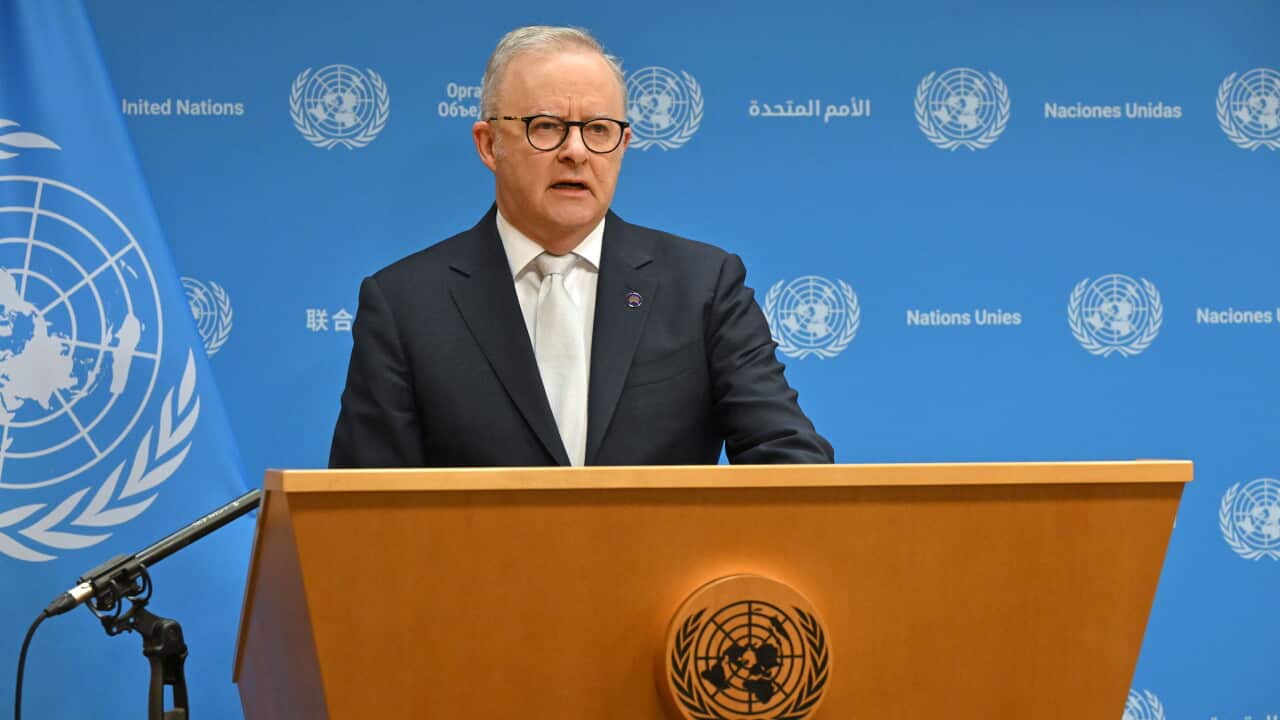

The Prime Minister has just stood on a global stage, spruiking climate action as a crucial component of national security. Meanwhile, the world is wrestling with the problems and opportunities presented by a global A-I boom, powered by energy and water. The question now is whether the two priorities are at odds with each other. Can we afford to prioritise the climate over AI advancement? Can we afford not to?
Listen to Australian and world news and follow trending topics with SBS News Podcasts.
TRANSCRIPT
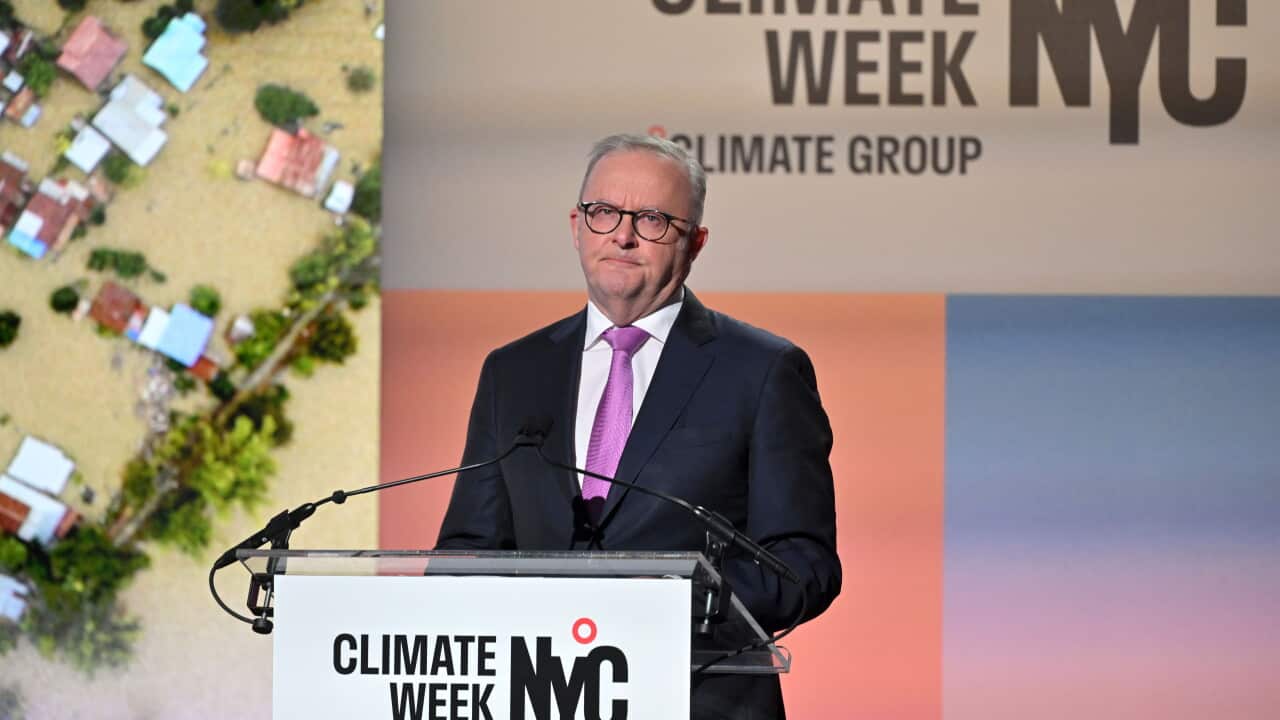
In a keynote address at Climate Week in New York, in front of world leaders, diplomats and delegates, Anthony Albanese shared a stark message.
“The science tells us these events will get worse and more intense. That's more communities facing repeated trauma. We need to come together to meet the problem head on. There is no avoiding the scale of our responsibility or the cost of inaction because of there is no denying what it also represents - another clear and urgent reason to advance the clean energy transition.”
In a statement to the Associated Press on Monday, United Kingdom Secretary of State Ed Miliband backed Albanese in linking climate policy with security.
“My argument to you today is we need to take the next step and recognize the national security imperative too.
"The climate breakdown "must be an issue for foreign ministers and prime ministers, as well as energy and climate ministers.
"The security community, not just the activist community. The generals, not just the green campaigners.”
Those remarks this week follow scientists reporting August as the earth's hottest month on record.
Globally, August was 1.65 degrees Celsius above pre-industrial levels, far exceeding the longer term 1.5 degrees Celsius threshold set by the 2015 Paris climate agreement.
And on a different stage in New York, the environment is on the agenda for world leaders and delegates inside the United Nations General Assembly.
But it's not the priority.
SBS spoke with members of the public outside the assembly.
“The thing is now that if you don't adapt with it, you're going to become extinct."
We've got to get rid of it, that's one thing that we don't want to happen in the future. There's got to be some kind of regulation, something has got to be done about it."
"That is something that probably in the future is going to be a problem."
"I think that obviously it is impossible to have control about that.”
And this is former US president, Barack Obama, addressing Colgate University students in recent days [[20 Sept]].
“I would encourage voters to pay attention to this. If somebody does not have a serious plan for how to deal with this, then they're not meeting the moment and you should probably look for somebody else.”
But they're not sounding the alarm about the climate.
The looming crisis in their minds will be brought about by A-I - and the growing global appetite for generative artificial intelligence.
Australia is one of 22 signatories to an international call for mandatory safety testing of so-called frontier AI models, as well as independent evaluations and greater international oversight.
The statement says the rapid growth of artificial intelligence needs to be brought under control to ensure the technology is reined in and stays under human oversight.
Professor Nicholas Davis, Co-Director of the Human Technology Institute at the University of Technology Sydney, spoke with SBS earlier this month (14 Sept).
“The term that is being used at the moment is pacing the AI frontier, which is I guess code for the very latest models and the models that are yet to be released, which are rumoured to be even more dangerous and we expect to be more capable.”
Prime Minister Anthony Albanese says it is important that countries work together to co-ordinate their actions.
“Artificial intelligence has the potential to improve lives to strengthen our economy and productivity - and to massively advance science and medical breakthroughs. But humans need to be in control of it. If it is going be successful, than we need to make sure that humans are at the centre of everything that occurs.”
Those calls to reign in a bolting horse, come as nations including Australia attempt to keep pace with it.
But environmental advocates say the current plan for keeping up with AI - even with guardrails - will come at a cost to the environment.
The Australian Senate Inquiry into Artificial Intelligence and Data Centres is currently examining the rapid growth, resource demands and regulatory oversight of data centres across the country.
Scientists have already raised concerns over the increased demand of water and energy that generative AI use brings.
Testifying to the federal inquiry on Tuesday, Karyee Chiu from community group, Voices for Benelong, called for the country to press pause on all plans for data centres.
“At a time when we ought to be reducing our emissions and being more judicious about resources in the face of increasing climate risks, we are waving through projects that put our path to net zero at risk. The social license is not there to permit the rollout of these facilities without far greater scrutiny on how they collectively impact our society and our environment.”
In the wake of the Prime Minister's Climate Week speech in the US, Professor Admiral Chris Barrie, a former Chief of the Defence Force turned strategist, says words are not action and Australia is not holding its own in this particular fight.
“When I look around now and I see movement in Africa to take a much bigger lead and do much more, I think to myself what a wasted opportunity we have had here in the Pacific. So, our disappointment I think is palpable that Australia is not doing a lot more to deal with climate change as our number one national security priority.”
If AI development and climate action are competing priorities, as some experts say, the question is which comes first - and the cost of that decision.