
The Royal Commission on Antisemitism and Social Cohesion has heard evidence relating to protests and police response to demonstrations during its seventh hearing block. A pro-Palestinian protest held shortly after the October 7 Hamas attacks, and a separate neo-Nazi rally in Sydney were both brought under scrutiny during the one day hearing.
Listen to Australian and world news and follow trending topics with SBS News Podcasts.
TRANSCRIPT
The Royal Commission on Antisemitism and Social Cohesion has completed its seventh hearing block, holding a single day of hearings focused on protests.
The commissioner has heard evidence on the general democratic function of protests, incidents of hateful conduct during protests, and how police respond to demonstrations.
During his opening remarks, Counsel Assisting Richard Lancaster stressed the right to engage in peaceful protest as fundamental to democratic life.
"Lawful public protests are a necessary and valuable part of a properly functioning democratic society. Rowdy public protests that deliver stinging criticism can be just as valuable and just as lawful. Public protests that express strong disagreement with or severe criticism of the policies of a government; whether local, state, national, or foreign, are commonplace and should be thought unremarkable. There is nothing unlawful or even objectionable about such protests."
Mr Lancaster says the commission's aim in this block is to focus on opportunities to tackle antisemitism, and possible ways to improve the policing of public protest events.
He says antisemitism and discrimination more generally must not be seen as a standard or acceptable part of protests.
"Interpersonal violence does not become lawful or acceptable in the context of a protest. Incitement to violence and racist vilification does not become lawful or acceptable in the context of a protest. Antisemitism does not become acceptable in the context of a protest. And of course, those occurrences are not features of all - nor most protests."
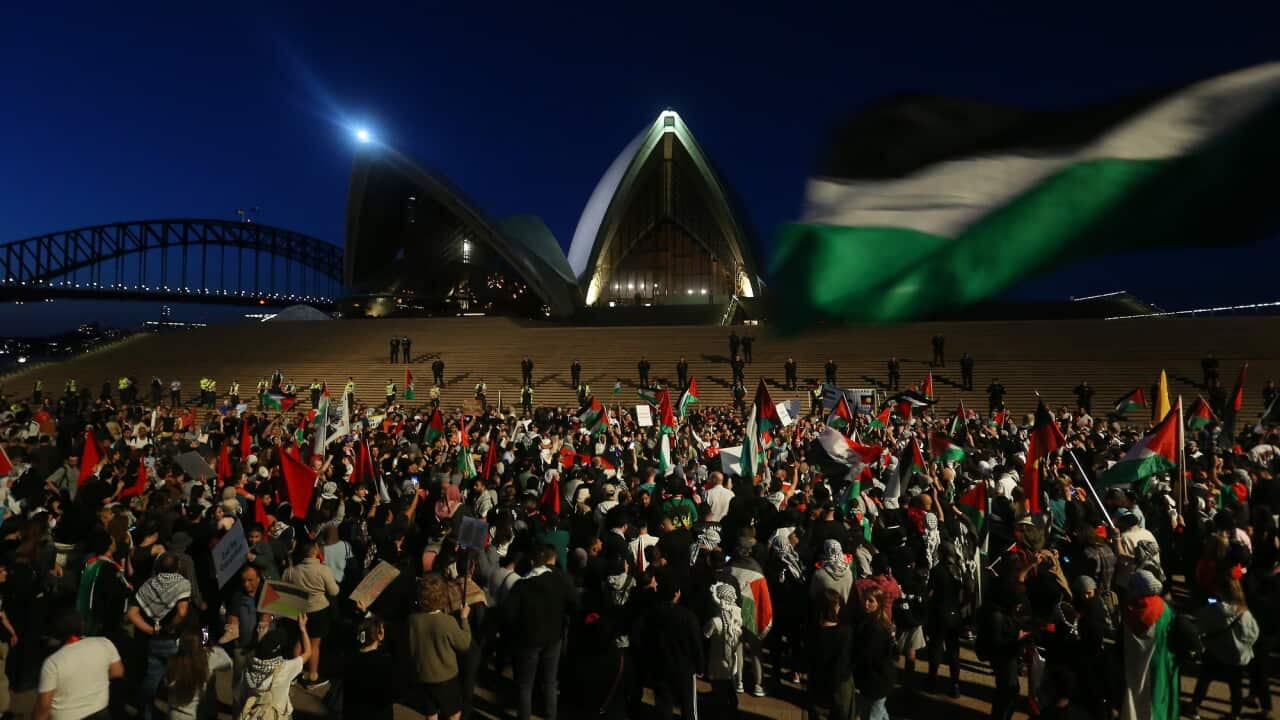
The majority of Tuesday's hearing focused on the circumstances around a pro-Palestinian march on October 9 2023 from Sydney Town Hall to the Sydney Opera House, which had been lit blue and white in to remember those killed in the Hamas' October 7 attack on Israel just days earlier.
The commission heard some in the crowd at the rally were heard chanting antisemitic slogans, and that an Israeli flag was set alight.
Speaking at the hearing, President of the New South Wales Jewish Board of Deputies David Ossip criticised the conduct of some demonstrators, calling it appalling.
"It was a scene of international disgrace and infamy. It's among the clearest examples of antisemitism we've seen over the past few years."
At the time of the protests, rally co-organiser Amal Naser said those shouting antisemitic chants were a small minority who did not represent the main group.
Fellow-organiser Fahad Ali - also at the time - described the behaviour of those people chanting slogans as 'vulgar' and 'selfish', and said their actions served as a distraction from 'immense human suffering in Gaza'.
At the hearing, Mr Ossip shifted focus to New South Wales Police, claiming police had advised the Jewish community to avoid the CBD, and that this had in turn handed control over to protesters.
"I thought it was quite an extraordinary and outrageous admission from police. I can't recall any group, particularly any religious or racial group, ever being provided advice that they should avoid their own city CBD."
Questioned at the hearing about the advice, New South Wales Police Acting Deputy Commissioner Peter McKenna says he was unable at that moment to confirm it.
"I haven't been able to ascertain factually that police gave the advice to the CSG (Community Security Group) for the Jewish community not to attend. As I sit here, I don't disregard the evidence of Mr Ossip. I just can't factually confirm that."
He says officers present were not concerned about the the protest getting out of control.
"We're talking hours of a protest that has been reduced to seconds or minutes on a news grab that has probably conflated it to make it more significant than what we would say it was."
Mr Ossip has also long been critical of the protest's timing, being held two days after the October 7 attack.
Palestine Action Group barrister Dominic Toomey challenged this criticism during his cross-examination at the hearing.
"You are aware aren't you that Israel Defence Force fighter jets began airstrikes in the Gaza Strip at about 5.30pm Sydney time on 7th of October?"
Mr Ossip questioned the information's relevance, prompting Commissioner Virginia Bell to intervene.
Virginia Bell: "Mr Ossip, if the line of questioning falls outside matters that are properly before me, I will rule the question inadmissible. I have not made that ruling."
David Ossip: "Absolutely commissioner, I fully respect that."
Throughout the hearing, Mr Ossip stressed the events of October 7, saying the protest that followed perpetuated the intergenerational trauma that many in the Jewish community have suffered.
When asked if he could appreciate that Palestinians have also faced years of psychological trauma, Mr Ossip said he had empathy for any innocent Palestinian.
Mr McKenna in his testimony also apologised to members of the Jewish community over a failure to give advance warning of a neo-Nazi rally outside the state parliament in November 2025.
He says the failure was not intentional.
"Absolutely, it should have happened. It was a human error. We have systems in place to do that sort of thing. And unfortunately, on this occasion that did not occur. And I understand why that would upset the Jewish community and they have our deepest apologies for not informing them of that. But unfortunately, it was human error and we have put systems in place since to make sure that doesn't happen again."
The hearings will now turn to looking at the key drivers of antisemitism in Australia, including religious, far right and other ideologically-motivated extremism and radicalisation.