
With hotter temperatures and more extreme weather becoming a fixture of Australia's holiday season, does this signal the end of the great Aussie summer? Should we schedule our 'peak' summer — holidays, school breaks and sporting events — according to safety rather than tradition?
Listen to Australian and world news, and follow trending topics with SBS News Podcasts.
TRANSCRIPT:
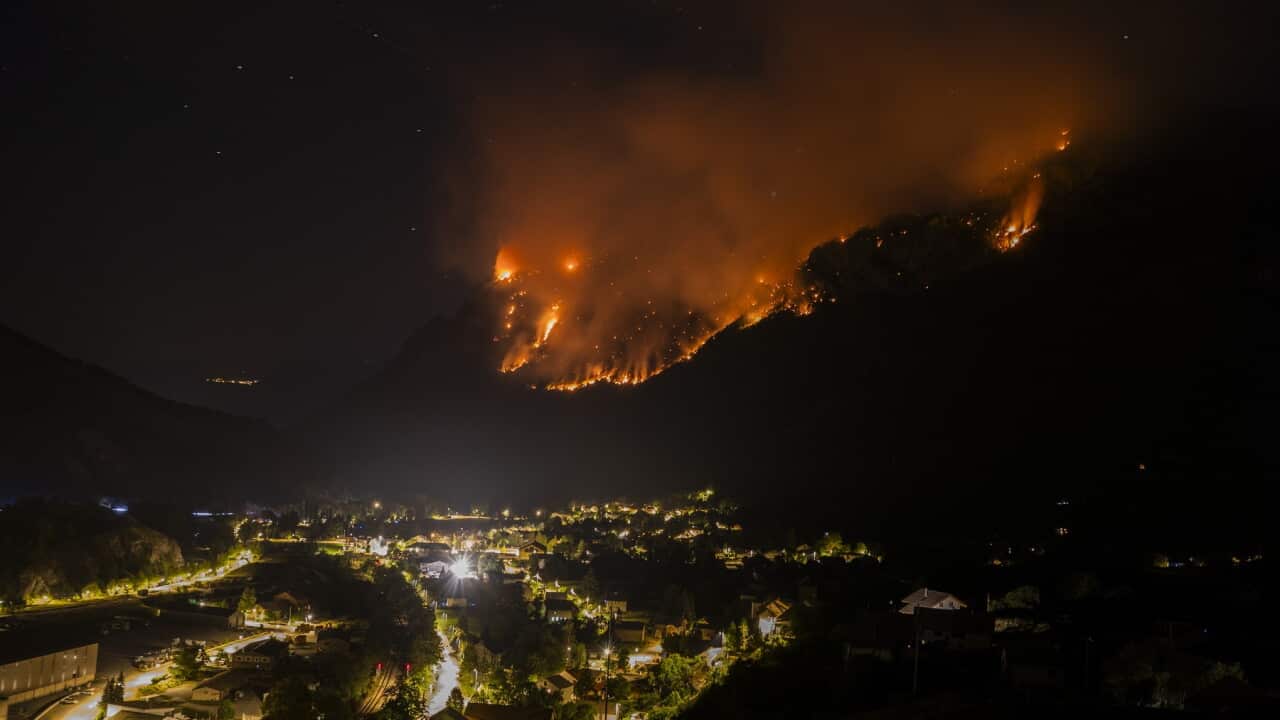
"The terrifying roar of a summer inferno. On a morning like no other in the coastal town of Mallacoota, thousands of people fleeing to the beach as the sky turned pitch black."
That news report by SBS News journalist Abby Dinham came on New Year's Eve 2019, as fire forced residents and tourists to the water's edge under a sky of smoke during Australia's Black Summer bushfires.
Five years later, people in Mallacoota in northern Victoria watched in horror once more as fire returned to the national parkland across the lake.
While the town wasn't directly threatened, residents like Paris Brooke say the impact was immediate.
"As soon as that occurred the camp park just emptied out and those businesses in town that rely on the summer tourist season to effectively make their revenue for the year were left with all of the supplies that they'd got in and all of their staffing that they had. Just the tourists dried up overnight."
Ms Brooke says visitors are still coming to her town, but many are staying for less time as awareness grows of summer's risks.
Climate Council director Lesley Hughes says climate change is altering not just our summers, but how Australians feel about them.
"Instead of looking forward to summer, many people now dread it. They dread the heat waves, they dread the bushfires. When I was growing up, you know, summer was a fantastic time, and now we all look forward to summer with some apprehension because of the escalating extremes. It's like climate change is stealing the part of the year that many Australians looked forward to the most."
So, how much are our summers really changing?
Australia is now about 1.5 degrees warmer than it was a century ago — and scientists say without drastic changes, our temperatures will keep rising.
Monash climate scientist and former Bureau of Meteorology forecaster Andrew Watkins says the changes ahead are stark.
"Summers are progressively going to become hotter, drier to some degree, but actually when it rains, more intense rainfall when it actually rains. And it is a severe weather season, but unfortunately it looks increasingly like the summer will become longer and hotter, and the high-risk weather season is going to extend out at either end of the summer break."
The Bureau is forecasting a strong El Niño this summer, bringing hotter, drier conditions to parts of eastern and south-eastern Australia, increasing risks of droughts and bushfires.
Experts say Australians should monitor forecasts, have emergency plans, leave early when conditions worsen, and avoid floodwaters and heavy smoke.
Ms Hughes at the Climate Council believe we need more public awareness around the dangers of heat stress.
But she'd also like to see something more radical: reframing the calendar year to keep more of us inside working during the country's hottest months, with outdoor leisure time moved to spring and autumn.
"We maybe should be having our biggest school holidays not in January, but in a more temperate time of year. That would be an enormous social change for Australia. But, you know, they're short term things, short term adaptations. The really important thing, of course, is fixing the root cause of the problem to stop everything getting worse. And that, of course, is to stop, mainly to stop burning fossil fuels."
She says many Australians are already adapting to hotter summers — often without even realising it.
Coolcations, for example, are fast on the rise, with travellers increasingly swapping traditional summer hotspots for cooler destinations — from northern Europe and New Zealand to Tasmania and snowy escapes, or choosing to visit the tropics during winter instead.
Booking.com found almost three-quarters of travellers now consider extreme weather when planning trips, while searches for cooler destinations have surged.
In Australia, the Climate Council found 61 per cent of people worry extreme weather will disrupt their summer holidays, with many shifting trips to the coast or cooler months.
Climate scientist Watkins is among them, choosing to spend his summers in Victoria's cooler High Country.
"For some activities, we might like to do it a bit earlier or a bit later. It might be more beach holidays in spring and more great camping holidays in autumn, taking a bit more advantage of Easter being at a really nice, typically at a pretty pleasant time of the year and possibly spreading things out a little more."
Climate scientist Linden Ashcroft says even the word 'summer' may no longer fit Australia's new reality.
"Seasons matter to us. They're kind of baked into how we talk about our year, but they're changing and so the way we talk about them also has to change. The Bureau is now using this terminology called severe weather season and I feel like that's kind of helpful. Summer is a part of severe weather season and knowing that, yeah, helps us plan and helps us prepare."
The impacts are also being felt across sport.
Cricket for Climate chief executive Joanne Bowen says community clubs are already cancelling games on extreme heat days, while elite players and spectators are increasingly exposed to dangerous conditions.
"There'll need to be some deep consideration given to, you know, how games are played in this country and also it's not just the players themselves, of course. You know, when you've got big sort of cricket games, you've got all the cricket fans that are showing up and, you know, it's them that are sort of sitting in these stadiums, some of which are concrete kind of jungles in a way. And so there's also a fan sort of aspect to this as well."
In time, she expects more games to move to night-time, and says shifting the cricket season to winter or spring is possible, though it would clash with other codes.
Another staples of our summer, the Australian Open, is also shifting its approach to the heat, with organisers now suspending play and closing roofs during extreme heat.
Experts say adapting to hotter summers means more resilient homes, stronger emergency services and warning systems and better infrastructure — from power grids to more public cooling and green spaces.
Back in Mallacoota, Ms Brooke has set up the Wilderness Collective, a community not-for-profit aimed at helping residents diversify the local economy beyond the traditional summer rush.
"Most of these small communities are actually, winter is the best time to come because it's much less crowded and the weather is actually really beautiful. But I think it's a really untapped time. I think we are starting to see a shift towards people coming at different times of the year. And that's great to see, but we definitely need more of it."
For Andrew Watkins, adapting to our summers of the future also means confronting what's being lost.
"Our natural environment report for the National Climate Risk Assessment noted a huge number of species, both plants and animals, are changing with climate change and will change a lot into the future. A lot of us feel a sense of loss in special places that are changing rapidly. I'm a person that skis in winter, and I look at the landscape and how that's changing in the High Country. And it's a difficult thought that it won't necessarily be there for my kids or my kids' kids. They'll see something different."