
.
Listen to Australian and world news and follow trending topics with SBS News Podcasts.
TRANSCRIPT
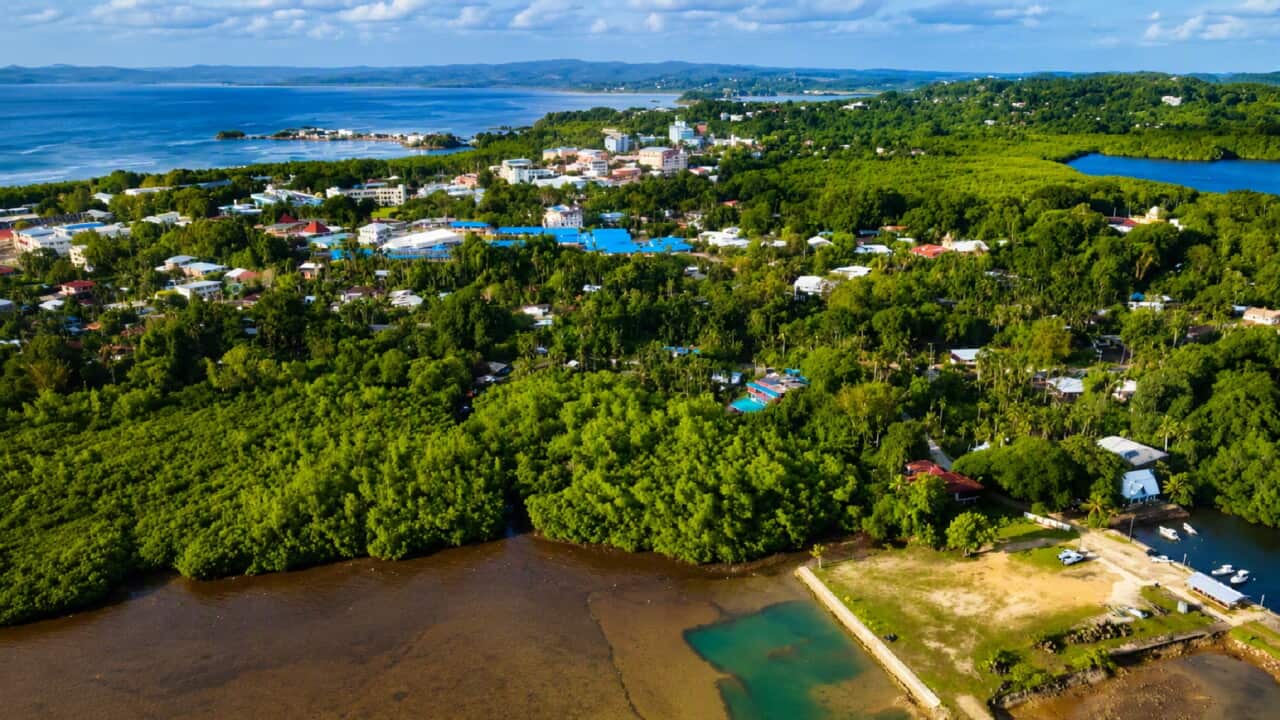
It's an idyllic backyard for Ricky Daniel.
A narrow beach protected by mangroves and a calm shoal.
But as a survivor of Typhoon Bopha in 2012, the destructive force of the ocean is never far from Ricky's mind.
“I feel always worried, always afraid of when the tide comes.”
His home sits just a couple of metres above sea level.
“When it comes, maybe, I don't know, maybe it comes over the flooring.”
Just down the road, another local resident, Lazarus Inacio, sees a visual reminder of the typhoon's fury every day.
“The road and the big rocks on top of the road, everything was messed up. Even my house, the salt water was like this inside my house.”
Pacific Island states collectively contribute around 0.03 percent of global greenhouse gas emissions.
But with so many homes and villages along Palau's coastline, it's low-lying communities that stand to lose the most.
Entire households - as well as schools and hospitals - are being relocated upland to escape the rising sea.
But these are major projects, which the Palauan government says it cannot afford on its own.
Steven Victor is the Palauan Environment Minister.
“So the cost of relocation of this infrastructure is something that Palau has to work with partners to be able to relocate them, because as a small economy we cannot.”
It isn't just coastal towns in need of financial support.
Traditional taro patches that have been cultivated for generations are at risk of inundation and unpredictable weather.
Cornelia Mason is from the Debedebokel Women's Group NGO.
REPORTER: “What stands to be lost by this community from climate change?"
CORNELIA: "Oh, we can talk culture, we can talk ecological knowledge, we can talk the viability of... this place..." (crying).
Minister Victor says time is running out.
“20 years ago, I think we were in the frontline of climate change. We're now living the impacts of climate change.”
He tells SBS ahead of the Pacific Islands Forum, that the impacts of climate change are fast outpacing his country's ability to adapt..
“We feel that Australia has the capacity to do more compared to any of us in the Pacific. With the understanding that they have a lot more capacity, both expertise and finance.”
Australia's Climate Change Minister, Chris Bowen, says Australia has already made a commitment to help.
“I work closely with Minister Victor. I'll be working closely with him at the PIF. Last year, I visited Palau and announced Australia's commitment to support the upgrade of their renewable energy system.”
New data puts Australia as the biggest aid partner in the Pacific, contributing 38 percent of total development funding.
But in Palau, that figure falls to around 7 per cent, where the United States is the biggest donor at 28 per cent.
In Palau's biggest city Koror, there are a large number of development projects funded by Taiwan.
There's the city's main administrative office, known as the One-Stop-Shop, then there's Palau's Capitol Building; even the Cultural Centre where the Pacific Island Forum is scheduled to be hosted, were all at least partly funded by the Taiwanese Government.
Taiwan and other non-member countries were barred from last year's Pacific Islands Forum leaders' meeting, after widely-reported pressure from China.
Steven Victor again:
“Which we saw as quite unfortunate because there were a lot of opportunities lost. We know as the Pacific, we need all our partners at the table, to enable us to achieve our goals of ensuring climate change is put under control.”
For now, Taiwan has pledged to attend next month's forum.
China has also been invited - so a diplomatic struggle is brewing, but it's an existential one for these communities.