
Are we alone in the universe? It's one of humanity's most pressing questions. NASA now believes it's a step closer to answering that very question with the launch of a new telescope that it says could unlock some of the universe's biggest mysteries.
Listen to Australian and world news and follow trending topics with SBS News Podcasts.
TRANSCRIPT
“Three, two, one, ignition and liftoff! Go Falcon Heavy and go Roman Space Telescope.”
A first-of-its-kind mission to search for life beyond Earth.
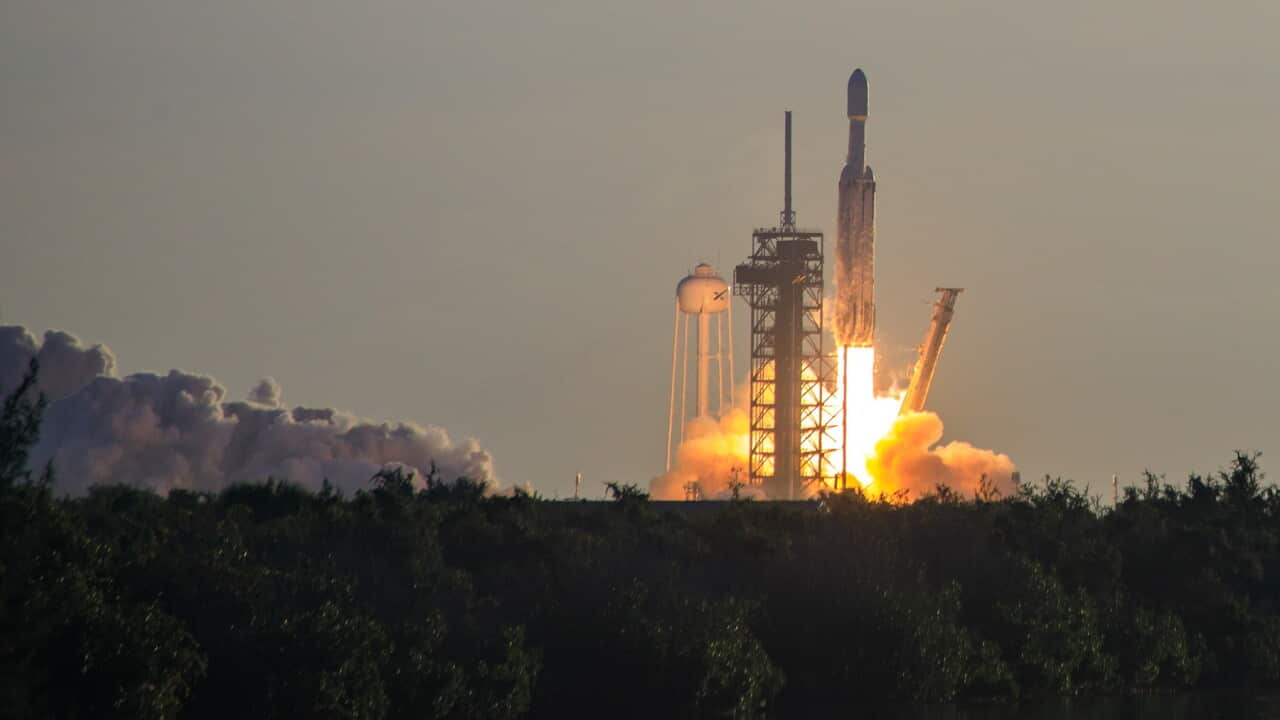
At the Kennedy Space Centre in Florida, the SpaceX Falcon Heavy rocket made liftoff.
“Falcon heavy has cleared the tower and is on its way to space.”
It carries NASA's Nancy Grace Roman Space Telescope.
It's called Roman for short and is named after the agency's first chief astronomer and female executive.
NASA says the telescope has a field of view at least 100 times larger than the infamous Hubble Space Telescope and will capture vast, panoramic views of space.
“One of our main goals at NASA is answering the question, 'Are we alone in the universe?'. Whether you like space, whether you like technology, whatever it is, people look up at the sky, and they think - 'Am I alone, are we alone, is there another Earth 2.0 looking back at me?'."
That's Nicky Fox, the Science Mission Directorate at NASA.
She says the telescope, which has been more than a decade in the making, will be used to shed light on two of the biggest mysteries in physics: dark matter and dark energy.
“And, with Roman we are going to make this giant leap forward with the coronagraph technology that is going to allow us to look at these distant, distant worlds ... just one mission, doing all of that. Billions of galaxies will be found, tens of billions of new stars, tens of thousands of new planets, and thousands of supernovae, all wrapped up in one beautiful telescope.”
Over the next 100 days, the Roman telescope will travel more than 1.5 million kilometres from Earth.
For at least the next five years, it will then send back data and images that scientists say could change our fundamental understanding of the universe.
Julie McEnery will lead the Roman mission as senior project scientist.
A venture she's described as the pinnacle of her career.
“ It feels like I'm on the edge of a precipice and we're just about to set a foot off into the unknown that is going to be pointed out by what Roman is going do. We're going to open Roman's eyes, we're going see the sky in a new way with Roman for the first time.”
The telescope features a specialised instrument known as a coronagraph which blocks glare from stars, making it easier to photograph planets around them in sharp detail.
Roman is also equipped with a Wide Field Instrument, capable of capturing large swathes of the cosmos.
It will work in tandem with the James Webb telescope, which is likened to a zoom lens - while Roman is a wide-angle lens.
NASA administrator Jared Isaacman says the remarkable power of the new telescope will open up a new trove of knowledge to scientists.
“Now, Roman has a field of view at least 100 times that of Hubble and over 1,000 times the scan rate. So, the telescope will provide a vast new atlas of the universe, potentially revealing more than 100,000 new exoplanets through its various surveys.”
He was interrupted during the event, by a phone call from US President Donald Trump.
Isaacman: "The president of the United States of America would like to address and congratulate everyone on this mission. You're live, Mr President.
Trump: "I just want to thank everybody and congratulate you. Boy, it looked beautiful on television. I just called Jared to find out, is there anything negative that I should know about? Like, it will never be able to return? The little things like that. He said no, it's looking great.”
US media reporting that the development, launch and operation of the Roman telescope will cost six billion dollars.
Mr Trump's praise comes despite his attempts to axe the project, a move that was eventually rejected by U-S Congress.
“You are doing a fantastic job and I am supplying you all that money.”
The telescope pays homage to Nancy Grace Roman, one of the architects of NASA's modern science program.
She's often described as the mother of the Hubble Space Telescope, with NASA saying her work laid the foundation for generations of space telescopes.
Today, both scientists and the general public will have access to all of Roman's data.
NASA saying the sheer volume of information will be daunting, but that opportunities for discovery are practically limitless.