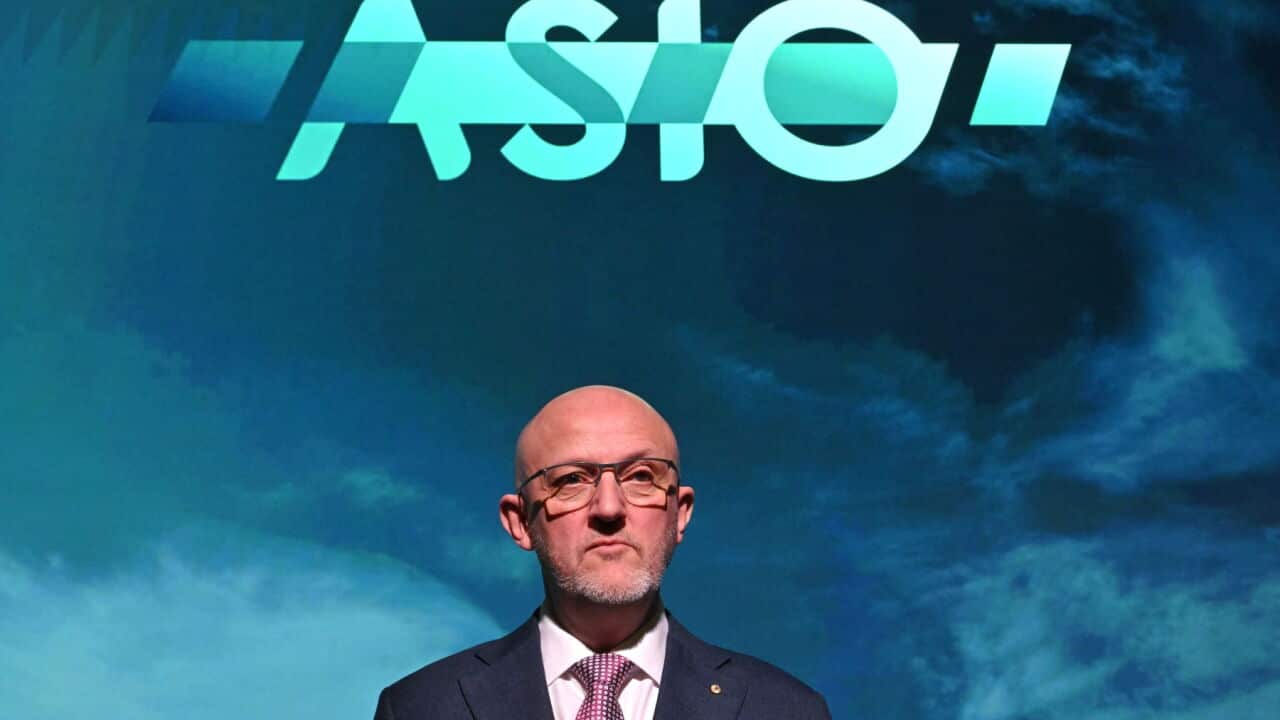

ASIO has revealed it has foiled 14 terror plots since the December mass shooting in Bondi, with the current terror level remaining "probable". But the service will undergo a review of its warning system, as Australia's spy chief warns the current one is understating the danger faced by the public.
Listen to Australian and world news, and follow trending topics with SBS News Podcasts.
TRANSCRIPT:
"When we see autocratic regimes seek to silence dissidents and perceived enemies, we are shocked, but shouldn't be surprised. When hackers exploit known vulnerabilities to compromise, we are shocked but we certainly shouldn't be surprised. When antisemitism grows after being tolerated and normalised, we are shocked, but we should not be surprised."
ASIO Director General Mike Burgess has made that pronouncement at his annual address, part of the agency's assessment of the current terror threat.
The address has revealed that ASIO has foiled 14 terror plots since the December mass shooting in Bondi.
The boss of the national spy agency says Australia's current threat level is probable, meaning there is a greater than 50 per cent chance of an onshore attack, or attack planning in the next 12 months.
But he says that it doesn't tell the full story.
"The next level on the scale is expected, which applies when we have intelligence about a specific attack. We do not, but we do know the environment is degrading and acts of political violence are becoming more likely than probable suggests."
The security environment he is referring to includes the threat of online radicalisation of Australians into extremist ideology and interference by foreign entities.
ASIO has identified two people with strong links to Australia, who allegedly directed attacks on Jewish targets on behalf of Iran.
Mike Burgess says an Australian citizen now based in Iran orchestrated the 2024 firebombing of a business in Bondi, and that a former Australian resident living in Iraq was behind the attack on Melbourne’s Adass Israel Synagogue.
Mr Burgess says both were linked to Iran’s Revolutionary Guard Corps and ASIO knows who they are, but cannot name them because investigations are continuing.
Intelligent Risks CEO Neil Fergus, who is an expert on international security and terrorism, has told Channel 9's Today show the attacks follow similar incidents overseas.
"If there was a trend it would be that they are using proxies or criminals to carry out arson attacks against the Jewish ambulance service in Golders Green, against the Bank of America in Paris. They haven't, there are no mass casualty attacks involved in that, thank God. But I think Burgess is correct that we have to be absolutely on our guard at the moment."
With ASIO warning that acts of politically motivated violence are becoming more likely, Home Affairs Minister Tony Burke has told ABC radio there is currently a review of the decade-old terror threat warning system.
"There is a review that is happening on that, that is right. And different countries, particularly our Five Eyes partners, everyone does it a slightly different way. And we are looking at that. The thing that matters is making sure that the Australian people and also our law enforcement agencies get the best possible information."
Liberal Senator Jonathon Duniam says if the system isn't working, changes should be a priority.
"All of these things, combined with all of the events that have occurred over the past 12 months including of course Bondi, are extreme concerns for us as a country. If the legal regimes need revisiting, if the framework around how we deal with terror-related matters needs revisiting, then let's do that as a matter of urgency."
Meanwhile, as Australia's spy agency was issuing its terror threat guidance, the partner of a member of the so-called Islamic State group - a designated terrorist network was granted re-entry to the country.
The woman, who has been living in Syria, was previously the subject of a temporary exclusion order, which was lifted to allow her passage home.
Minister Burke has told ABC radio the woman would be subject to "very high level of surveillance" on her return.
"But we received the final advice yesterday that we can no longer have an exclusion condition any longer for her. We have checked with our agencies. They are ready. So, that permit gets issued. What it then means is the conditions that do apply to her are everything that is possible. For example, she will have to report, and we will have to know where she lives, where she works, where she studies."
National Party leader, Matt Canavan, says the government has not stood on the side of the safety and security of the nation.
"We feel the government should have done more to keep people like this, who have associated with terror organisations, the worst terrorist organisations in the world, they should have been kept out of our country."
Security threats from beyond Australian soil were also the subject of an Australian Strategic Policy Institute [[ASPI]] conference today, on 'Securing the Region for Uncertainty’.
Professor Peter Dean from the Strategic and Defence Studies Centre at the Australian National University has echoed ASIO's call for preparedness in the face of a regional security threat.
He says the key is in self-reliance as a nation, referencing the 2026 National Defence Strategy, which calls for Australia to move away from reliance on the US for intelligence and logistics.
"That is dead. So, what does self-reliance in the face of a major war potential against a major power threat, look like? As the NDS tells us, it is starting to look like more industrial self-reliance. It is starting to look like more national resilience and social cohesion. It is starting to look like civil preparedness. It is starting to look like all of these things."
As experts called for increased national self-reliance, Defence Minister Richard Marles weighed in on the future of AUKUS - a trilateral defence agreement with the US and UK that was signed in 2021.
Mr Marles says he accepts criticism around the deal's practicality and future - including from former prime ministers and the first head of ASPI.
But he says the deal is crucial for Australia's security.
"In regards to all three countries, we have now seen changes of government in terms of political persuasion in all three, whilst the commitment to AUKUS has been maintained in all three."
According to a poll by the Lowy Institute, there is public support for the deal, too.
The Lowy Institute survey also found for the first time in history, the majority of Australians feel unsafe.
But researchers including Charles Lyons Jones say that almost three quarters of respondents [[73%]] support Australia's alliance with the US, despite falling confidence in President Donald Trump's administration acting responsibly.
"And what that shows is that Australians remain pragmatic about the global environment we face and understand world events' impact here at home."