
The European Union's migration chief is commending Spain's handling of the Cueta crisis. This, after reignited debate over the bloc's migration policy - following the mass crossing of migrants from Morocco into Spain's north African city last week. Spanish authorities say around 72,000 people crossed to Cueta, with 70,000 since returned to Morocco. But calls for tougher action against migrant smuggling networks remain.
Listen to Australian and world news and follow trending topics with SBS News Podcasts.
TRANSCRIPT
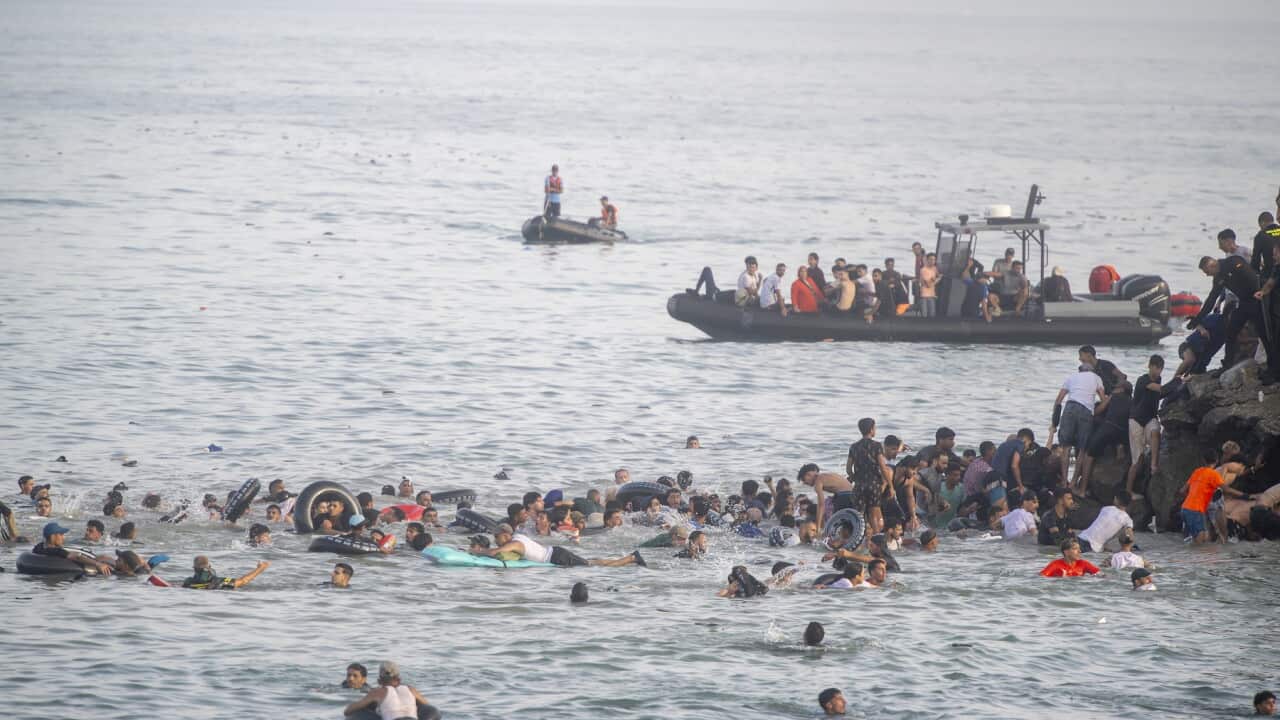
Around 72,000 migrants crossed into the Spanish enclave of Ceuta last week.
Cueta is located on the northern coast of Africa, bordering Morocco and the Mediterranean Sea.
Spanish authorities say 70,000 have since been returned to Morocco.
But according to Director of Spanish Commission for Refugee Aid [[CEAR]], Mauricio Valiente, there's about thousand of migrants, that remain stranded in Cueta.
[[Spanish translated to English VO “We think there might be between 3,000 and 4,000 people left (in Ceuta). Progress is being made in identifying them, but it’ll take time to complete this task. We cannot give an exact number.”]]
Among those still there is Ahmed Haroun, a 29-year-old from Sudan who's spent four years trying to reach Europe.
[["I have many family that wait for me and I want to help them. I have many dreams, first dream to me is I want to help my last family. You know why I said last? Because I lost a lot of them, now there is just three or one of them, so I want to help them. I don't want to lose that people and I'll fight for them, I'll do anything, just to help them."]]
He says he's spent four years trying to reach Europe.
A least 75 people died on the Spanish side of the border, while Moroccan authorities reported 11 deaths.
The crisis prompted an emergency meeting of European Union interior ministers in Brussels on border security.
Earlier, European Commission President Ursula von der Leyen proposed strengthening EU borders and increasing support for Morocco to prevent a repeat of the incident.
The European Commissioner for Internal Affairs and Migration, Magnus Brunner, said the crisis had tested Europe's border security, its resilience to disinformation and solidarity among member states.
He says the events showed how dramatic images can outweigh even the best statistics - referencing EU making progress in reducing irregular migration.
[["But of course, the events from Ceuta, that is also pretty clear, show that dramatic images beat actually the best statistics. And that's also, of course, one of the learnings. And as I said before, these past few days were a test of our European resilience, a test the security of our external borders. And these days showed clearly that there are actors who have no regard for the safety, or even for lives, of innocent people."]]
This, after reignited debate over the bloc's migration policy.
But Brunner says the integrity of the Schengen area was maintained during last week’s migration surge.
Reiterating that smuggling networks and social media disinformation helped drive the surge.
[["Over 70,000 people, as you know, crossed in a matter of hours, fuelled by criminal smuggling networks and also disinformation; social media disinformation, the integrity of our external border was placed, of course, under severe strain."]]
This is an example of a Moroccan man on social media.
[[Arabic translated to English VO "Never believe those who tell you that if you get into Ceuta, they will send you back. You will not be sent back. Those at sea are not sent back. So that you know. Those at sea are not being returned. They take them to Ceuta where a procedure applies to see if they can be returned or they can stay. So those who can find a way to try, have to try.”]]
Brunner says the scheme regularising undocumented people 'not a good signal' for Europe.
[["I do understand and it's a member state's competence, and I do understand that Spain did it because it's mainly about Latin Americans speaking the same language, having the same culture. But the signal for the rest of Europe is not a good one, definitely not."]]
The recent incident exposes longstanding tensions within the European Union over migration policy.
It's one of the EU's most divisive issues since the 2015-16 crisis, when more than one million refugees and migrants arrived in Europe, many fleeing the war in Syria.
Although the EU has made progress on irregular migration, this incident has sparked tension.
Italian Prime Minister Giorgia Meloni earlier announced that the country would introduce temporary air and sea border controls with Spain and questioned Madrid's handling of the crisis.
At the EU meeting, ministers heard from their Spanish counterpart.
Spanish Interior Minister, Fernando Grande-Marlaska says that there had been no warning.
[[Spanish translated to English VO “There was no report, and I will also have to use the word, nor warning, that anything even remotely similar to what happened could occur. But nothing like what happened, nor anything like what occurred in 2021, when 10,000 people entered irregularly, and you know the obvious social impact which that situation caused."]]
But the response has drawn criticism.
European Policy Centre migration analyst Helena Hahn says Spanish Prime Minister Pedro Sánchez is under immense pressure - not just domestically from both sides of the political spectrum , but from other EU member states.
Sparking calls for tougher return policies and action to be taken against smuggling networks.
[[“This really rattled the European Union because I think that political leaders got very used to the idea of irregular arrivals reducing and continuing to fall, but without necessarily thinking about, well, something could still happen and we do still need to be prepared.”]]
European Commissioner for the Mediterranean Dubravka Šuica said the surge shouldn't have happened, and that the response must be shared.
[["We have to somehow defend our external border together, it's not only a Spanish issue, it's also, a European issue so it's a shared European responsibility plus Moroccan issue. So both of them have to be on it. And, I think, that from now on, we will be smarter."]]
The French Interior Minister, Laurent Nunez also weighed in, warning that images of the crisis had been weaponised.
[[French translated to English VO "All member states expressed regret that the circulation of a number of images gave rise to information interference by foreign states, which used these images to criticise the European Union's migration policy and to try to sow division among member states."]]
As the leaders met, more than 170 migrants were rescued after their boat caught fire crossing the English Channel - one of the largest such operations since records began in 2018.
Rescue boats were sent from the UK and France.
French authorities say many were forced to jump into the sea near the boundary between French and British waters.
Some suffered burns, cuts and bruising, but no serious injuries were reported.