
Australia's government insists it still has not received any direct requests from the United States for military aid in its war with Iran, after a public attack from President Donald Trump. The US president has criticised allied countries for not providing assistance in the conflict, as the closure of the Strait of Hormuz continues to put pressure on global oil prices. Meanwhile, the government maintains it's imperative for the war to be resolved as soon as possible, as the economic and social consequences unfold locally.
Listen to Australian and world news and follow trending topics with SBS News Podcasts.
TRANSCRIPT
On Sydney talkback radio, callers have been under pressure - like this woman on Radio 2GB.
“I was just panicking seeing, you know, driving past five different fuel stations with no fuel thinking well what do I do. I mean if there's no fuel, if my kids get sick and I can't pick them up and I've got no family help. I do everything on my own.”
Her experience is not unique.
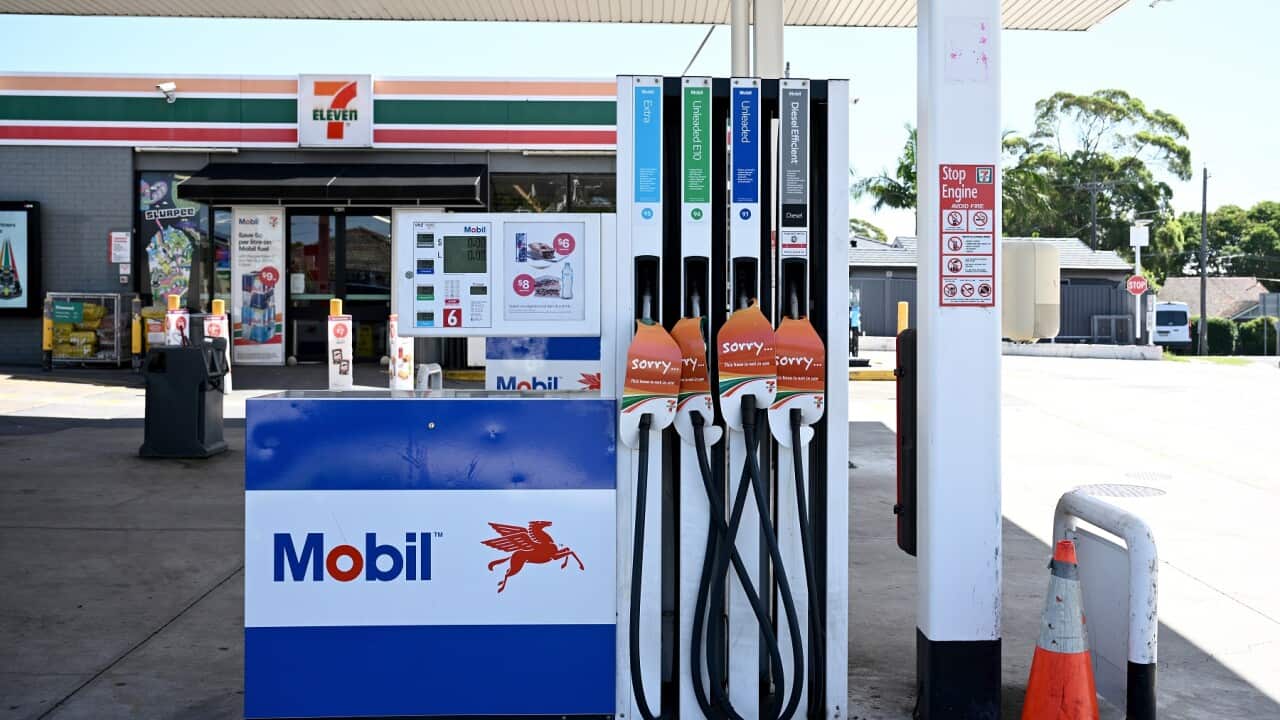
Across the country, more than 500 service stations are now without some kind of fuel as the war in the Middle East drags on, impacting supply chains everywhere.
The opposition's Dan Tehan says the government has failed to take decisive action.
“Where is the legislation? It's not here. It is not here. Where is the urgency in dealing with the national fuel crisis?”
The federal government for its part says it IS taking things seriously.
Fuel companies have been told to release more than 500 million litres of petrol and diesel from their emergency reserves, which is being directed towards regional areas where shortages are most acute.
And the government has confirmed six tankers of fuel will arrive between now and the 8th of April from China and other countries.
Energy Minister Chris Bowen says the newly secured tankers will replace six previously cancelled cargo loads that had been bound for Australia.
He says deals have recently been signed with Singapore and Japan which supply oil to Australia, and other countries too.
“I have also been talking to the Malaysian government. I have been very pleased with those conversations. Malaysia has indicated they regard their relationship as a liquid fuel supplier to Australia extremely importantly and they see Australia as a key ally and friend.”
Some states have been reassured by the government saying it will take time for supplies to move through the system.
Queensland liberal premier David Crisafulli says peoples' experience is very different to what the government is saying.
“Comments out of Canberra that there's more fuel today than two months ago belies Aussies' intelligence. They know they're paying more. They know it's getting harder to get fuel.”
The crisis has prompted state and federal leaders to organise another emergency meeting next week.
In New South Wales, the state government is not taking any chances.
Environment Minister Penny Sharpe has sent notices to fuel providers, asking them to share data about their supplies and sales, so the country's most populous state can prepare for the exercise of emergency powers - if necessary.
Premier Chris Minns says any action needed will be coordinated with the other jurisdictions.
“We'll look at the circumstances, the inbound fuel tankers to Australia. If that number drops significantly, then we'll make the decisions that we need to do, hopefully with the other states, certainly with the national government, to do whatever we can to manage fuel demand. But we're not going to jump to the end. This needs to be a proportionate, sensible, commonsense approach to what is an international problem, affecting every jurisdiction and every marketplace in the world.”
The issue of course is not just availability - but cost.
Prices have soared as the war in the Middle East has unfolded.
But stations that artificially raise the price of fuel could now face fines of up to $100 million.
Federal Parliament has approved new laws that double the fine for petrol stations and suppliers who price gouge customers.
Still, NRMA spokesman, Peter Khoury, says fuel prices are stabilising after a significant surge.
“We've seen oil prices fall off and overnight [[Tues to Wed]] quite considerably. What we need is for that to be sustained so that we start to see that flow-on with the wholesale prices. Because until it gets passed on at the wholesale level, we're not going to get any relief at the bowsers.”
In the meantime, the impact of the petrol crunch is showing up in other situations too.
Social support organisations have reported those on Centrelink payments risking fines and other penalties because they are unable to attend the in person appointments required for those on unemployment benefits.
And in the hospitality industry, the Australian Restaurant and Cafe Association is calling for a temporary surcharge during the fuel crisis, to cover higher expenses for businesses.
The industry says it's being hit hard by surging petrol prices and shortages, which are impacting supply of ingredients.
Senator Bridget Mckenzie says that experience is being echoed in other industries.
“We do need to have a serious conversation about focusing on critical industries though.”
Meanwhile, as the war unfolds in the Middle East, US President Donald Trump has again accused Australia of not doing enough to help.
At a Cabinet Meeting Trump said Australia was "not great" and he was a "little surprised".
Australia has signed to a multi-nation resolution to assist in the reopening of the Strait of Hormuz.
But Deputy Prime Minister Richard Marles told Channel 9 there has been no direct call from the U-S for assistance.
“We have been providing an E-7 for the defence of the Gulf states. That was at the request of the UAE. The one request we've had from the United States is to provide support for the gulf states, which is in fact what we are doing. And that is where we see our national interest.”
Some analysts argue that Australia's position as an energy exporter has put the country in a potentially better position than other nations.
Defence analyst John Blackburn, who is with the Australian Institute of Energy, has told Channel 7 petrol stations are running dry because of an issue with logistics, not current supply.
“Some people are hoarding or getting all this other stuff, so the supply chain is actually starting to choke up. Now when you're trying to reverse that, which the government is doing by releasing stocks, you are putting it back into that distribution chain which is under huge stress. This is a complete own goal, partly because we didn't look after our supply chain design for the past 15 years.”
For former Prime Minister Malcolm Turnbull, the crisis is the perfect opportunity to make progress on renewable energy sources.
“We are more secure when we are less dependent on imported fossil fuels. And the way we do that is with electrification. As many people have said, there is no strait which can be blocked to stop the sunshine or the wind.”