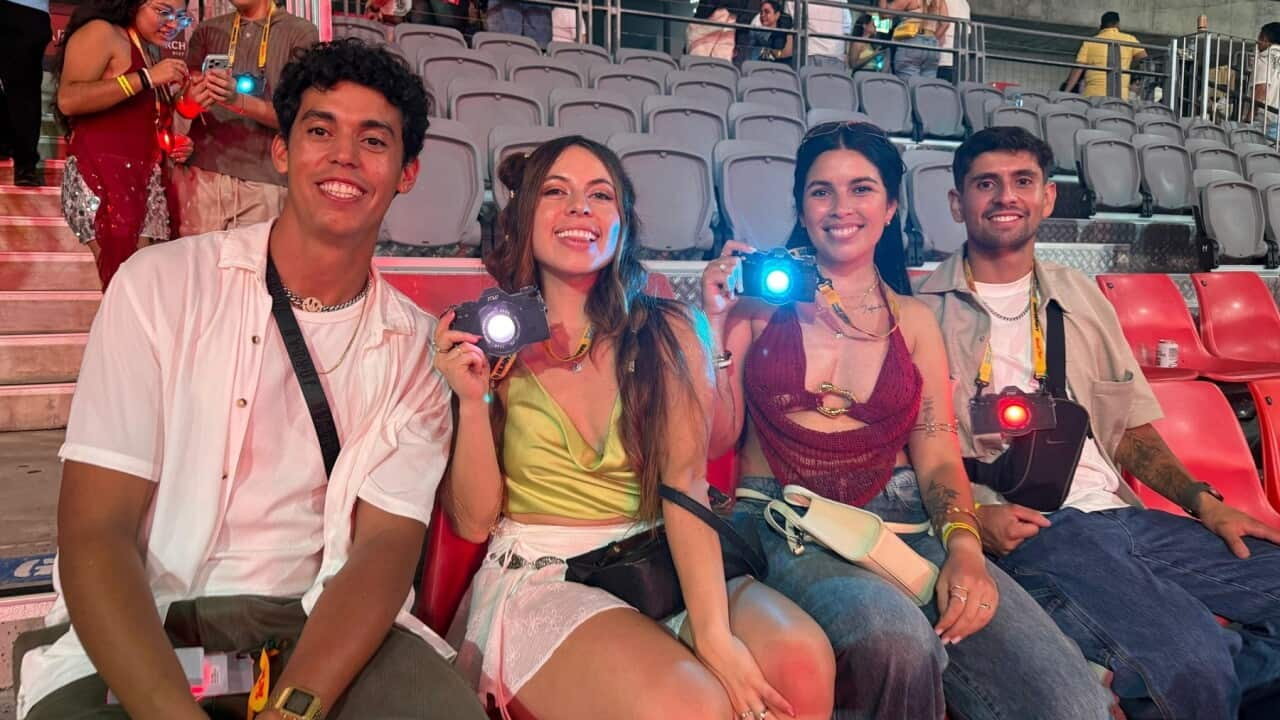

Almost 90-thousand people have packed a Sydney stadium to see Bad Bunny’s first live concerts in Australia. It's a record for the ENGIE Stadium, underlining the global audience for music sung in Spanish, including among Western audiences that don't understand or speak the language.
Listen to Australian and world news, and follow trending topics with SBS News Podcasts.
TRANSCRIPT:
It is 45 minutes after the opening act and the star performer is nowhere to be seen.
Then he appears.
It's 31-year-old Puerto Rican artist Bad Bunny, stepping onto an Australian stage for the first time.
This fan says he made sure he had his tickets in advance, travelling from Melbourne to see the Sydney show ((Sat 28 Feb)).
"My name is Alejandro. I'm from Melbourne, uh, originally from Venezuela. Been here 10 years. Best night of my life. I don't know what to say. It was just the best, the best night of my life. [laughs] The whole thing, it was like a, like a dream come true."
89-thousand fans showed up over two nights in Sydney for Bad Bunny's debut.
That's a stadium record for the venue - ENGIE Stadium - at Sydney Olympic Park.
His decision to avoid taking his world tour to locations in the US that could put undocumented migrants who are his fans at risk has been praised.
But the decision to play in Australia for the first time raised a few eyebrows.
While the number of Spanish speakers in Australia increased by 21.7 per cent between 2016 and 2021 in Australia, the overall number is 171-thousand ((based on the 2021 Census)).
Juanita, born in Colombia, says Bad Bunny’s appeal is that he makes people feel proud of their cultural heritage.
"And it is great to have those, those vibes here. I think Bad Bunny is making a great change in what Latino means for everyone in the world, which is great to know and which is great to see, like, uh, people from other cultures just enjoying their, like, his music and our vibes and what we are, what we really, like, what Latino really means. That's many more things that what just media shows. Um, so yeah, I mean, just great. Very happy and proud of that, um, talent that he's sharing with us."
Bad Bunny's full name Benito Antonio Martínez Ocasio, and he has triggered renewed interest in the role of music in keeping Puerto Rican culture and history alive.
Puerto Rico has always had an outsized influence on the development and innovation of Latin music genres like Salsa, Reggaeton and its predecessors: Plena, Bomba with its African drumming rhythms inherited as a result of slave trade and migration patterns.
Dr Consuelo Martinez Reyes is a senior lecturer of Spanish and Latin American studies at Macquarie University.
"The fact that we all know that in each of our different countries we have very specific music rhythms that the mix of cultures and races from Spain and Africa and our indigenous communities. There's also obviously experiences of oppression that we've all throughout Latin America, in terms of governments failing us, in terms of politicians and the imperialism of the US and how it affects us. So when he talks about coloniality and colonialism in Puerto Rico, he's not only talking about one island, he's talking about political experiences that we've all had at different stages."
Reflecting the fusion of cultural and musical influences that underpins Afro-Caribbean Latin music, Bad Bunny explore issues like gender fluidity, shared histories of immigration; and the impacts of colonisation through his lyrics and songwriting.
It started in 2016 with his first record deal, after being discovered on Soundcloud with his song Diles or 'Tell Them' about sexual attraction and a hidden relationship.
His popularity over the last decade has been growing steadily since then, culminating with him headlining the US Super Bowl in February, with a history-making show for the first time almost entirely in Spanish; which set a new global viewership record of more than 4 billion people.
That same month he won three Grammy awards - including album of the year with Debí Tirar Más Fotos (I should have taken more photos) - the first non-English language album win the category in the award show's 54-year history.
Accepting his Grammy award, Bad Bunny delivered this rare comment in English:
"We're not savage, we're not animals, we're not aliens. We are humans and we are Americans."
Bad Bunny makes an interesting choice when playing live, choosing to keep with his approach of singing entirely in Spanish - even at an overseas concert where not everyone may understand his lyrics.
It’s a potentially risky move - considering predecessors with Puerto Rican heritage - Ricky Martin and JLo - have resorted to singing in English to attain commercial success among mainstream English-speaking audiences - what's called the crossover era.
Born and raised in Puerto Rico, Dr Martinez Reyes says it's part of a new global trend of which Bad Bunny is one example of.
"It happens also with, groups like Måneskin in Italy or Kneecap in Ireland. You have a lot of groups that are singing in their language and circulating because of platforms like Spotify and others. They are being consumed in their language. And so Bad Bunny in that context is part of that global trend of sticking to your language and not doing the English crossover. I think where he contributes even more to that is where he speaks Spanish wherever he goes. Even if he's in Saturday Night Live, he will speak Spanish, and there may not be subtitles, and that is sold and put out there. And people are willing to then explore and try to find out what he's saying."
At the concerts in Sydney, the set list was broken into two distinct parts based on the staging.
The main stage opened the night with the sounds of salsa and iconic Puerto Rican instruments like the cuatro, a string instrument.
It the shifted to the other end of the stadium where an informal house party took place in a building modelled on an iconic Puerto Rican house - La Casita or little house, which marked a shift to the Reggaeton songs.
Dr Martinez Reyes says that was a deliberate choice.
"Well, la casita is the very... the, the average Puerto Rican house. They're built with cement blocks, which are good for the weather, and we are hit by hurricanes every couple of years. The average Puerto Rican house, everybody has lived in one of these houses. But it's not the house that we present ourselves with because it's not ... we don't perceive it as a beautiful house. It's homey, but it's not necessarily the picturesque house that we use for tourism. In that sense it's a very special house because we think of home when we see it, and we think that only us, only we are able to recognise it. Nobody else can."
Born in Peru, Stacy Ramos Melendez has been in Australia for six years and has been following Bad Bunny since his early days back in 2016.
She says it has been affirming to celebrate culture and feel a sense of togetherness through music.
"I loved it. I think it is really big for the Latino community to have an artist - a Spanish-speaking artist perform for the Super Bowl come to Australia. I think it gives a lot of (support) to how big the Latino community is becoming. A great space for community - just dancing, screaming, crying. So it was great. I loved it. And this is probably going to be the highlight of my year for sure."