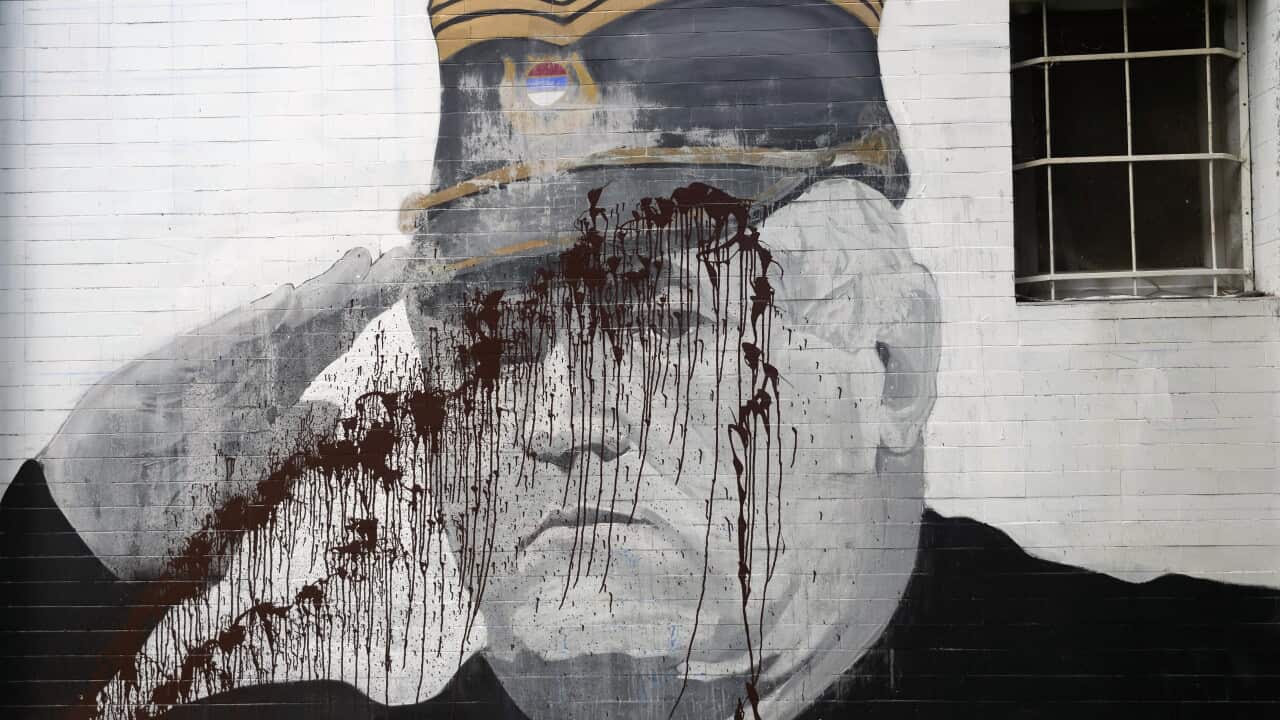

Ratko Mladić, the Bosnian Serb commander responsible for Srebrenica massacre has died in prison at the age of 84. Mladić, nicknamed the 'Butcher of Bosnia', spent years in hiding before a UN-established court found him guilty of genocide and crimes against humanity.
Listen to Australian and world news and follow trending topics with SBS News Podcasts.
TRANSCRIPT
A life in hiding, a trial, and imprisonment for war crimes.
The death of convicted war criminal Ratko Mladić in a prison hospital in The Hague was confirmed by UN court officials.
Called the 'Butcher of Bosnia' by his opponents, the 84-year-old former Bosnian Serb military chief had suffered several strokes in recent months, with the Hague tribunal ultimately rejecting calls from Mladić's family calling for his release due to his declining health.
The news led bulletins on the Serbian state RTS television and the official Bosnian Serb television.
A newsreader in Serbian: "Breaking news that former commander of the army of the Republic of Srpska, convicted by The Hague, Ratko Mladić, died at the age of 84 in a detention unit in The Hague tribunal."
Mladić spent 16 years on the run, hiding in remote safehouses - aided by family and nationalist sympathisers, before being arrested in Serbia in May 2011.
More than 20 years after the war in Bosnia and Herzegovina, he was found guilty - by a UN-established court - of orchestrating the 1995 massacre of more than 8,000 Bosniak Muslim men and boys - in the UN-designated safe area of Srebrenica.
The massacre is regarded as Europe's worst atrocity since World War Two.
The chairman of the Presidency of Bosnia and Herzegovina, Denis Becirovic, says his thoughts are with the families of the victims.
(Bosnian then translated into English): "War criminal Ratko Mladić was one the most brutal killers of Europe in 20th century. He's a war criminal that UN court convicted for genocide against Bosniaks, terror, expulsions, deportations, most horrific crimes. He will be blacklisted in the history of Bosnia and Herzegovina, Europe and world.
The war between 1992 and 1995 left an estimated 100,000 people dead and 2.2 million displaced.
Ratko Mladić's trial at the International Criminal Tribunal for the former Yugoslavia in The Hague lasted 530 days, involving some 9,914 exhibits and a total of 592 witnesses.
Mr Becirovic says the present is informed by the past - and the work now is ensure genocide and war crimes are not repeated.
(Bosnian then translated into English): "We, as Bosnia and Herzegovina, have to turn to the future. Preserve the truth, fight for justice, and educate new generations so the genocide and war crimes never happen to anyone else again."
On the streets of Sarajevo, these residents say the death of Ratko Mladić provokes strong emotions.
Resident 1: (Bosnian* then translated into English): "I think it's the end of an era. He is a convicted war criminal according to international courts. What's interesting here is that one part of the country perceives him differently, but I think history will make us understand what is his place and where does he (Mladić) belong."
Resident 2: (Bosnian* then translated into English): "I am glad, because I think people can now move on. If his death makes it easier for people to move on, then I'm really glad it happened. People and victims especially, will never forget it. But if his death makes it easier, then I'm glad. I don't know what else to say, but there is this psychological barrier, so I think this will make it easier for people to move on to the future."
Bosnian Serb nationalist leader Milorad Dodik says as far as he is concerned, Mladić had his supporters; and he regards him as a "fighter for Serbian freedom".
(Serbian* then translated into English): "In any case, for Ratko Mladić, who is a criminal to some, but for the Serbian people is exactly how those people perceive him, is a great figure, a man who, as I already said, defended the people, and thus will be inscribed into history."
Dodik is a controversial figure who himself was convicted in February 2025 by a Bosnian state court for defying the decisions of the international official overseeing the country's post-war peace agreement.
He dismissed the conviction as a politically motivated attack orchestrated by foreign actors.
Meanwhile, United Nations Secretary-General Antonio Guterres expressed solidarity with victims of the Bosnian war - and urged political leaders to reject genocide denial, following the death of Mladić.
UN spokesman Stephane Dujarric says what happened must never be forgotten.
"The Secretary-General reiterates his call for all those in position of power to refrain from denying the seriousness of the crimes that have been adjudicated. He strongly condemns any denial of the Srebrenica genocide as a historical event. And any action that glorifies those convicted of war crimes, crimes against humanity, and genocide by international courts. Accountability remains an essential step for lasting peace."
Munira Subasic lost two sons and her husband in the Srebrenica massacre.
She says she will forever carry the pain of the loss of her family and the actions of Mladić are hard to understand.
(Bosnian* then translated into English): "First of all, I am sorry that he died. He should have suffered more. He should have waited longer to die. He should have dreamt of our children’s eyes, as he complained that he was dreaming this. So I’m sorry that he died. He should have lived in his suffering, under the pressure of his ‘heroism.’ Second of all, he died where he belonged."
Munira Subasic says even with the pain, she wants to look forward to a brighter future.
(Bosnian* then translated into English): "People should learn from the past so they can have a better future, that is my message. People should learn things. People should know that differences are OK, but divisions are not. People can be divided only by good and bad. That is my message to everyone, to my grandchild, every child and every person who wishes to hear my message."