
The UK and France are taking a major step in their support of Ukraine, sharing classified technical information with Kyiv, to help it develop its own long-range missiles. The move comes as 50 countries and the European Union sign a joint statement, calling on Russia to end the war. But, will this international support go any way to finally ending the conflict?
Listen to Australian and world news and follow trending topics with SBS News Podcasts.
TRANSCRIPT
This week, Ukraine marks its 35th Independence Day anniversary.
The world was watching Kyiv on this bittersweet milestone - some at close range.
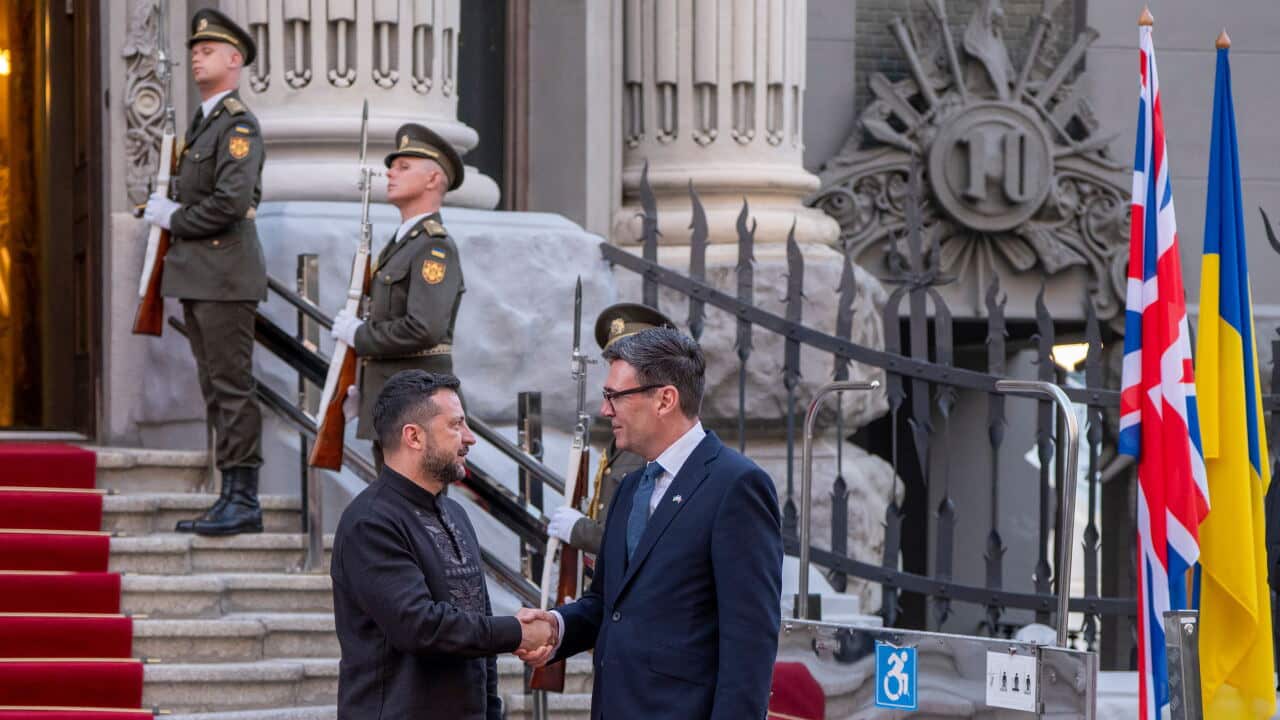
New UK Prime Minister Andy Burnham was in Kyiv for his first trip abroad since taking office.
"(Ukraine has been) Europe's protector. Not a drain on our security, but the front line of keeping Europe safe.You have endured 12 years of naked aggression, the occupation of Crimea, and now 4 1/2 years of Russia's full-scale invasion. All aimed at crushing the independence that we are here to celebrate, trying to break your will."
For Ukraine's President Volodymyr Zelenskyy, it's a show of the global support Ukraine has been able to build during more than four years of war.
And he has a request of his allies; Ukraine needs interceptor missiles to fight its war with Russia.
”We need to make sure that the winter package of air defense will be in Ukraine and we need a winter package of Patriot missiles. And, we need that... we hope that we will have this package. We need at least 300 Patriot missiles for the winter and for the cold months. Every missile means lives to be saved.”
As Ukraine prepares for another winter and more Russian attacks, its allies are helping it build its weapons stockpile.
The UK and France are giving Ukraine tools to develop its own long-range weapons.
Britain's Prime Minister came with highly classified blueprints for British made components of the SCALP missile.
It is the French-produced version of the UK's Storm Shadow, an air-launched, high-precision missile with a range of more than 250 kilometers.
Both use shared French and British technology.
And it was this move that prompted an angry response from Moscow.
Kremlin spokesman Dmitry Peskov, says Britain is now participating in the war on the side of the Kyiv regime.
(Russian translated to English) "Britain methodically and regularly adds fuel to the fire and methodically and regularly hatches schemes to prevent even the slightest progress in the peaceful settlement process. This is what Britain is doing."
Russia is accusing Britain of deliberately preventing a peace process, threatening to destroy the facilities in which the weapons are produced.
But Mr Burnham says Russia’s "outrageous threats" will not dissuade his government from doing the right thing.
"Who started the fire? That's the question, isn't it? Ukraine did not do that. Russia began this illegal invasion and that is absolutely clear and they could stop it at any given time. Britain will never be a fair-weather friend. People would expect me to be out here showing our unflinching support and that's what I'm doing."
That sentiment is echoed by the European Union, which has reiterated its commitment to increase pressure on Russia to end its war.
French President Emmanuel Macron says NATO countries should expect more Russian provocations.
"It's clear that NATO countries will be targeted and the provocations will multiply. We need a proper... we have to follow up what we started to do in NATO in order to ensure a robust posture. But the bottom line is for me very clear - keep calm and carry on."
More than 50 countries, including Australia, and the EU are calling on Russia to accept an immediate and unconditional ceasefire.
The leaders of Luxembourg, Moldova, Estonia and EU Council President Antonio Costa were also in Kyiv for the talks hosted on Ukraine's Independence Day.
As all of this was happening, Ukraine struck a Russian military plant in the Rostov region, causing a fire.
And Russian attacks on warehouse facilities in the Odesa region injured five people.
United Nations officials have warned drone warfare is inflicting mounting civilian casualties and transforming daily life near the front lines of the battle.
UN aid chief Tom Fletcher describes the situation on the ground in Ukraine.
"I spent last week in Ukraine. In Kherson, I witnessed how drone warfare is dismantling civilian life. The area has become a dystopian landscape of kill zones and kamikaze drones, with roads and buildings draped in anti-drone netting. Our colleagues and the local population have become experts in the sound and lethality of different models. We've seen a 60% increase in first-person-view, FPV, drone attacks this year, often with civilian victims.”
This has prompted the US to call on Russia and Ukraine to return to negotiations toward a meaningful and lasting peace.
Dan Negrea is a US representative to the UN Security Council.
He says Washington is prepared to help facilitate talks between Moscow and Kyiv.
”The United States remains committed to Ukraine’s future as a sovereign and prosperous nation. We join President Trump in continuing to call for an immediate ceasefire and good-faith negotiations to end the Russia-Ukraine war and return peace and stability to both countries. Deaths continue to mount, strike after strike. We call on both sides to end any strikes that target or risk damaging civilian vessels. It is senseless.”
The Patriot missile system is one of the most important parts of Ukraine's air-defence network.
But the United States holds the vast majority of the world's Patriot missiles, meaning Ukraine remains heavily dependent on Washington and other allies for supplies.
Just last month, US President Donald Trump suggested Ukraine could eventually be allowed to make its own Patriot missiles, before he walked back his suggestion.
For Kyiv, the message is clear - until there is a ceasefire, Ukraine must be able to protect its sovereignty.
And increasingly, it wants greater control over its defence.