
Fears of a civil war have been averted for now, with the announcement of a ceasefire between Armenian separatists and Azerbaijan. The deal relating to the Nagorno-Karabakh region, ends a 24-hour surge in violence - but the situation still remains volatile.
Listen to Australian and world news, and follow trending topics with SBS News Podcasts.
TRANSCRIPT:
A ceasefire has been adopted by warring parties in the region of Nagorno-Karabakh.
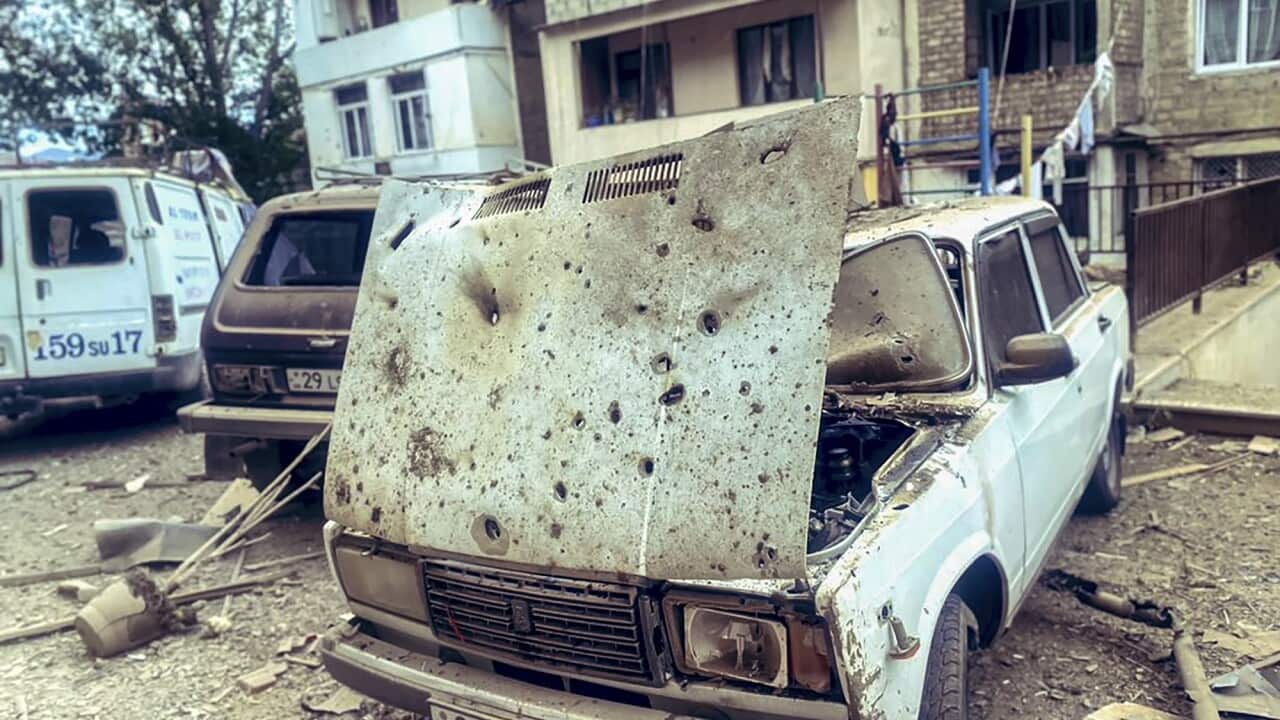
The agreement comes 24 hours after Azerbaijan launched a new military offensive against the local Armenian government in Nagorno-Karabakh, responding to the death of six people - including four police officers - in two landmine explosions.
That move ratcheted up tensions, adding to an effective nine-month blockade imposed by Azerbaijan on the landlocked Nagorno-Karabakh region, achieved by blocking the only route into the area from Armenia, known as the Lachin Corridor.
Azerbaijani presidential aide Hikmet Hajiyev says he welcomes the terms of the ceasefire, including guarantees to lay down weapons.
"Azerbaijan has received assurances that the so-called illegal forces on the ground will disarm themselves, and also military detachments of the Republic of Armenia stations on the sovereign territory of the Republic of Azerbaijan will disarm itself, and they will also abandon all their military outposts and military positions and also military equipment and their arms and vehicles."
Armenia's prime minister Nikol Pashinyan says he rejects accusations Armenian forces were behind "systematic shelling" or the deadly landmine explosions.
He says Armenia had no role in drafting the text of ceasefire, but he hopes the truce holds.
"Of course, we familiarised ourselves with the text of the ceasefire agreement, although the Republic of Armenia did not participate in any way in the formation of this text and was not a party to the discussions. In any case, we take note of this agreement and its endorsement by the authorities of Nagorno-Karabakh."
Officials in Armenia accuse Azerbaijan of launching a campaign of ethnic cleansing against the ethnic Armenians in Karabakh.
The Human Rights Ombudsman in the region, Gegham Stepanyan, says at least 10 civilians are confirmed among the dead in the latest fighting, including five children.
Talks are set to be held in Azerbaijani town of Yevlakh on plans for the reintegration of Nagorno-Karabakh into Azerbaijan.
The mountainous, landlocked region is contained entirely within the south-west of Azerbaijan and is populated by 120,000 ethnic Armenians, who claim a long historical dominance in the area.
However, the enclave is recognised internationally as part of Azerbaijan.
Two wars have been fought over the region since the fall of the Soviet Union in 1991 - the latest in 2020.
Since the end of 2020, 2,000 Russians have monitored a fragile truce, but the war in Ukraine has split its focus.
Russian President Vladimir Putin says Russian peacekeepers in the region were the ones who worked to broker the new agreement.
"Our peacekeepers are working very actively with all parties involved in this conflict. They do everything to protect civilians. Our main basing point includes over 2,000 civilians. Of these, more than 1,000 are children.
"I repeat, we are in very close contact with all parties to the conflict and with the authorities of Yerevan, Stepanakert and Baku. I hope we can achieve de-escalation and solve the issue in a peaceful way."
Russian officials say an unspecified number of Russian servicemen were killed while on patrol in Nagorno-Karabakh [[in the village of Dzhanyatag]]. They were inside a car that was hit by shelling.
The years of conflict have seen abuses committed on both sides, and there are concerns of a fresh refugee crisis as Karabakh's ethnic Armenian population fears being forced out.
Azerbaijan's President, Ilham Aliyev, says there is no ill feeling towards local Armenians, only the "criminal junta" - and he says residents should be assured there will be no reprisals.
"All the rights of Karabakh Armenians will be ensured. The right to education, the right to culture, religion, municipal and electoral rights. Azerbaijan is a free society. We are a multinational and multi-religious state".
Meanwhile, thousands of protesters gathered in the Armenian capital of Yerevan, called for more support for ethnic Armenians in Nagorno-Karabakh.
Gathering with others in Republic Square, 40-year-old Ashot says many are demanding the resignation of Armenian Prime Minister Nikol Pashinyan.
He says they see his actions as contributing to the final collapse of Armenian authorities in Nagorno-Karabakh.
"Internal enemy, Nikol Pashinyan, rejected to support Armenian citizens who are now living there. So this is a shame of our nation that our government, with the face of Nikol Pashinyan, is not taking all the required measures to save Armenians wherever they should be."
The leaders of several countries have urged both sides to abide by the ceasefire.